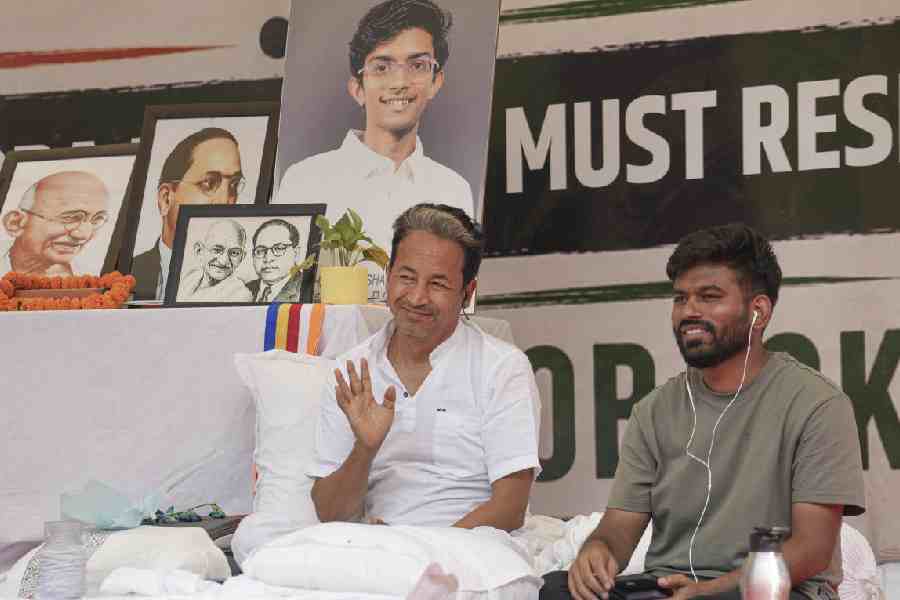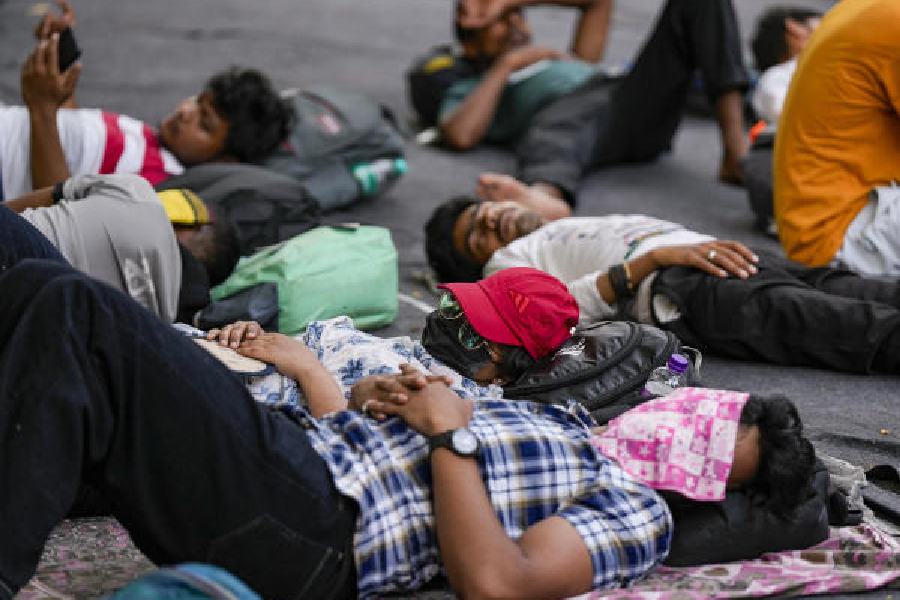
Mohammad Siddiqui has been a regular at the Cockroach Janta Party protest near Jantar Mantar, providing hands-on physio treatment for the demonstrators’ sore limbs and stiff joints.
He is not doing it for a lark.
Siddiqui, who earned his Bachelor of Physiotherapy from the Jamia Hamdard deemed university in 2024, is protesting because he has no regular job. He worked briefly at a private hospital but left within months because of the low salary.
“Private employers pay less and make their employees work longer. I was paid only ₹18,000 a month,” he said at the site of the two-week-old protest, which began on June 20.
“The joining salary for a junior physiotherapist at a government teaching hospital is over ₹50,000,” he added. “I left the job and began private practice.”
Siddiqui said he now earned more than his hospital salary, but not enough to keep him away from Jantar Mantar, where his presence means he has to juggle work and protest.
Mohammad Bilal, a fourth-year PhD student of history at Delhi University, had similar complaints.
“Job opportunities for the educated youth are shrinking. The government is not serious about addressing unemployment,” he said at the protest site.
“It is opening new institutions; private institutions are expanding — but they are hiring very few faculty members. I’m worried.”
The CJP movement’s flagship demand may be the resignation of education minister Dharmendra Pradhan over the question leaks marring the national undergraduate medical entrance test, but it’s also attracting educated youths agitated about the job crisis.
Some of the answers they are seeking may be found in a recently released book, India Out Of Work, by labour economists Santosh Mehrotra and Jajati K. Parida.
The book flags a disconnect between economic growth and employment that has left India’s educated youth struggling to find jobs.
“While the education system is expanding rapidly, it often fails to equip students with the learning level or skills the modern economy requires, which is leading to a significant mismatch between the supply and demand for labour,” it says.
The book adds: “This phenomenon is reflected in high youth unemployment. The overall youth unemployment rate (UR) doubled [in the period between] 2011-2012 and 2022-2023 from about 6 per cent to 12 per cent.”
The book debunks the government’s portrayal of a steady decline in the unemployment rate.
According to the Periodic Labour Force Survey, conducted by the National Statistical Office, the unemployment rate among people aged 15 and above fell from 6 per cent in 2017-18 to 3.1 per cent in 2024-25.
Economists have, however, underlined that the inclusion of “unpaid family labour” feeds such feel-good official figures.
The term describes unpaid work that contributes to the family income — mainly, women helping out with farming or other family enterprises.
India Out Of Work says that people engaged in unpaid family labour account for 20 per cent of the country’s official employment figure.
It emphasises that the International Labour Organisation does not recognise unpaid family labour as “employment”.
The book also rejects the rising registrations with the Employees Provident Fund Organisation (EPFO) as an indicator of a growth in formal jobs.
“The EPFO registrations are, at best, merely showing formalisation of the existing workforce in the same company,” it says.
In 2020, a Supreme Court judgment said all enterprises that employ 20 or more workers must register them with the EPFO.
This means that as soon as a firm that has 19 contract workers hires a new one, it has to register all 20 with the EPFO, automatically raising the “formal employment” figure by 20.
Such numbers, when they show up on the EPFO registration statistics, help authorities paint a rosy picture of growing employment.