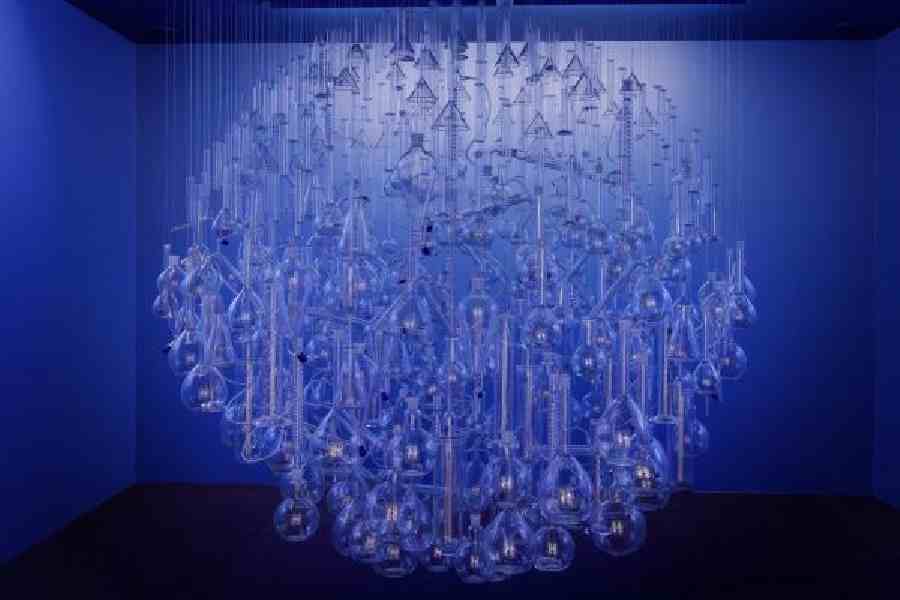
What looked like a giant shimmering chandelier displayed against a velvety amethyst blue wall turned out to be Sheba Chhachhi’s assemblage of 600 pieces of laboratory glassware (picture), the kind that the Nazis once used to manufacture amethyst blue Zyklon B, the poison gas that exterminated their prisoners. Experimentations with alchemy had led to the discovery of this lethal gas. This work was part of an exhibition titled All that you Leave Behind curated by Gayatri Sinha and held at Art Exposure.
Sinha has written in her note: “The artist stills time, seizes the moment and offers it for contemplation.” Nothing should be taken at face value. Aban Raza’s painting of Aurangzeb’s simple grave that was at the centre of turmoil recently is not so much about the last great Moghul as it is about the reach of history and the countless lives it touches. Thus Baiju Pathan’s beautiful bloom is actually an encrypted encapsulation of the origins of human culture and religion. Sudhir Patwardhan’s pavement dwellers and heads resting on a surface seem to be caught between sleep and reverie. Vasudha Thozur’s painting based on a photograph of land riven by a superhuman force is a metaphor for the deadly earthquake in Gujarat in 2001 and the sectarian violence that followed. The illusory nature of what exists in plain sight is emphasised in Mahesh Baliga’s works.
The magic of folk rituals that elevate the stature of marginalised people as a ‘deity’ possesses them comes alive in the short film by the artist and film-maker, K.M. Madhusudhanan. Two of the most beautiful works were Shambhavi’s giant iron sieves with pinpricks creating floral designs that could be ‘read’ by touching the raised dots. The motifs glowed when light filtered through them. They cast enchanting shadows on the opposite wall. Abir Karmakar’s footprints on sand, Riyaz Komu’s images of the trauma of violation viewed through a blood red filter, and, in a more obvious way, Atul Dodiya’s painting of an attack on an airport are all residual memories.