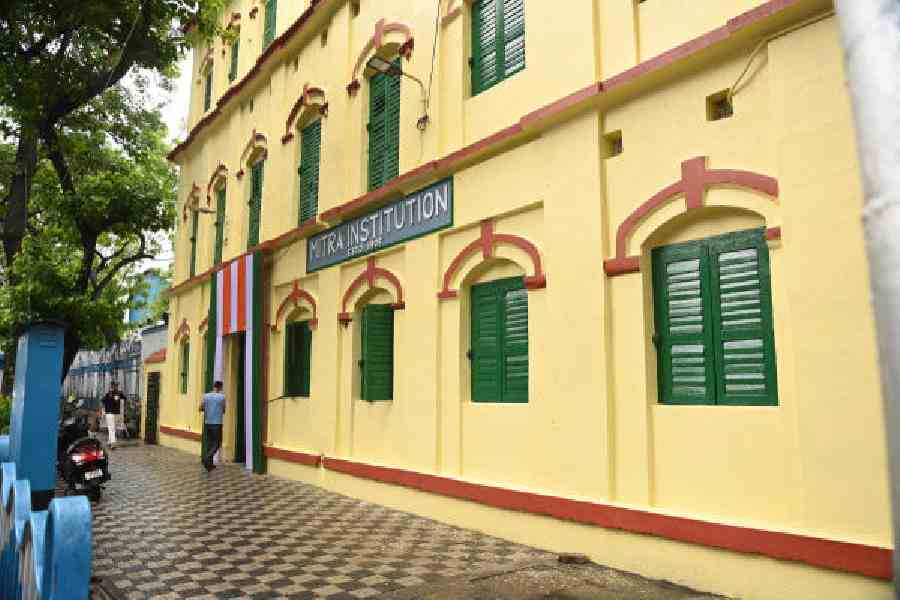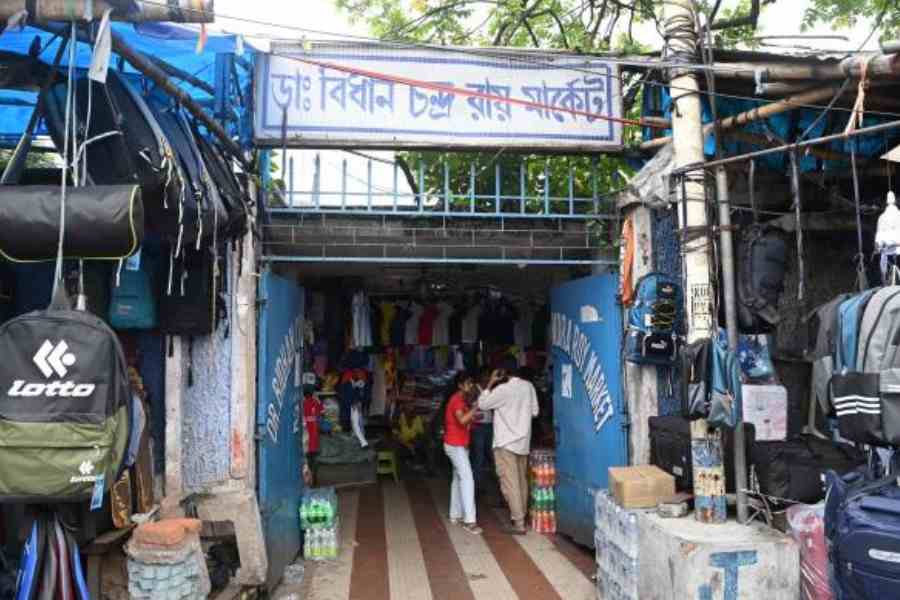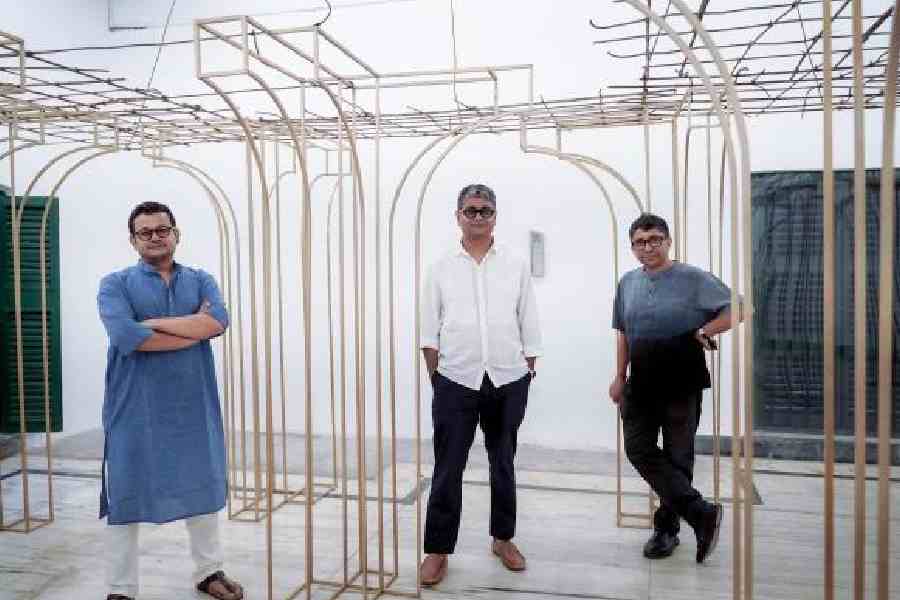
As artist Rathin Barman, whose ‘The Cage Broke’, and I Found the Horizon’ was showcased at Experimenter’s Outpost at Alipore Museum, sat for a chat with architect Abin Chaudhuri, moderated by Prateek Raja, co-founder of the contemporary art gallery, his Resurrected Living Space, splashed across the wall of the first hall, formed the backdrop. And as the conversation kicked off around the idea of home, memory and belonging, themes that Rathin closely works with, the inhabitants of the old Calcutta building that the artist had spoken with seemed to have joined us, sneaking in through the panelled wooden window, resting against the ornate cast-iron boundary of the balcony and listening with great attention.
Prateek first asked Rathin, who has a background in engineering, to reflect on the starting point of his journey into the world of art and how the old architecture and houses of Calcutta became an integral part of his work.
“After finishing engineering, I decided to come to Calcutta in 2003, as part of our study was to do outdoor sketches of landscapes and buildings. So this is how I actually started interacting first with the architecture and then became friends with the people living there, gradually understanding the process of the way they have been living. Most of them were migrants; some of them migrated post-Independence. So this is how my interest grew in the architecture itself, and in finding how each of these architectural pieces is actually containing people from many regions and nurturing their aspirations,” said Rathin, who grew up in a small village in Tripura, then moved to Agartala and finally found his true calling in Calcutta.
Turning to Abin, Prateek enquired about the role memory, or spatial memory, has in the places that he designs. Referring to the term placemaking in the parlance of architects, Abin shared how difficult it is to achieve and how memory plays an important role in determining the character of what is being built. Prateek then moved on to talk more about Rathin’s practice, starting with the idea of a city resisting and an artist making connections and building a body of work.
The revelatory titles of Rathin’s works took centre stage, with Prateek first asking Rathin to take us through ‘We Played Even at Night’, a wall installation that stemmed from the memory of someone Rathin had spoken with. “I met him in a tea shop, and he was describing his experience of migration from East Pakistan in the mid-50s or late 50s. They ended up at Sealdah station, and afterwards went to Bonhooghly, a northern suburb on B.T. Road. His parents had started working in the small industries nearby, and he told me that when he used to live in the shanties, they would play at night,” said Rathin, altering our understanding of space and perspective.
‘Kitchen Stories’, a series of paintings, talked about food, habit and what we carry with us when we move. More than just paintings of vegetables, the artworks spoke of survival. “It’s more than collecting recipes from the people I’ve been interacting with for maybe two decades now. It’s more about how they have been surviving all these years, living in the shanties, living in a makeshift sort of home situation, with no proper kitchen. And at times, they couldn’t afford to buy vegetables from the market, so they ended up making survival food,” shared Rathin.
Lastly, the house spoke through the titular installation that occupied the second hall and invited the audience to walk through it later and experience time and memory through the skeleton of the curves and pillars of an old house built by Rathin. Between the spaces and the stripped architecture of the house, we discovered how ‘The Cage Broke, and I Found the Horizon’.