The exhibition, PURVAI: Printmaking in Eastern India — Pedagogy to Practice (on view at Emami Art till today), curated by Paula Sengupta, unfolds as a careful meditation on the elasticity of printmaking and its continuing dialogue with landscape, memory, and material process. It brings together artists from across eastern and northeastern India, several of whom turn to the land itself as a site of inscription. Sangita Maity’s prints evoke landscapes scarred by mining, rendering the altered earth in subdued tonal registers that suggest both erosion and endurance. The same concern with ecological precarity surfaces in the work of Anupam Chakraborty, whose cyanotypes contemplate the fragile ecology of the East Calcutta Wetlands.
Other artists explore the medium’s capacity to hold memory within its surfaces. Deepanwita Das begins with ornamental motifs drawn from Calcutta’s architectural vocabulary, but quietly replaces them with botanical forms she gathers herself. The resulting forms hover between archive and improvisation, suggesting that memory is less a stable record than an accumulation of fragile traces. An attentiveness to the poetics of everyday objects informs Temsüyanger Longkumer’s work, which reads almost like a forensic study of use and wear, where the surface records the quiet labour embedded in domestic tools.
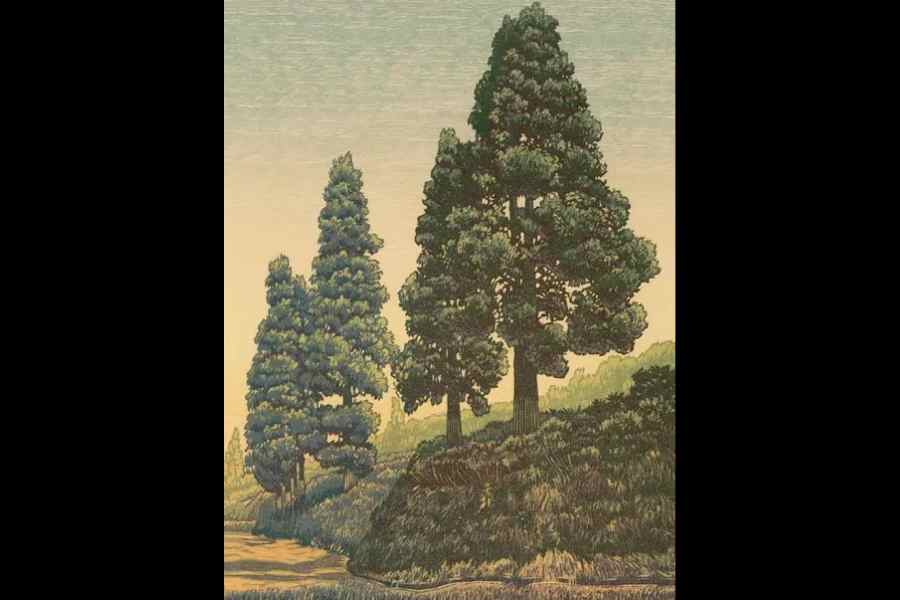
Above the Clouds by Raja Boro Emami Art
Landscape reappears in the prints of Atanu Bakshi and Sarika Goswami; the former’s dense, etched lines that resemble fractured geological strata where the repeated pressure of the printing process mirrors the extraction of buried material, while the latter imagines the environment from the perspective of non-human observers — fish, birds, and worms, questioning the relentless industrial intrusion into natural ecosystems.
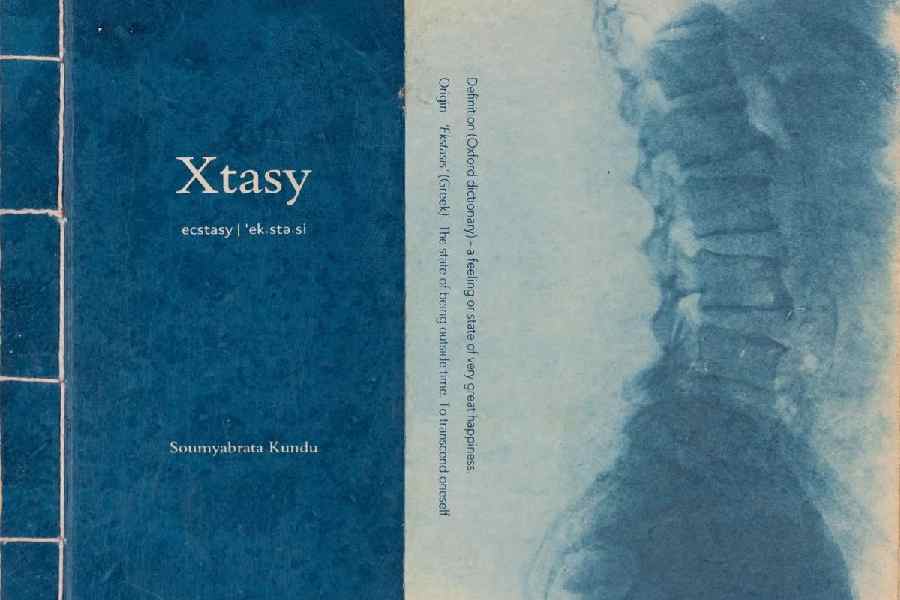
A quieter, lyrical register emerges in the woodcut prints of Raja Boro, whose Above the Clouds series reflects on a journey through the mist-covered hills of Darjeeling (picture, left). The compositions are spare yet contemplative, allowing the stillness of pine forests and mountain air to permeate the surface of the print. The exhibition also reveals how contemporary printmaking stretches beyond its conventional boundaries. Soumyabrata Kundu’s artist book combines cyanotypes, drawing, and rust printing to construct a fictional character named Nobody whose skeletal imagery appears across the pages like fragments of an anatomical dream (picture, right). Meanwhile, Rajarshi Sengupta’s textile work adapts the compositional logic of Japanese screens, layering natural dyes, woodblock printing, and stitched fabric into a field of repeating motifs.
Taken together, these works reveal a medium that remains grounded in craft and, yet, remarkably open to reinvention. PURVAI suggests that printmaking continues to thrive because of this dual nature: its commitment to the slow discipline of the hand and its willingness to migrate across surfaces, materials, and narratives. The exhibition thus offers a portrait of a medium that persists through collaboration, pedagogy, and a sustained conversation with the textures of the world.