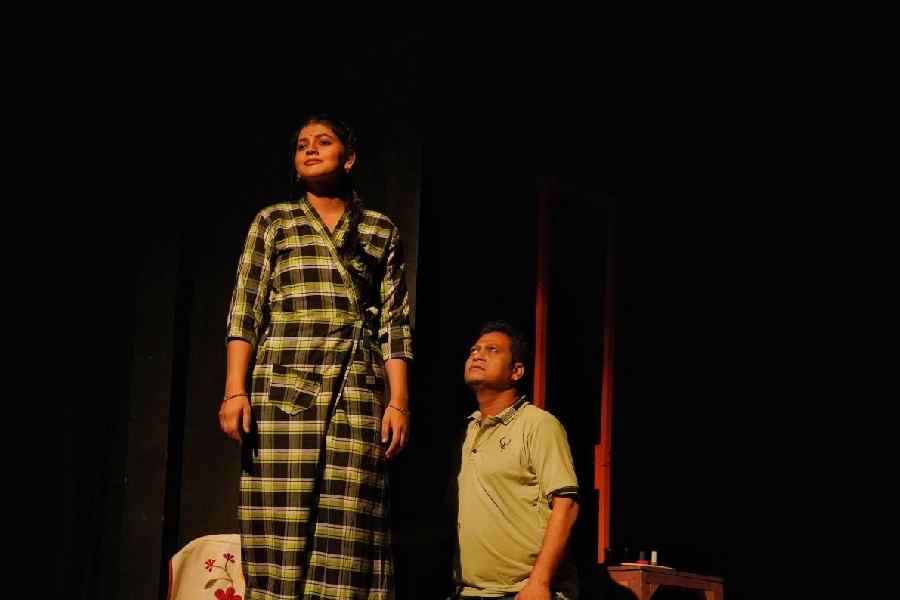
Mahsa, produced by Sunil Nagar Drama Centre (Picnic Garden), is an abridged and edited version of a longer play, Sesh Bikeler Surjya, penned by Gopal Das. It is surprisingly densely packed in terms of content. The play is launched through the ‘play within a play’ trope, showing a theatre group attempting to put together a play about Mahsa Amini, the young Kurdish-Iranian woman who died under mysterious circumstances in the custody of Iran’s morality police, having been charged with not wearing the hijab properly. The plot then veers into a narrative involving the director of the group (Prodosh), his talented, idealistic protégé (Indu) and her husband (Samir), a theatre-person turned politician. This narrative, which assumes the status of the main plot, relies on snatches of plays (Antigone and Raktakarabi) within the play to draw analogical parallels between the thought processes of Indu and Antigone/Nandini.
For an 80-minute play that juggles all these elements and a non-linear timeline, Mahsa is quite smartly designed. The director, Animesh Biswas (who also plays Samir), has seen to it that the narrative shifts are achieved swiftly enough. The seniors, Jayantadeep Chakraborty and Biswas, do adequate justice to their roles. But a cluster of younger actors is the surprise package, displaying commendable training and admirable skills. Sankhadeep Chakraborty (Santu), Sreyasree Sadhukhan (Mahsa) and Mira Roy (Indu/Antigone/Nandini) deliver standout performances. Roy has a captivating stage presence, is quite good with tonal modulations and performs with thorough understanding of the character. Roy, not a known face in the Calcutta theatre circuit, is living proof of the depth of the talent pool of actors in West Bengal, if such proof is required to be presented.
The non-verbal choreographic compositions in Mahsa are the play’s weakness — the intensive practised discipline of performing bodies that is required to pull off such compositions is missing. The fancifully glorified characterisation of the director without any attempt to turn a critical lens on the character is too much to take in and comes across as indulgently anachronistic.