DAG Museum’s first Points of Departure commission, Beral Teral Ityadi, presented as part of the first edition of Jamini Babu-r Jonmodin, set out to revisit Jamini Roy’s oeuvre through a contemporary lens on the occasion of the artist’s recent birth anniversary. The result was not only charming and resplendent but it also offered fresh insights into the world of one of Bengal’s most renowned artists.
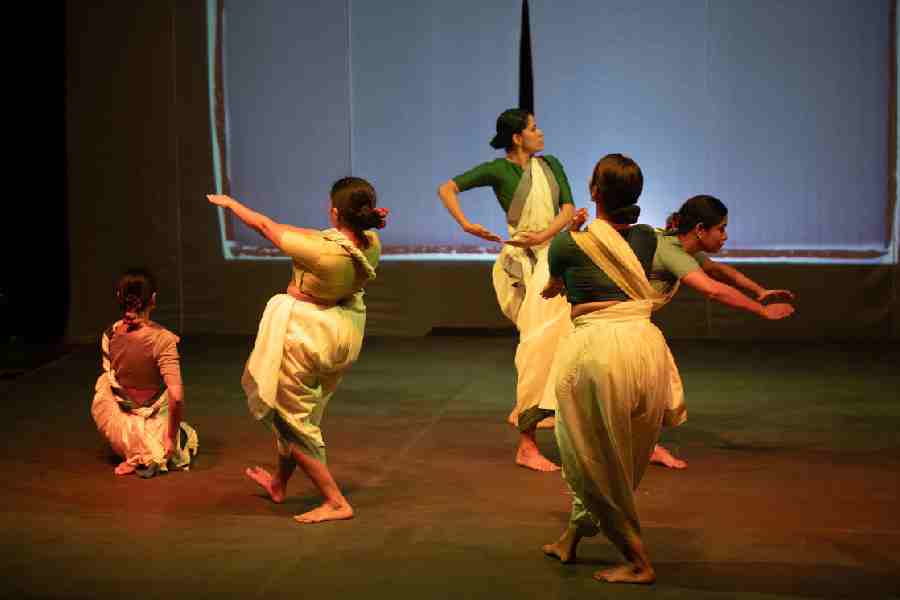
Directed by Vikram Iyengar, the work, created in collaboration with the dancers, Kankana Singh, Monami Nandy, Mukulita Ganguly, Olivia Saha and Srijaini Ghosh, wove together dance, music and design. In transforming Roy’s iconic visual idiom into movement, the choreography compellingly veered towards evocation through association rather than mere interpretation.
Staged at Ballygunge Pratisthan Durgabari in the neighbourhood where Roy lived and worked, the performance animated the space with recognisable motifs from his paintings. The visual echoes were reimagined through the interplay of bodies, light, colours and sound, the passage from homage to reimagination taking on an audaciously playful tone. Sudip Sanyal’s lighting, alongside the music design by Sourjyo Sinha and Rohit Ganesh, suffused the performance with an interpretive luminosity.
The movement language played with the tension between legacy and improvisation. The dancer’s limbs and spines moved through space with a precision that carried memories of classical training but the energy that they held within themselves was profoundly contemporary. Roy’s familiar figures were treated with delightful whimsy, their bold outlines translated into kinetic form with clarity and verve. The tonal shifts across “Ami Miss Calcutta” with its sizzling sass, the measured erotic longing of Jayadev’s “Sakhi hey kesi madhana mudaram” freed from its classical mythmaking connotations to achieve new narratives, and the spontaneous celebratory vigour of Rabindranath Tagore’s “Ore bhai phagun legechhe bone bone” made the characters warm, sensuous, quirky and accessible, bringing them out of their frames to show them up through contemporary optics.
Beral Teral Ityadi was, in the end, what the best acts of homage always are, which is not a reverent iconification, but a quest into a living, human inheritance.