Held at Raj Kutir, Swabhumi, the Graduation Show 2026 presented by the graduating class of the fashion communication department at NIFT Kolkata brought together an eclectic body of work spanning visual communication, branding, publication design, exhibition design, film, digital media and immersive spatial experiences — offering a glimpse into the evolving language of fashion communication through the lens of a new generation of professionals who are navigating an increasingly fluid creative landscape.
Celebrating months of research, experimentation and interdisciplinary thinking, the afternoon, apart from felicitating the graduates, offered visitors a glimpse into the future of fashion communication, while an equally thought-provoking panel discussion, Designed or Generated: The Crisis of Creativity in AI-driven Fashion Communication, brought together industry practitioners to examine one of the domain’s most pressing questions: As artificial intelligence reshapes creative practice, what becomes of originality, authorship and the designer’s voice?
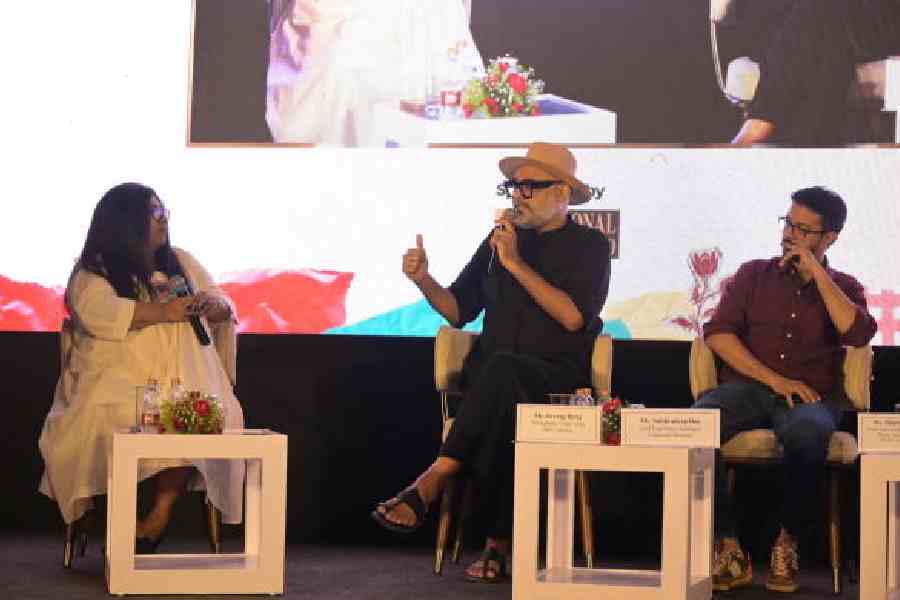
The event was graced by guest of honour, communications professional Jeena Mitra Banik and chief guest Sanjay Kumar Panigrahi, managing director, Jute Corporation of India. The panel discussion featured scenographer and visual artist Swarup Dutta, lead experience strategist at Cognizant Moment Subhradeep Das and visual communication designer and photographer Swarnabha Nandi, with associate professor of fashion communication Sreenanda Palit, steering the conversation.
Opening the evening, Banik reflected on her long association with NIFT Kolkata. As India increasingly commands global attention across fashion and design, she urged students to see themselves not as followers of established practices but as contributors shaping the country’s next chapter of creative innovation.
Setting the tone for the panel discussion, moderator Sreenanda Palit framed the central dilemma confronting creative education today. While artificial intelligence has undoubtedly accelerated ideation, prototyping and production, she questioned whether its growing presence risks making creativity increasingly homogeneous and diminishing the individuality that defines a designer’s voice. Bringing together practitioners working across diverse creative disciplines, the discussion sought to unpack AI’s evolving role — not as an abstract technological force, but as a tangible reality already reshaping creative industries.
For Dutta, the debate was never about choosing between human creativity and artificial intelligence but the human thinking behind it. While he acknowledged AI as an exciting creative collaborator, he argued that meaningful outcomes depend entirely on the depth of one’s references and understanding.
Das approached the conversation from the perspective of global experience design, where AI is rapidly becoming embedded across industries. Rather than viewing the technology as a replacement for creativity, he described it as a catalyst that is transforming the designer’s role.
Offering a practitioner’s perspective from branding and photography, Nandi challenged the notion that AI represents a sudden disruption. Automation, he pointed out, has long been embedded within creative software and imaging technologies; generative AI is simply the latest chapter in that evolution. He further emphasised that AI’s greatest value lies in streamlining workflows rather than replacing creative thinking.
The discussion also addressed one of the industry’s greatest anxieties: whether AI threatens employment within the creative sector. Dutta responded candidly, acknowledging that the disruption is already underway, particularly in visual production. Sharing examples from his own practice, he revealed that AI-generated imagery has begun replacing commissioned illustrations and even campaign photography, particularly for clients working within constrained budgets.
Palit noted that NIFT Kolkata’s fashion communication department has already integrated AI into its curriculum, ensuring students gain both conceptual understanding and practical familiarity with emerging technologies. Rather than resisting change, she emphasised, design education must prepare students to engage with it responsibly and critically.