The village on the outskirts of which St Paul’s Church Burial Ground Keorapukur was built is called Ramchandrapur. But since the early 1970s, the area has been known as Kabardanga. Kabar is the Bengali word for grave.
“When bus No. 40 began plying from Thakurpukur to Babughat via Tollygunge Phari, the conductors started referring to the stop near the burial ground as Kabardanga More. And the name stuck,” says Aparesh Makal, who lives in the neighbourhood.
Aparesh’s father Manoranjan was a deacon — a Church official who officiates over burials — at St Paul’s Church in Keorapukur.
The stories of the church and the burial ground are entwined. This church was established by Protestant missionaries in 1856.
The burial yard, in all likelihood, dates back to the same period. There are three adjacent grounds, each separated by walls. They had once belonged to three different denominations — Protestants, Anglicans and Baptists — but now they are open to all.
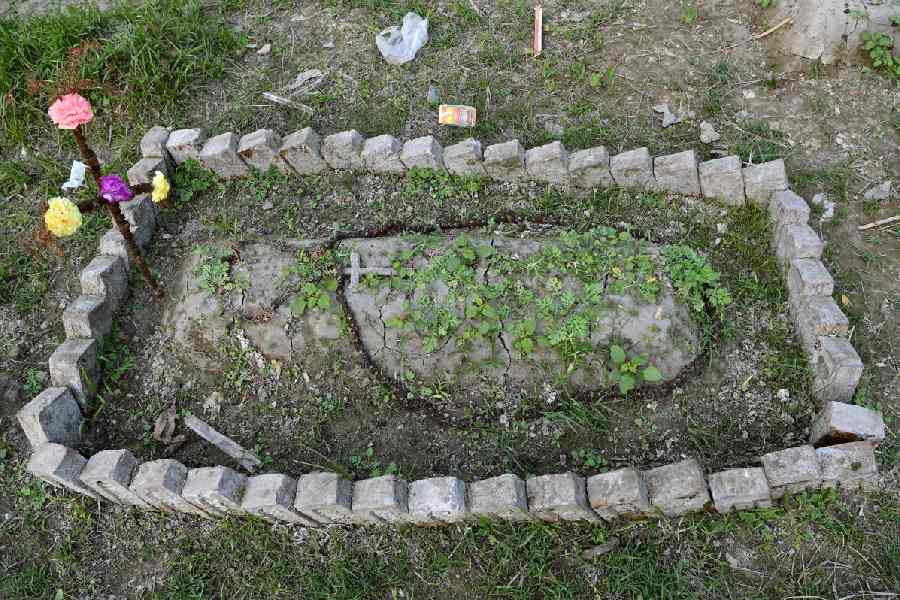
The oldest of the lot is Ground No. 1. It has a huge tree shading a cluster of whitewashed cement graves, some individual plots and some family plots. Ground No. 2 has graves with headstones and crosses as well as some grassy mounds. Those few graves that have dates on them are from the last decades of the 20th century. Ground No. 3 has mostly unpaved graves with no name or date on them.
“The road to Nepalgunge was built on a part of the graveyard,” explains Pradeep Dolui who is a Kabardanga resident. “Ground No. 2 and No. 3 were granted by way of compensation,” he adds.
Word is that Ground No. 3 is used for those who have died by suicide, accident victims and others with no family to arrange for a burial.
“I used to make a cross for every coffin I built,” says Debashish Mondal. He adds, “Sometimes the families are too poor to pay for the coffin. In those cases, I would give them the coffin free of cost.”
Unlike Aparesh and Pradeep, whose families moved to Kabardanga some generations ago, Debashish’s family has lived in the area for as far back as they can remember. They were farmers whose land holdings became smaller with the passing years, forcing them to seek other livelihoods. Debashish was trained in carpentry at the Baruipur vocational centre, once run by the Keorapukur Mission.
“This place was originally home to small farmers and farm labourers,” says Suranjan Midde, a professor at Rabindra Bharati University who settled down in Kabardanga in the 1980s.
“Those are the people who were first laid to rest in the Kabardanga burial ground,” Midde adds.
One of the oldest of the family burial plots belongs to the Rangas. Kartick Ranga, the grand patriarch, is interred here; that was four generations ago. The last to be buried was Kartick’s youngest granddaughter-in-law Subala, two years ago.
Subala was a teacher at Keorapukur Boys’ Primary School. Her husband Rabindra was a clerk there, while an older brother-in-law, Ranjit, went on to become headmaster of the same school.
At the foot of Kartick’s grave lies that of Indurani, his eldest granddaughter. She had studied nursing at Jiagunj and at the time of retirement was matron of B.R. Singh Hospital in Sealdah. “She did not want to be buried in the family plot, so she bought her own,” says Angkesh Kumar, great-grandson of Kartick and nephew to Indurani.
A stone’s throw from the Ranga family plot is the one allotted for the Dharas. It bears the name of the founding father Haran Dhara.
“The Dhara and Ranga families can be considered the oldest Christian families of Kabardanga,” says Manjusree Ranga, wife of Angkesh and teacher at the United Missionaries Girls’ School in Bhowanipore.
The Rangas came from western India. They were lethels, lathi-wielding security personnel, brought by the earliest British missionaries for their protection in what was then a bandit-ridden village on the outskirts of an evolving Calcutta. For their services, they were awarded farmlands and a place to stay. The Dharas, according to Makal who is married to a Dhara, owned most of the land in the area.
The Kabardanga burial ground is also resting place to multiple former teachers of the United Missionaries Girls’ School. Kanaklata, Purnima Biswas…
Taposh Das, who passed away in the early 1990s, also lies here. Taposh had no family in Kabardanga but he was well-known in the area as he headed a Christian NGO called Social Economic Development Project.
Coffinmaker Debashish too has many of his kin buried here, multiple generations lying in unmarked graves. The burial ground is choc a bloc with unpaved graves, graves that will disappear into the ground like hundreds of others before them.
The grounds are dotted with cement graves, a Chittaranjan Sarkar here, a Nirmal Midde there, the dates range from the 1980s to the 1990s. And yet, this burial yard goes back one hundred years before that. Why are there no older graves?
Says Manjusree Ranga, “The people here have been historically poor and uneducated. The early Christians knew that they had to cover the dead with earth, so that is what they did. These people were farmers, mostly farm labourers, usually unlettered. They did not know that they had to mark the graves or keep note of dates. Many were anyway too poor to afford anything more.”
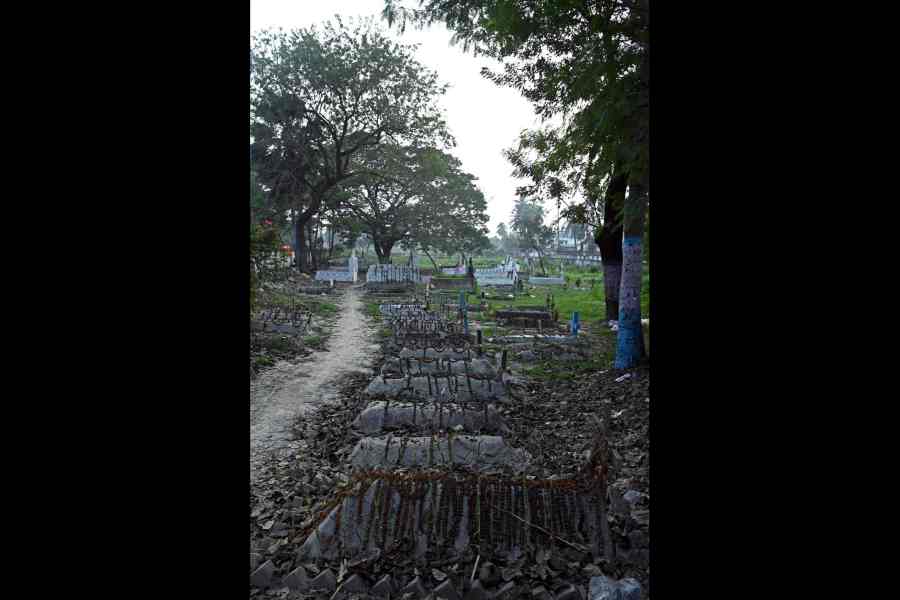
Kabardanga cemetery
As for the missionaries who set up or worked at the Keorapukur Mission and the clergy who followed them, none of them wanted to be laid to rest at their place of work, all of them wanted to go home to England.
“That was the custom,” says Manjusree.
Currently, the Kolkata Municipal Corporation is responsible for the upkeep of these burial grounds. And except for Ground No. 3, the other two are reasonably well maintained.
From time to time, the grounds host fair-sized gatherings. Every Easter and also on All Souls’ Day on November 2, people convene to pay their respects to the dead. The burial grounds are spruced up for the occasion.
In videos on the social media page of St Paul’s Church, you can see the graves decorated with marigold garlands and lit up with hundreds of candles on All Souls’ Day. The place is crowded and the atmosphere lively, people greet each other warmly.
There may be no headstones to mark their resting place, but they are not entirely forgotten, Kabardanga’s dear departed.