Amid a cluster of artists from across the globe at Kochi-Muziris Biennale, a slice of Bengal and its intangible heritage reached the port city and enticed art lovers and cultural crusaders to savour the grand festival’s alluring accents. An initiative by massArt, Kathamo — The Structure exposed visitors at Jew Town, Mattancherry, to the visual and audio language of Durga Puja, which is marked by imagination, craftsmanship, innovation and collective spirit. Curated by Sayantan Mitra Boka, it featured works by artists such as Bhabatosh Sutar, Deep Das, Eshika Chandra, Manash Das and Pradip Das.
Guided by tactile floor tiles that spoke of the inclusive nature of the festival, a film, Chayachobi, acted as a prologue. The films capture the micro and macro worlds of Calcutta’s Durga Puja art pandals and have drawn crowds in Calcutta in large numbers, revealing the ingenious ecosystem featuring works by artists such as Abhijit Ghatak, Amar Sarkar, Anirban Das, Raju Sarkar, Rintu Das, Rono Banerjee, Tapas Dutta and others.
Five curated rooms expand the narrative and introduce the various facets of Durga Puja as a public art phenomenon, documenting its partnerships with the UN, UNESCO and the Tourism Department of West Bengal. Chayachobi progresses to Nouko — The Boat, an 80-foot bamboo sculpture of an upturned boat, standing as a structure of a pandal preparing to welcome the Goddess. The structure not only evoked memories of large pandal structures that dot the map of Calcutta, but also of Bengal’s nouko tradition, the iconic do-chala roof, architectural brilliance and craftsmanship.
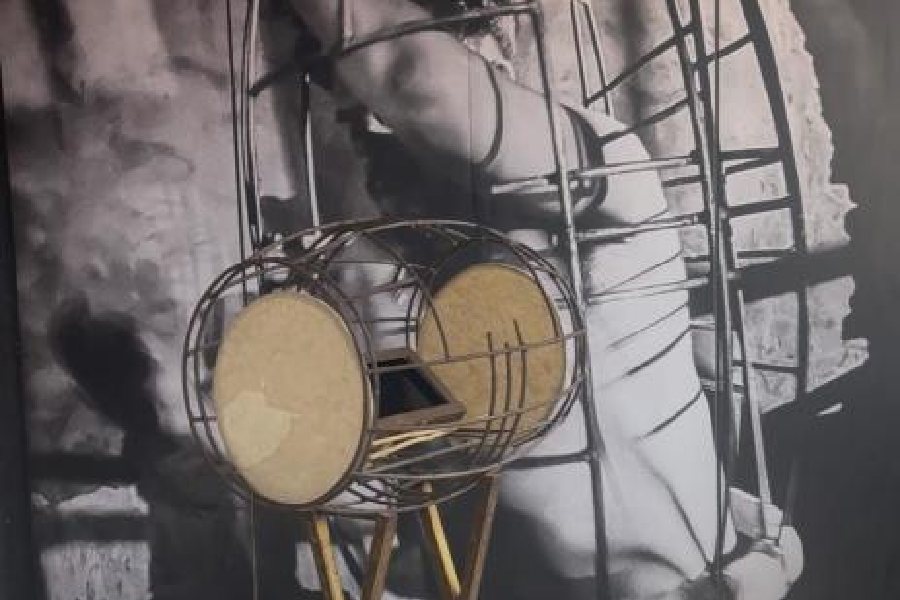
The Nouko also evoked memories of countless adda sessions, carefree five days of revelry and rituals. All of these images brought the rhythm of the dhaak to mind, along with the dhunuchi naach. The sound of the dhaak lends rhythm to the festival, and bringing it to visitors was ‘Dhak’, an iron installation replicating the structure of a dhaak, featuring two leather discs on either side and a small screen in its belly. The installation was not just a celebration of the craft but also of the drummers who migrate to Calcutta during the grand festival and uphold the tradition year after year.
Pandals have evolved over the years and often turn into canvases that bring out different socio-political themes, further eliciting dialogue and free conversation among the public. This significant aspect was showcased with ‘Samarpan — A Pattern of Equality’, which recreated a powerful element — a wooden chair breaking into swift movement and bowing in submission — from a North Calcutta Puja pandal of 2021. Open to interpretation and symbolic of political structures, it spoke of the power of citizens, human resilience and more. Socio-political commentary was also made through jatras, and a jatra-inspired installation recreated the sensation of walking through a dense Calcutta lane — chaotic, colourful and alive.
Blurring the boundaries between Bengal and Kochi, ‘Bisarjan: The Farewell’ made visitors feel at home. Stationed at the edge of the backwaters of the Kochi harbour, it spoke of the immersion of Durga, marking the end of the festival. Inspired by immersions on the Ichamati River, where the two Bengals momentarily meet in shared spirit, the work captures the emotional threshold between farewell and renewal.
Kothamo arrived in Kochi as a collateral to Kochi Biennale 2025-26, on view till March 31, and acts as a bridge connecting cultures, narratives and stories.