Tehran, Beirut, Riyadh... as West Asia continues to eddy with conflicts, school children must be buried and ships, submarines, homes and hospitals burn days after the killing of Ayatollah Ali Khamenei. As the death toll mounts — 1,300 and increasing — and Donald Trump thunders “patriots of Iran... take back your country”, a word comes to mind. Unlike villain, which describes a person, villainy defines an act or conduct. You can argue as to who is a villain and who is not, but villainy is rarely a thing of conjecture though there are shades of it — subtle, relatable, unfathomable, heinous.
‘I do it to do it’
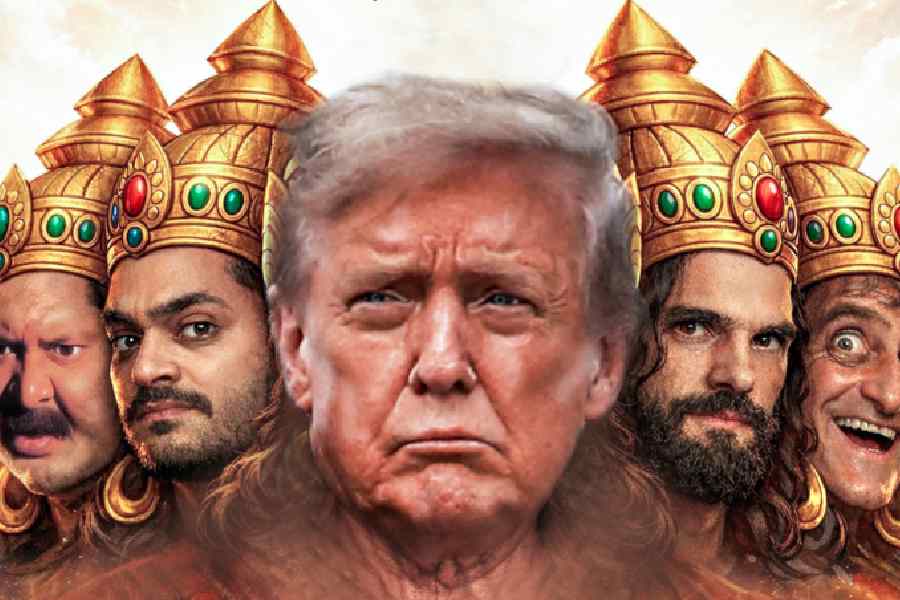
Following the US-Israel attacks on Iran beginning February 28, much is being said about US President Donald Trump’s war policy, not that the Israeli Prime Minister is in the clear. Trump’s reason for launching this offensive: “I think they were going to attack first.” Is it indeed a gut feeling that guides Trump every time he takes aim? Is it about profits or power? Or does he have some other reason? He wrote in his 1987 book Trump: The Art of the Deal: “I don’t do it for the money. I’ve got enough, much more than I’ll ever need. I do it to do it. Deals are my art form.” Here’s a look at some of the nations Trump targeted in his second term. It may not be villainy, but is it typical of a political leader who calls himself the President of Peace?
Somalia
In 2025, the US made 125 air strikes on this country in the easternmost corner of Africa. Reason: to dismantle terror networks. Late last year, Israel recognised Somaliland, a breakaway territory in Somalia, as a free country. The US defended Israel’s decision. Soon after, the president of Somaliland reportedly held talks with his Israeli counterpart and Trump’s son Eric to seek international recognition and foreign investment. Khadar Hussein Abdi, minister of the presidency, said, “We are willing to give exclusive [access to our minerals] to the US. Also, we are open to offer military bases to the US.” Somaliland occupies a strategic position on major Red Sea and Gulf of Aden shipping routes.
Syria
In May 2025, Trump ordered the lifting of decades of sanctions against Syria and promised to rebuild the civil war-torn state. The Guardian reported that the construction of a 45-storey tall “potential $200m tower was proposed in an effort to woo the US President”. The report read: “It came alongside an offer to provide the US with access to Syrian oil and investment opportunities, as well as guarantees for Israel’s security.” But since December 2025, the US has launched retaliatory military action on ISIS called Operation Hawkeye Strike.
Nigeria
In December 2025, the US carried out “deadly strikes” on this West African nation. Trump called it “a Christmas present”. He had earlier accused Nigeria of Christian genocide and the attack was supposed to be the US’s way of giving it back to “ISIS Terrorist Scum”. But news reports suggest that the violence is more widespread and not motivated by religion.
Venezuela
In January 2026, the US launched a military strike and captured President Nicolás Maduro and his wife Cilia Flores before transporting them to the US. Trump made it out to be about curbing migration and drug trafficking, and boosting democracy. Some experts say this is a ploy to get control of Venezuelan oil, but many also argue that the whole exercise was carried out to deflect attention from “domestic issues” and Trump’s own plummeting popularity within the US.
Greenland
No, Trump didn’t attack Greenland, insisted he “ won’t use force” but pushed for negotiations to annex it for “national security reasons”. Mike Waltz, who used to be Trump’s national security adviser, told US troops stationed in Greenland last year, “…it’s about your mission, which is... making sure the American people can sleep safely in their homes”. But he also said, “This is about shipping lanes. This is about energy. This is about fisheries.”
Compiled by Upala Sen
Feluda’s kryptonite?
By Bitan Sikdar
While more than enough gets said about Feluda, Ray’s smooth sleuth, not nearly enough is said of Maganlal Meghraj, who belongs to the same detective series. And yet, he embodies a villainy that is as menacing as it is old-world.
Instead of pitting the ruthless businessman directly against Feluda, Roy pits him against the endearing Jatayu; this enhances Maganlal’s villainy.
Kharaj Mukherjee played the iconic Ray villain in the latest Feluda film Srijit Mukherji’s Feluda Pherot: Jawto Kando Kathmandute. “I was surprised when I heard Srijit had picked me,” says Mukherjee.
The first Maganlal was played by Utpal Dutt. Remember him in Joi Baba Felunath? Looking on animatedly as the doddering knife-thrower takes aim at Jatayu’s silhouette? Feluda looks away, Topshe is ashen and Jatayu himself goes from being the good sport to faint. Dutt’s is the lone voice heard. Sometimes saying “nazuk nazuk”, sometimes “shabaash”, sometimes “sher hai, sher”. The knife hitting against the board seems to say — nailed it!
Mukherjee delivered his own version of Maganlal. “Srijit didn’t tell me to play it this way or that way,” he tells The Telegraph. So did he go back to the book? Says Mukherjee, “No. But when Srijit told me he was going to give Maganlal a mobile phone, I got the drift. Had I gone back to the original text, it would have created a clash of two different worlds.”
He adds, “I’ve read all the Feluda stories but I hadn’t re-read this one in a good while. That helped me maintain a distance from the original.”
The other unforgettable Maganlal was delivered by Mohan Agashe in Sandip Ray’s Feluda films. In Golapi Mukta Rahasya, when Agashe’s Maganlal is stared down by Feluda, he makes the switch. From shouting clipped orders to his minions, he turns focus on Jatayu. “Unkel,” he mock pleads, “do you know how to sing a Tagore song”. And then within seconds he is holding a gun to Jatayu’s temple hollering “Gaaan… sing.”
Mukherjee’s Maganlal turns the volume up on the menacing. In Jawto Kando Kathmandute, the tension peaks in the casino scene. Maganlal drops his veneer of politeness and warns Feluda to stay out of his business. Says Mukherjee, “I wanted to show that my Maganlal is purely dangerous. This is not the place for foolishness — that’s what I had to convey.” And so, he fine-tuned his delivery — spoke in low measured tones to convey a sense of danger that words alone couldn’t.
And that’s how in Jawto Kando Kathmandute, the most complex character, Maganlal Meghraj, finds a new life. No caricature, no exaggeration, no ghost of Utpal Dutt hovering over his shoulders. Mukherjee’s Maganlal is his own — raw, chilling, sinister. Tota Roy Chowdhury, who plays Feluda in Srijit’s film, says, “If you are familiar with Ray’s sketch of Maganlal, you will realise Kharajda has remained true to the original.”
Speaking of originals, this is what actor Saswata Chatterjee says, while admitting that he is yet to watch the new film. “You require a villain not only to defy but also to define your hero.” Chatterjee, who has played Topshe several times, continues, “Ray’s belief in the villain as a narrative pillar is most evident in his Feluda films. Remove them and the stories collapse.”
More Heathcliff than Heathcliff
By Debabratee Dhar
Readers have always had to wrestle with their conscience to root for Emily Bronte’s Heathcliff. Up until a few generations ago, depending on which part of the spectrum of feminism you were on, you would have inevitably measured Heathcliff’s cruelty and treachery against the yardstick of his abusive childhood. And secretly perhaps, the scales would tip oftentimes in favour of the abandoned boy.
Emerald Fennell’s Heathcliff from the recently released Wuthering Heights is different. The accusations stacked against Bronte’s Heathcliff have been washed out.
Jacob Elordi’s Heathcliff in his white dress shirt, flirty smirk and golden hoop is quite the performative male. One moment, he is promising to follow Cathy “to the end of the world, like a dog” and the very next, he is devising ways to make her jealous. “Performative male” is a GenZ term for a man who affects a sensitive personality to appeal to women.
Fennell’s film is centred around an inherently modern relationship. Despite your best efforts, you cannot help but see Elordi’s Heathcliff as someone who finds himself entangled in multiple situationships. A situationship is yet another GenZ term for a romantic relationship that ducks definition, often in order to avoid commitment.
This Heathcliff is someone you would warn your friends to stay away from but also someone you won’t have anything so incriminating against to be able to drag him to a court of law. He is a soft boy, who wears his broken heart on his sleeve.
Yes, in the film too, he marries an infatuated Isabella for revenge and torments her, as Bronte describes, only here it is made to seem consensual and Isabella’s freakish plan all along. Fennell makes it clear in the film that her Heathcliff is only indulging Isabella’s sexual whims and so he is absolved of some of the worst crimes that the Heathcliff in the book might be accused of.
In the 19th century novel, Heathcliff’s villainy is barely spelled out, mostly alluded to. The rest is left to the readers’ imagination. Laurence Olivier’s Heathcliff is note perfect, all bushy brows and fiendish smile as he stands over a dead Cathy and says, “Haunt me.” Richard Burton’s Heathcliff is more Antony. Ralph Fiennes and Tom Hardy’s Heathcliffs are most forgettable but still retain the villainy.
Elordi’s Heathcliff is the 21st century’s Everyman. If anything, housekeeper Nelly has more villainy than him.
Just another father
By Debabratee Dhar
Ravan, dressed in red and black, walks out of Corbett National Park. He is mourning Kumbhakarna’s death. He says, “Like a logger deep in the forest cuts the branches before felling a tree, so does this enemy weaken me relentlessly.” His voice is measured and face, emotionless. This is a scene from Ashish Avikunthak’s film The Killing of Meghnad. Avikunthak is a professor of film and media at the University of Rhode Island in the US. He has roots in Calcutta.
The film, which is based on Michael Madhusudan Dutt’s Meghnadbadh Kabya, had its world premiere at the International Film Festival Rotterdam in early 2026.
In Dutt’s epic poem, Meghnad is the valiant dead, Ravan the tragic hero. The burden of villainy is clear. Ravan’s vulnerability is the central theme of Avikunthak’s film. Here, Ravan is not a king but a father afraid of losing his son to the enemy.
His film is perhaps the only cinematic adaptation of Dutt’s poem. Avikunthak tells The Telegraph, “Fundamentally, I am not an entertainer. I think of filmmaking as a way of thinking.” So he strips his film off all frills and decorative elements.
The film has been shot in 11 locations across India — in Spiti Valley, in the forests of Uttarakhand, in the Sundarbans, in the Rann of Kutch... “Every word, every dialogue in the film is written by Michael, I have not added anything of my own,” says Avikunthak. In terms of casting, he stays away from known faces, celebrity actors.
Avikunthak calls his style of film-making “infra-realism”. He says, “In melodrama, the characters, the setting and every given situation are explained to the audience, they are told what to think. In infra-realism, I give you very little. You make of it what you will…”
In The Killing of Meghnad, Ravan and Meghnad are neither hero nor villain. They are only humans, rooted to their fortress in Lanka and their familial bonds. Yet, the strain of villainy, which on the battlefield one side must embrace, and its exacting nature hang heavy over their heads.
Goldilocks and the missiles
By Upala Sen
When the Cold War was still thawing, when Ronald Reagan was in the White House turning the volume up on the arms race and military spending, when India was still only on the cusp of liberalisation, Mr. India was released. The Hindi film, written by Salim-Javed and directed by Shekhar Kapur, opens with a leader of state holding a meeting with several men in uniform. The Indian flag is in the background and the leader is heard saying that behind all scams, scandals and tragedies of this country is a foreign force.
Cut to the next scene and there is a chopper making a descent, some men doing a version of the Nazi salute while saying “Hail Mogambo”. Before the audience can see Mogambo’s face, they see a hand on a globe, fingers playing on it. Just arrived emissaries stand before the hand on the globe and rattle away updates — government grain godowns set on fire, hunger and poverty stoked, black marketeers activated, adulterated grains released. More updates… bars and gambling dens multiplied, profits pouring in.
The camera pans the figure, reveals him in all his alien splendour. Mogambo is big, blond, with bushy side whiskers, dressed like Superman’s nemesis Lex Luthor, full of bluster and one memorable dialogue — “Mogambo khush hua”. Meaning, Mogambo is pleased. Profits please Mogambo, acquisitions more so, and when he is displeased, he makes sure the world bears the brunt. His hand reaches for his missiles.
Mr. India was released 40 years ago. Any resemblance to persons living or dead is purely coincidental.