 |
| HAZARDOUS: The internal wiring in most toasters is not adequately protected |
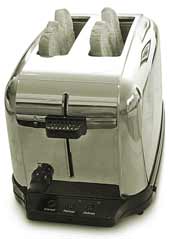
To many households, a toaster is a necessity to beat the morning rush. Put the slices in, switch on the toaster and just wait for the toast to pop up. Sounds simple, doesn’t it? But most toasters in the market do not conform to the safety parameters. That is the conclusion based on a survey conducted by the Consumer Education and Research Society (CERS), Ahmedabad.
Brands tested
Ten brands of two-slice automatic pop-up toasters were tested — Bajaj, Birla, Black & Decker, Inalsa, Kenstar, Morphy Richards, Orpat, Philips, Spherehot and Usha Lexus. As pop-up toasters are covered under the Quality Control Order, 1981, they have to conform to the standards of the Bureau of Indian Standards (BIS). The order states that “no person shall himself or by any person acting on his behalf manufacture, store for sale, sell or distribute any household appliances which do not conform to the specific standard.”
Key findings
• The brands were tested for safety as per IS 302-2-9 (1993), and IS 302-1 (1979), performance tests as per IS 1287 (1993) and for energy consumption as per International Standards IEC 60442.
• All 10 brands tested failed in the abnormal operation test as none provided for the non-self resettling thermal cut-out, necessary to prevent fire and other hazards.
• If for any reason the ejector mechanism (plunger) does not work and the toaster continues working, it might lead to a fire and the appliance may deform. Bajaj was distorted and the outer body of Inalsa deformed slightly. The plunger did not work in Bajaj and Philips after the test. None of the brands provided a non-self resetting thermal cut-out.
• Various parts of the toaster like the grip, knob, power cord, etc. should not heat beyond the value given in the standard. Spherehot did not conform to the parameter.
• Internal wiring and electrical connections were not adequately protected in Bajaj, Birla, Kenstar, Morphy Richards, Orpat, Philips and Spherehot.
• If the plugs are not of standard quality, they may soften and lead to the risk of exposure of live parts and cause accidents. None of the brands conformed to this test except Philips and Spherehot.
• Spherehot consumed the maximum energy at 28.99 watt per hour. Black & Decker consumed the least at 17.34 watt hour while Bajaj consumed 23.51 watt per hour.
• When converted into rupee value, the energy consumption of Black & Decker would cost the least at Rs 29.13 per month for a family of four on an average of four slices a day to a member. With Spherehot, you would spend the highest at Rs 48.70.
• According to the standard, it should not be easy to remove the marking or the marking plate on the toaster. Except for Spherehot, none of the brands conformed to this parameter.
• Orpat and Usha Lexus were not marked with information on the country of origin. In the case of Bajaj, Birla, Kenstar and Morphy Richards too it was not marked clearly.
• The parts carrying the current as well the metal parts should not corrode. It was found in the Spherehot model that the terminals where the supply cord was connected were corroded.
• Power cords for toasters should be at least two metres long. Except Bajaj, Morphy Richards and Spherehot, the power cords of all the brands came to less than two metres in length.
• When the bread carriage is released immediately, the damping system should work well. In Spherehot, the carriage did not come up softly and the bread slices popped out with a jerk.
• Birla scored the highest at 74, followed by Black & Decker at 71. Orpat and Usha came third with 70 points.
Best buy
With a good score and a reasonable price, Orpat emerged as the best buy.
Chromium flakes
• CERS performed pilot tests before the actual testing to get familiarised with the various tests as well as to check the validity of the test method. During these tests, chromium flakes were seen coming off the surface of the Philips toaster along with the bread. Also, in another Philips sample, chromium peelings were found during visual inspection at the time of purchase. These toasters belonged to batch no. HD4820.
Philips agreed with CERS’ findings. It asked its dealers to replace any toaster belonging to the batch mentioned if a customer brings it to them for any purpose.