 |
He was a nomad in his early days, passing through different cities in his childhood. As a result, he’s had the opportunity to study in places like Ahmedabad, Calcutta (South Point), Delhi (St Mary’s) and Hyderabad (Hyderabad Public School). Then it was back to Ahmedabad (H.L. Commerce College) for graduation, after which he went on to do cost accountancy and an MBA from Chandigarh.
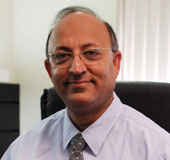
Meet Sushil Handa, the force behind Claris Lifesciences, a pharmaceutical major, manufacturing and marketing high-end sterile injectable preparations, life-saving medicines and hospital products for the treatment of critical illnesses. Handa has finally found an anchor for his dreams. He’s rooted for life in the pharma industry.
Handa’s passion for entrepreneurship goes back to his school days. His father worked in the textile industry, and it was at his dad’s workshop that he developed his first “understanding” of the various aspects of business.
“The people I interacted with — my mother, the staff — had a treasure trove of stories from mythology to recount. This shaped my vision for the future. I spent all my free time with my cousins and friends, dreaming of and planning blueprints for industrial complexes,” says Handa, with a chuckle.
While the seeds of a sharp business brain were planted early in life, the resolve to set up something took shape during his college years. “While doing my graduation, I made it a point to visit financial institutions, and study projects,” says Handa. “And I took the entrepreneurial plunge in my own way — buying old textbooks from graduating students and selling them to the next batch.”
However, right after college, he drifted into other things. He worked with two companies — McGaw Ravindra, the Indian arm of McGaw Laboratories, a subsidiary of American Hospitals Corporation, and Dalal Consultants & Engineers. Handa also dabbled for a while in marketing home appliances, finance and consulting. While these were profit-making ventures, his goal in life was not just earning a livelihood. He craved for a sense of achievement and dreamt of creating wealth for society at large. Thus, manufacturing was the logical next step.
“As consultants, we had researched several businesses, and had decided that we wanted a business that was knowledge-based, consumer-oriented and with a social orientation that impacted lives directly. The pharmaceutical industry was a perfect fit, and we set up Core Parenterals, which went on to become the undisputed leader in the Indian IV fluids industry,” says Handa.
Core was one of the greatest success stories of its time. Case studies on the company found their way to some of the best management schools in the country. Recounting the early days, Handa says: “We started with limited resources. Our business model was an IPR-driven one, which required getting together scientific, sales and marketing, and management teams. This was difficult. Moreover, as we had chosen a proprietary business model (product development and its regulation, manufacturing, and international environment), it required a high level of competence. Also, as the products were manufactured by a few companies that dominated the market, entry was difficult, time-consuming and required significant resources.”
Somehow Core, with Handa at its helm, managed to tide over these difficulties and became a market leader in India and abroad. Later, however, Core ran into a lot of trouble and fell sick. It was sold off to Nirma. Handa then set up Claris Lifesciences, on the same lines as Core. Claris, living up to its name, is in the pink of health today.
What has also helped is the Claris mantra. The motto is “Think big”. There is also a 20-point value system which includes excellence, persistence, surpassing your own standards, respecting human dignity, learning from mistakes, and enjoyment of work.
If you enjoy your work, you don’t see it as “nose to the grindstone”. “I’m a workaholic and work 100 hours a week,” says Handa. “The time left after this is limited, and I find the best way to unwind is to be with my family. We compete in some sport, exchange notes on books and films, or take off on vacations.”
In his second coming, Handa has much more clarity about his core concerns.
Based on a conversation with Shibani Chattopadhyay in Calcutta