 |
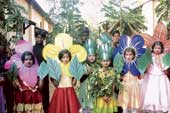
| COLOUR ME GREEN: Students of Army School at a fancy dress competition on environment awareness in Ranchi. Picture by Hardeep Singh |
Say no to plastic; Plant trees; Do not waste water and electricity; These are the buzz words of every environment club, but while some stand up and deliver, some don’t. Most schools in Jamshedpur have responded positively to rainwater harvesting projects and have no plastic zones on campus but in many Ranchi schools environment clubs don’t function.
Every Wednesday ADLS Sunshine School, Jamshedpur observes a no plastic day while Carmel Junior College (CJC), Jamshedpur, and Jamshedpur Public School (JPS) have made their campus a no plastic zone. JPS has also signed an MoU with Jusco in this regard. “Students are penalised if they get plastic bottles or carry bags to school,” said Shreya Bhattacharya, a Class-X student of CJC.
Some schools like ADLS and CJC have also been organising jute bag making contests to increase awareness. “Last year, we had a similar contest for the juniors while senior students went out to 50 shops to spread awareness,” explained Pradipta Chatterjee, principal of ADLS.
Plantation drives, too, are quite popular. “Students here had themselves come up with the idea of planting breathers — plants that give out a large amount of oxygen,” claims Nandini Shukla, principal of Kerala Samajam Model School, Jamshedpur.
In a similar move, JPS students organised a club for women living around the school. “We taught them to make vermin compost pits in a small way in their homes. We even helped to make a green patch for them,” said Lalita Sareen, principal of JPS.
While everyday lessons help spread awareness in some schools, some adopt a stricter routine. Severe water crisis at KSMS recently was taken as an opportunity by school authorities to teach the importance of saving these resources. Meanwhile, the Go Green Club of CJC has devised a unique method to keep a check on students.
“We have a squad that keeps a check on classes that have left without switching off lights and fans. If they are found guilty they have to stay without electricity the next day,” said Hinal Mehta, a member of the club.
Kerala Public School, both Kadma and Mango, ranked 5th and 18th in the Green School Project organised by the Centre for Science and Environment, Delhi. “Students have to prepare an audit report of the total amount of land on the campus and how much of it is used for plantation,” explained Manorama Ramdas, principal of KPS, Mango. Even the ICSE council introduced a course on environment studies.
However, the scene in Ranchi is not that pleasant. Eco-clubs like Vasundhara, Blossom, Palash, Nature and Dream Singer sound good, but many don’t function.
Few years ago the Jharkhand Pollution Board had taken an initiative to introduce eco-clubs in 150 schools in the capital. While the club has been a success in Bishop’s School, Guru Nanak Higher Secondary School, Vivekananda Vidya Mandir, Dhurwa and DAV schools in Ranchi, others lacked enthusiasm. The board had also paid Rs 1,000 to these clubs for but the fund was discontinued later.
Rajan Verghese, principal of Kairali School admitted the eco-club of the school was inactive. “Nobody seems to be taking an interest to start the club, which was running under the guidance of the World Wildlife Fund. And its 200 members only appear on paper,” he said. Principal of Surendranath Centenary School, Ranchi, Samita Sinha also said their eco-club Dream Singer was not active. It is only once in a while that members organise seminars and undertake cleanliness drive.
Not only schools, but the governing body, too, should come together to solve environment issues.
With inputs from Arti Sahuliyar