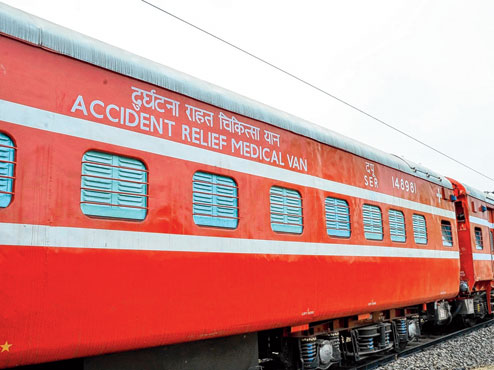
It’s the SPART of a new era. Ranchi railway division recently welcomed its first self-propelled accident relief train (SPART), which runs at 110kmph for quick relief, an improved version of accident relief trains (ARTs). P.K. Gupta, assistant divisional mechanical engineer, and Ram Narayan Mehta, senior section engineer, Ranchi railway division, help Chhandosree decode the rescue train for readers


BARE BASICS
SPART is an accident relief train with two engines on either end. It also has three coaches — a supervisor van, a medical van and a tool van
TWIN BRAINS
With engines permanently attached on both ends, it can immediately leave for an accident spot in any direction. Earlier, before this self-propelling avatar, an engine had to be attached before sending the accident relief train, which wasted over 30 minutes of crucial half-an-hour of rescue time.
POWER-PACKED TRIO
The relief train’s first coach, the supervisor van, has space for manpower — doctors, paramedics, rescue workers — to reach the accident spot. The second one, medical van, is fully equipped with a doctor’s room, a 12-bed post-operative ward, an autoclave cubicle, an airconditioned operating theatre, hi-tech medical equipment. It also has a kitchen to cook basic food needed for distribution during relief operations. The third coach, tool van, has equipment to cut coaches to pull out accident victims and other evacuation tools needed at the site of an accident
TECH SAVIORS
• Air bags: SPART has four inflatable rescue air bags, which can take loads 39.5 tonnes and 67.5 tonnes, respectively. Used to insert in narrow spaces, between berths and walls, the bags can help lift heavy weights to
rescue passengers
• Hydraulic rescue equipment: Hydraulic cutters, spreaders and hand-operated tools can split coaches open to rescue passengers trapped inside, even if a train has fallen underwater
• Breathing apparatus: The train has four self-contained breathing apparatuses to be worn by rescue workers and firefighters working in a situation where there is immediate danger to life
• Tower lights: Inflatable, portable and glare-free illumination systems, these tower lights are a godsend during night or tunnel rescue operations
• Tents: Lightweight structures can be erected within five minutes