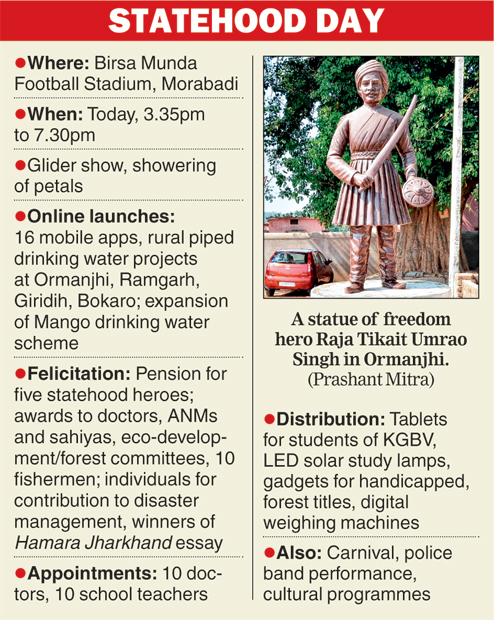

Ormanjhi (Ranchi), Nov. 14: Mani Devi, married into freedom fighter Raja Tikait Umrao Singh's family in Khatanga village, Ormanjhi, some 35km from Ranchi, raises her eyebrows in surprise to see a reporter in the shabby village yesterday afternoon. "You came months early," she says with dignified irony.
"The media, government babus and politicians normally come on January 8," she refers to the day when Jharkhand's heroes of the 1857 uprising, Raja Tikait Umrao Singh and his lieutenant Deewan Sheikh Bhikari, were hanged by the British on January 8, 1858.
Khatanga, the Raja's turf, and Khudia-Lotwa, Bhikari's home, are shabby, dusty villages separated by around 10km on Ranchi-Ramgarh NH-33, where descendants of the patriots and others struggle as daily wagers and farmers.
From 1858 to now, the hopes of these two villages have been hanged countless times, including in the past 15 years of Jharkhand's inception. For residents, Jharkhand celebrating its 16th Foundation Day tomorrow means precious little.
Ask anyone at the two villages, and they will remind you of 2012 when then deputy chief minister Sudesh Mahto laid the foundation stone to turn them into model villages. Sudesh was then part of BJP-led Arjun Munda government.
Jharkhand had conceived converting about 100 villages selected on the basis of their historical significance, into model ones, two years before Prime Minister Narendra Modi launched his Sansad Adarsh Gram Yojana last year. Initially, about 70 villages with priority being freedom fighter homes were to be revamped in three years from inception, that means by 2015.
But the project, like most in Jharkhand, slipped into oblivion inside some file. Today, both Sudesh and Munda are out of power.
Now that the state has a full majority BJP government led by Raghubar Das, there is only one question on the lips of the residents of two patriot villages.
"When will our village become a model one in reality? Netas swear by the names of patriots to invoke the feeling of statehood according to their convenience. But, what do they do for us?" asks an unemployed youth of Khudia-Lotwa, who confesses to pedalling illegal coal from closed mines in Ramgarh and Patratu in cycles to sell in the grey market.
"When the government does nothing for us, we have to find ways and means to earn," he says defiantly.
The Muslim village with 60-odd households has a government primary school but no health centre. Most pedal illegal coal. Some work as daily wagers. Farming has not been an option for decades. Water promised for irrigation did not reach them, says elderly villager Sheikh Qurban, claiming to be a fourth-generation descendant of Sheikh Bhikari.
"Politicians come on January 8, garland the chowk named after my great-great grandfather and leave," he said, his sentiment echoed by Sheikh Jamal, another descendant of the freedom hero.
"Our youths are forced to work as coal peddlers or daily wagers as there is no water for farming and there is nothing else to do," Jamal said, pointing at an unfinished cement cylinder. "See that? A water tanker was to come up, but didn't. Getalsud dam is so close, yet so far from our fields."
All one finds in the name of model village are three plaques announcing the construction of the check dam, Sansad Bhavan, and akhra or community centre.
The Raja's village Khatanga, with a mixed Hindu and Sarna population of 100-120 households, faces same problems.
"In the name of model village, we got a Sansad Bhavan, akhra and a piyao (drinking water kiosk), but so far they are mere civil constructions. They are yet to be launched," said farmer Bharat Bhushan Singh, a descendant of the Raja.
The piyao would be useless even after its inauguration. "How will it quench thirst, when there is no water supply linkage or even taps?" he said. "We struggle to farm with poor irrigation facilities. Many farmers are selling land to private parties nowadays. The village is changing for the worse."
Gram pradhan Mani Munda said they were promised a 24/7 ambulance, job opportunities, check dams for irrigation, among many other amenities as per the model village tag.
"We don't know what happened to all these promises," Munda said candidly. "We approached the block development office many times, but got no answers."
Pointing to the lone middle school named after the freedom fighter, he said: "It is battling very poor student-teacher ratio. Only four teachers, including two para-teachers, for 400 students, and they mostly do non-teaching work."
What about a health centre? "It was proposed in the model village project," he wryly smiled.
Enough said.