 |
If an environment where communities co-exist or where people allow many (and different) cultures to influence each other is one’s version of cosmopolitan behaviour, then Jharkhand is as cool and cosmopolitan as it gets.
Here, people from all across India — Punjab, Nepal and Orissa — have not only congregated and accepted Durga Puja as an intrinsic part of their cultural scene, they have lend it a colour and character of their own, redefining the old normative Bengali flavour.
The official list of Jamshedpur Durga Puja Kendriya Samity (JDPKS) boasts of a whopping 248 pujas in the city. While Bengalis in Jamshedpur mostly dominate the celebration scene, there are people from Orissa, Nepal and Punjab, too, who can teach a thing or two regarding how things may be done.
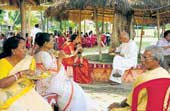
A case in point is the puja at Durga Mata Temple near Akashdeep Plaza in Golmuri. The 17-year-old puja is celebrated at the residence of Gurmej Singh and is perhaps the only place in the city where a Sikh priest, accompanied by a Nepalese priest, perform the rituals. And it has been so for the past 17 years. At the end of the day it’s quite a show, as hundreds of Punjabi families gather here to be part of the festivities.
“What makes this different is the 41-feet high flag that’s hoisted on every Saptami. The immersion procession is quite unique, quite similar to what one gets to see at Vaishno Devi. There’s also a langar that’s held every Saptami, gurudwara-style,” says Gurmej Singh who is not only the priest but also helps in the idol-making process.
While the Sikhs only have a lone puja to boast of, there are communities who have created quite a niche in the puja scene. Leading the way is Utkal Samaj, which hosts over eight pujas, celebrated in traditional Orissa style. “There are eight separate pujas conducted by the Oriya community alone in the steel city. The oldest among them is the one at Utkal Association in Sakchi, which is celebrating its 74th year this year,” said Tara Chand Mohanty, president of JDPKS, who is also associated with the Utkal Association Puja.
Apart from this special one, the other prominent Durga Puja by Utkal Samaj are the ones celebrated at Kadma Ganesh Puja Grounds, Dhatkidih Utkal Sarbojanin and one at old Purulia Bus Stand at Sakchi. The best part of these “hatke” pujas is how each community has successfully integrated its cultural theme into them. The traditions of the people from Orissa are different from the rest. “Though most of the rituals remain the same, compared to Bengali norms, our proceedings begin a little late. Moreover, the prasad offered is sweet pulao, instead of the traditional khichdi,” said R.N. Sathpathy.
And if the Oriya community strives hard to maintain its identity, people from Nepal, too, are not far behind in the festivities. There are about three pujas performed by them. While two are at Adityapur, Jamshedpur Nepali Samiti in Golmuri holds the mother of all celebrations. Started in 1969, till last year it included animal sacrifice on Ashtami.
“The practice was dropped after a replica of Pashupatinath Temple was built nearby. But other than that, most have remained the same,” said C.R. Dahal, president of the Jamshedpur Nepali Samiti, which boasts of 13,000 people under its aegis.
Though in Jamshedpur, the community has stopped the sacrifices, in Ranchi the ritual continue. Here a fast for nine consecutive days is maintained. On Navami, devotees sacrifice 50 to 60 goats outside the temple premises at Jharkhand Armed Police (JAP-1) grounds. The puja ritual starts from Ashtami and continues till Navami.
Another striking feature is that devotees who have had their wishes fulfilled do not participate in the rituals. “Therefore, before participating in the puja, it is imperative to have some wish,” added Vimal Pathak, who has been performing the rituals since 1986. In Ranchi the rituals are performed without the idol of Durga Instead, a copper vessel or “kalash” covered with a red cloth is placed underneath a mandap adorned with banana leaves and marigolds. The vessel is filled with holy water or Ganga jal along with other paraphernalia like gold, silver, iron and copper.
And the rituals are sprinkled with beliefs and lore that make it all the more exciting. Like in place of the kalash, if an idol is worshiped then it may lead to a devotee’s death. “It so happened a few years ago that a member brought an idol. He wanted to celebrate in the same way as other committees. The person died after putting the idol in the temple. Since then puja is performed by placing a kalash along with the goddess’s photo,” Pathak explained.
Gunfire, flag hoisting, different flavoured prasad — the small details notwithstanding, the uniting feature is the ultimate victory of good over evil.