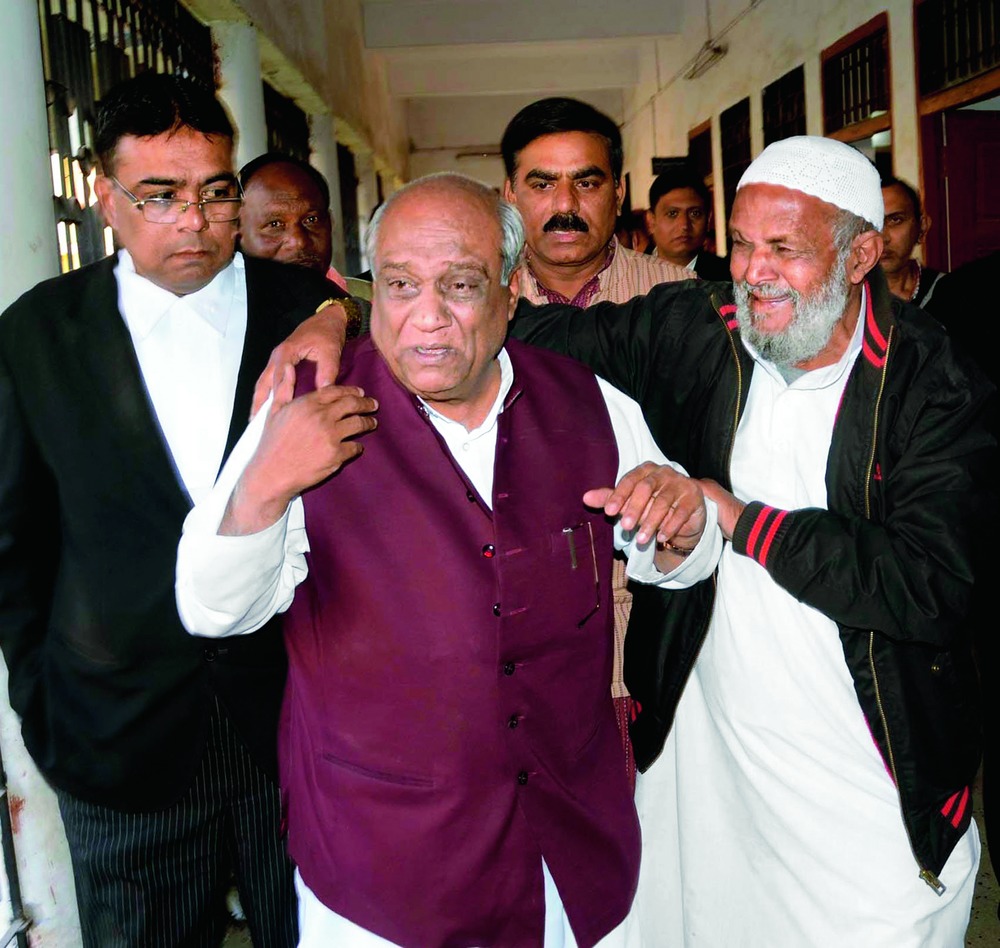

Three persons accused of the 1990 murder of church functionary Martin Tete were acquitted on Wednesday after a trial that lasted 26 years with the civil court citing lack of evidence as the reason behind letting off Congressman and Ranchi trader Roshan Lal Bhatia, Anil Kapoor and Tapas Kumar Mukherjee.
Pushpa Rani, the niece of Tete, who was president of Gossner Evangelical Lutheran (GEL) Church, was overcome with emotion after the verdict announced by Pradeep Kumar of Ranchi civil court.
"We will keep fighting. We will appeal before the high court. At least somebody should tell us who killed my uncle. I don't believe my uncle died a natural death. My aunt Herelin Tete died fighting for justice. God is supreme. He will give us justice," she said.
Tete's family alleged he died of unnatural causes in June 1990, citing his apparent mission to safeguard vast tracts of land that the GEL church owns on Main Road, Ranchi.
Tete had gone to Calcutta on June 10, 1990, and was supposed to return the next day. But his dead body arrived in Ranchi on June 13. He was buried the next day.
On July 8, 1990, an FIR was lodged at the Lower Bazar police station, alleging that Tete was murdered after which his body was exhumed for a post-mortem. The family cited allegations that Bhatia wanted control of the land owned by GEL on Main Road - GEL Church Complex is today one of Ranchi's largest shopping areas. But, that Tete was opposed to this.
Two others named accused, C.S.R. Topno and M.G Mohan, died during the course of the trial, which took several unexpected turns.
Bhatia was arrested in September, 1993. But in January 2002, a local court acquitted all five accused due to lack of evidence. Tete's widow challenged the decision in Jharkhand High Court which went on to uphold the lower court's order. She then moved Supreme Court, which directed the high court to reopen the case.
But since the trial wasn't expedited, Tete's son Siddhnath appealed before the high court a few months back, seeking a speedy trial. The high court then directed the civil court to hasten the trial and conclude the case.
A much relieved Bhatia said he was glad the court had removed his "murder" stigma. "I have been fighting for justice from the last two and half decades. Truth finally prevailed," he said.
Vishwajeet Mukherjee, who argued on behalf of Bhatia and the others, claimed it was a politically motivated case. "A conspiracy was hatched against them (the accused) by a lobby comprising GEL officials and police administration. And unfortunately, the media played up the case unnecessarily," he said.
Then who killed Tete?
Mukherjee believes Tete did not die an unnatural death. "The post-mortem could not ascertain any reason. Tete's viscera was preserved to ascertain whether he was given a lethal dose of poisonous chemicals. It was sent to Bhabha Atomic Research Centre which also ruled out any such possibility," Mukherjee said.