

Ranchi, Nov. 21: Jharkhand's success in reviving its fisheries sector by using a technique in which small fish is reared in a protected environment to increase yield, was today lauded by the Centre, which certified the state's training centre at Dhurwa on the outskirts of the capital as the best skill development centre.
Union agriculture minister Radha Mohan Singh presented a trophy and citation to state fisheries director Rajiv Kumar at ICAR complex in New Delhi today at national conclave on the occasion of World Fisheries Day.
Kumar, who led a team of 20 progressive fishermen from Jharkhand at the day-long programme also attended by representatives from other states, said, "It is a great achievement for fisheries sector and fishermen of Jharkhand."
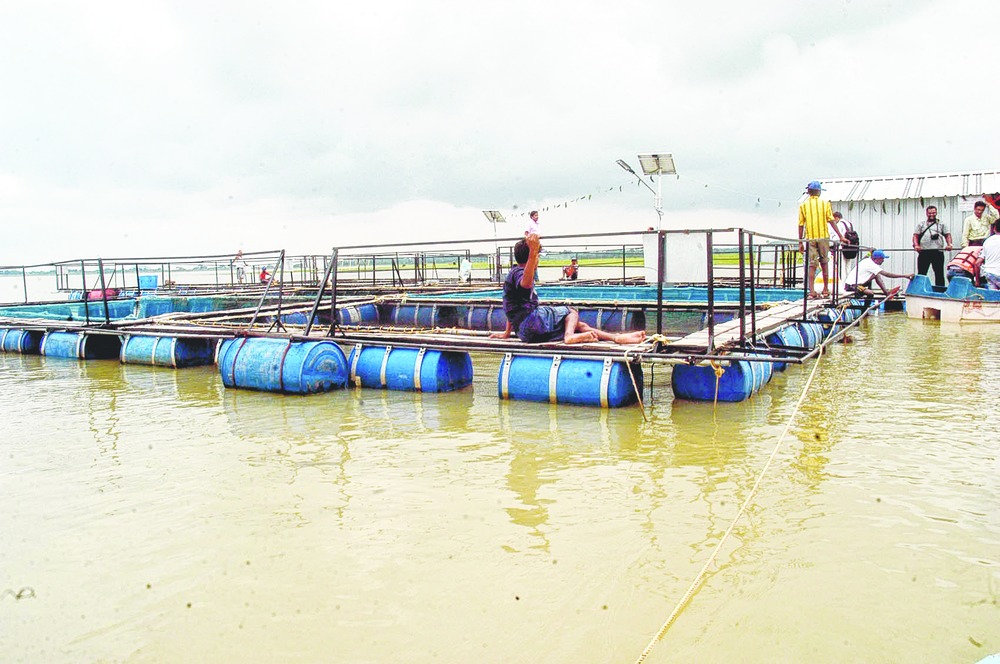
The director made a detailed presentation on how despite several odds, Jharkhand was able to put its fisheries sector back on track by adopting what is known as "cage culture" of fish, an initiative started in 2011 as an experiment at Ranchi's Hatia dam.
Initial hiccups notwithstanding, the state fisheries department managed to step up production.
"About a decade back, Jharkhand used to produce around 14,000 metric tonnes of fish annually. Today, this has zoomed to 1.6 lakh metric tonnes. From cage culture, we are producing, roughly, over 10,000 metric tonnes of fish. As the number of cages grow, production will automatically see a massive surge," Kumar said.
In cage culture, explained an officer, water resistant cages with nets are released in water. "Rather than releasing fingerlings (or small fish) into the free water, we release them through cages which enables us to nourish them from time to time in a controlled environment. The cages don't sink in the water as they have drums attached, which help them stay afloat. Fish grow faster this way," he said.
As of now, around 2,000 cages have been set up at several big and small water bodies/dams at Chandil, Tenughat, Koderma and Hatia. "Our target is to have 10,000 cages by 2017-18 fiscal," he noted.
News that cage culture has been paying dividends has spread. Teams from several states have been visiting Jharkhand to get a first-hand feel of the process. In September, an 18-member team from Rajasthan toured the state extensively to study cage culture, while in July-August, teams from Jharkhand went to Telangana to talk about it.
State fisheries deputy director Ashish Kumar cited another positive spin-off. "Apart from becoming self-sufficient in fish production, cage culture is also generating employment for a large number of people in the rural hinterland," he said.