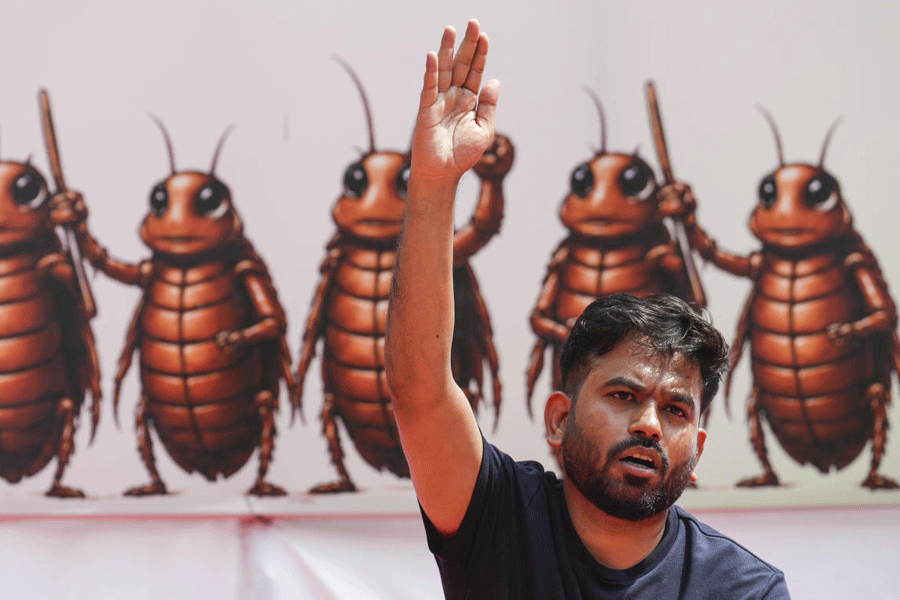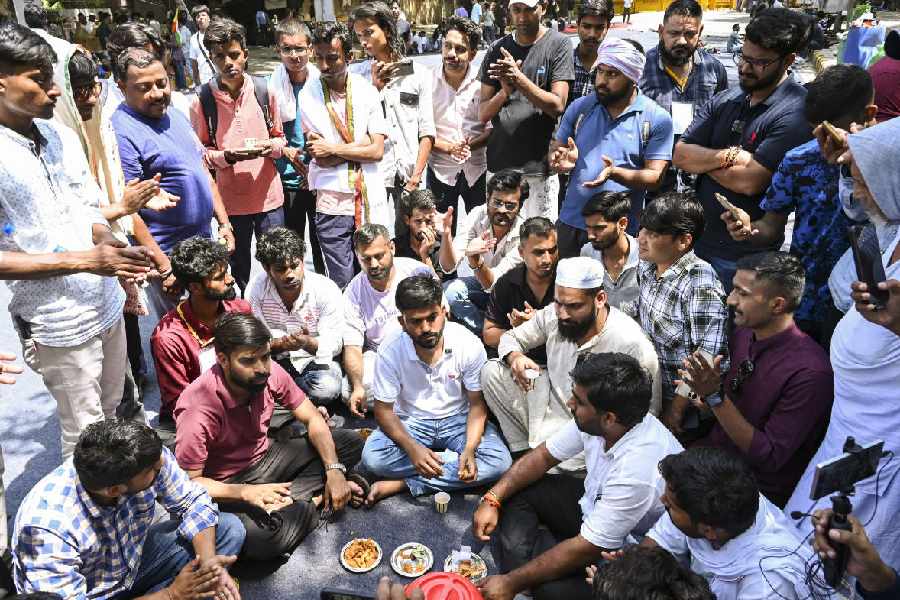
The crowds demanding accountability and the resignation of Union education minister Dharmendra Pradhan – following paper leaks and institutional corruption within the National Testing Agency that has frozen in uncertainty the futures of lakhs of students – do not comprise the youth alone.
In the unforgiving anvil of the Delhi summer, the Jantar Mantar protest site includes veteran teachers who travelled days by bus, octogenarians who remember a cheaper, kinder India, and professionals who have paused their careers to chop ice and distribute water.
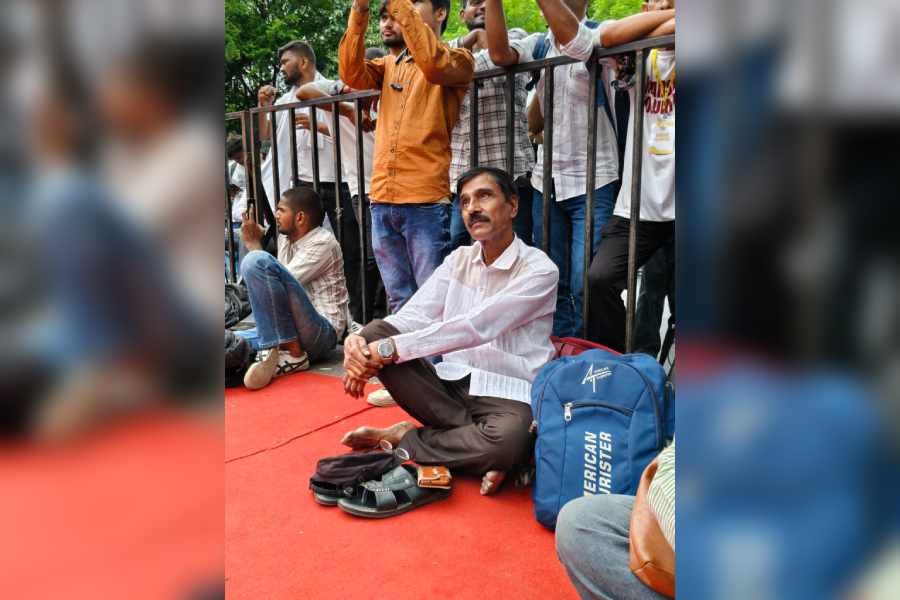
Sudesh Patel, a teacher from Mumbai at the Cockroach Janta Party protest at Jantar Mantar, Delhi. Debayan Dutta
Sudesh Patel spends his days explaining the certainties of algebra and geometry to teenagers in Chembur, Mumbai. But the 60-year-old teacher said the political arithmetic of modern India no longer adds up.
When the scale of the NEET examination scandal became evident, Patel did not look for a train ticket because there were none available. He boarded a state transport bus and travelled for 34 hours to reach the national capital.
"My body was in pain by the time I arrived," Patel told The Telegraph Online, his voice raspy from the dust but steady. "At my age, facing lathis isn't what one should do, but I came because I had to come. I have been sitting here since the first day."
Patel avoids the shade of the nearby canopies, choosing instead to sit directly under the blazing 45-degree sun, watching over the young protesters. He said that while he teaches in a shaded classroom, labourers, farmers and the protesting children have to endure the elements. He feels a responsibility to share their pain.
For Patel, the crisis hits close to home. Two years ago his only son, overwhelmed by the systemic opacity of the UPSC civil services exams, confessed to feeling suicidal.
"I was terrified," Patel whispered. "He is my only child, my only son. If he became that disappointed, what about the rest of the country’s children? In the old days, even if someone failed, they found a job or small work. Today, even with degrees and certificates, the youth are unemployed. The entire system has rotted."
He looks around at the heavy deployment of riot police framing the protest square with a look of grim determination.
"I have come after careful thought to protect these children. If lathis ever rain down on them, we elders will face them first. We will take the blows on ourselves so the numbers increase and the pain is shared."
Manju Jain is 6-feet tall, carries the poise of a seasoned activist, and refuses to let her 84 years keep her indoors. When she heard on the news that the administration was attempting to stifle the protests by cutting off food and water supplies to the site, she could not sit still.
"I got up from my house in Delhi. I thought I would bring two or four bottles of water, but I couldn't carry them," Jain told The Telegraph Online, having navigated her way to the protest site alone in an auto-rickshaw. "When I arrived and saw that everyday citizens had already arranged water, I was so happy. I thought, 'Will you stop providing food and water? Will you not let us speak?'"
Jain graduated from Delhi’s Lady Shri Ram College in 1970.
"When I was in the final year of my BA, my fee was Rs 18. There was no other expense; I used to come and go by bus," she remembered. "Today, someone told me a medical education costs Rs 2 crore. Who can pay back a loan of Rs 2 crore if they don't even know if they will get a job? The burden falls entirely on the child's mind.
“You have excluded the common person from studying, and this will not work in our democracy," she added.
For Jain, the paper leaks are not an isolated administrative failure but the terminal symptom of decades of “unchecked corporatisation and privatisation” that began in the 1990s.
She fears that the nation is transitioning from citizens of a free country to slaves of the corporate elite.
"We are a free country and being a citizen of a democracy is a very big thing," she said. "For 2,500 years of written history, the country belonged to the king and the people were his servants. The king’s wish was the law. But our Constitution explicitly states: We, the People of India. It means I belong to this country, and this country belongs to me.
“If our educated youth do not reclaim politics from the corrupt elements occupying Parliament, this country can never improve."
While others speak, Mohammad Junaid moves. A lawyer by profession who also manages his family's farm and a buffalo dairy, Junaid has turned a corner of Jantar Mantar into a free dhaba.
"The backbone of any country is its education system and an attempt is being made to push that very system into darkness," Junaid said, wiping sweat from his forehead. "The exploitation that lakhs of NEET children have faced is destroying their future. We are doing this collectively so that the threat looming over the future of the country is removed."
Both Jain and Junaid pointed to the reports of student suicides across the country tied to the exam cancellations and leaks.
"Fed up with this broken system, around 14 to 15 children chose suicide," Junaid said. "Ask their parents what they must be going through. It sends shivers down my spine just hearing about it. With whose support will they spend their lives now? They have been pushed into a near-death situation while still alive."
For Junaid, the kitchen and water stalls he operates are a rebuttal to the divisive rhetoric outside the square.
"All of us — Hindus, Muslims, Sikhs and Christians — are brothers to each other here," Junaid told The Telegraph Online. "We are neither looking at anyone's caste nor their religion. We are only seeing that people have gathered for a voice of right; we have a major cause. How long will you keep trapping people in false Hindu-Muslim propaganda? How long will you incite people on the issues of casteism? Stop it. Provide good education, good employment, good healthcare, and take India forward."
As the sun began its slow descent over New Delhi, the ice blocks next to Junaid had completely melted away into the dry earth. But the lines for water did not shorten and the older faces in the crowd showed no signs of leaving.