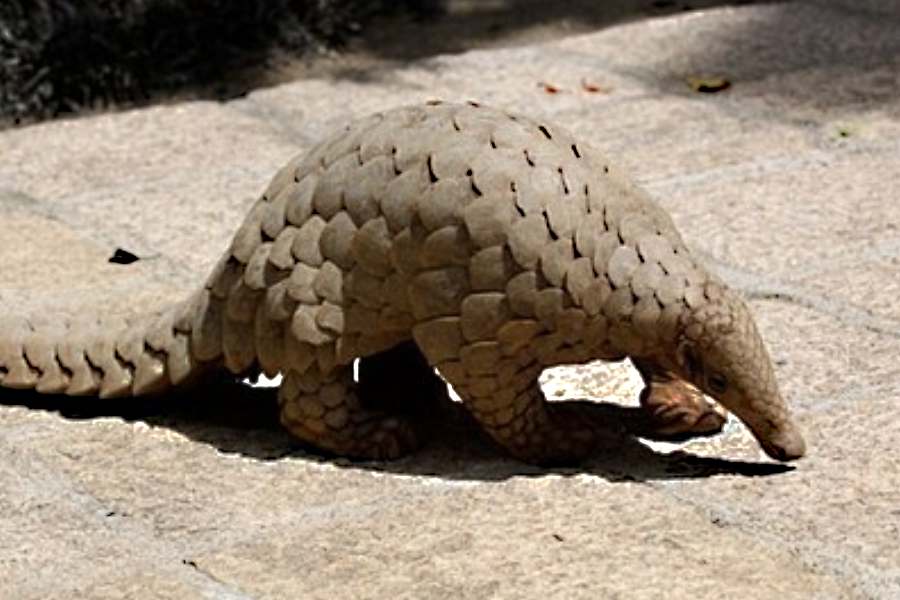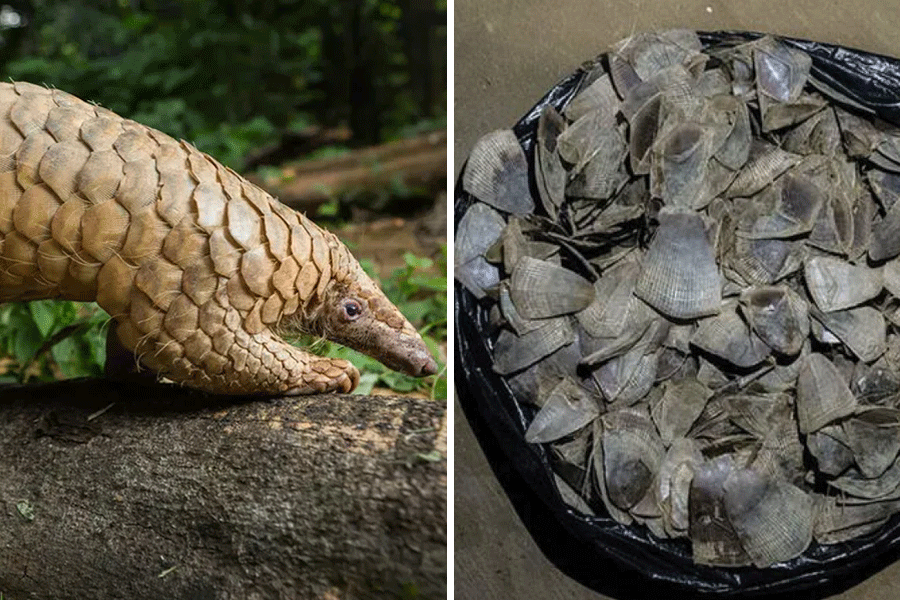
Days after four poachers were arrested with cheetal scales along the Jharkhand–Bihar border, forest officials in Jharkhand’s Latehar district have uncovered another strand in the illegal wildlife trade, arresting a woman with 2 kg of pangolin scales.
The woman was apprehended from the Baresand area on Tuesday with a bag containing pangolin scales, Latehar forest range officer Nandkumar Mehta said.
Pangolin scales, made of keratin like human nails, are among the most trafficked wildlife products in the world and fetch high prices in international markets.
“The arrest was made based on a tip-off... two more poachers were nabbed with a rifle from another forest area on Tuesday,” Mehta said, indicating a wider network operating across forest belts in the region.
“Frequent raids are being conducted to catch poachers in the Latehar forest region,” he added.

Pangolins are often mistaken for reptiles, but they are scaly-skinned mammals known for their distinctive defence mechanism, curling into a tight ball when threatened, exposing only their hard scales. This very adaptation, meant to protect them from predators, has made them easy targets for poachers.
Because pangolins are elusive and largely nocturnal, scientists know little about their wild populations, making accurate estimates difficult.
According to the World Wildlife Fund, pangolins are the most trafficked mammals in the world, with most trafficking involving African species smuggled into Asia.
Countries such as China and Vietnam are key destinations, where pangolin meat is considered a delicacy and the scales are used in traditional medicine and folk remedies. The demand is not limited to Asia alone; there is also a market in the Americas for pangolin skins used to make leather products such as boots, bags and belts.
All eight species of pangolins recognised by the International Union for Conservation of Nature (IUCN) are protected under national and international laws. Yet legal protection has done little to curb the trade, which has grown in recent years alongside rising demand.
Data from 2019 suggests that a pangolin is poached every three minutes, making seizures like the one in Latehar part of a much larger, ongoing crisis.
The danger to pangolins is closely tied to beliefs around their medicinal value, particularly in Chinese medicine.
The scales are believed to cure ailments ranging from asthma and rheumatism to arthritis, malarial fever, deafness, excessive nervousness and hysterical crying in children, as well as conditions attributed to spirit possession.