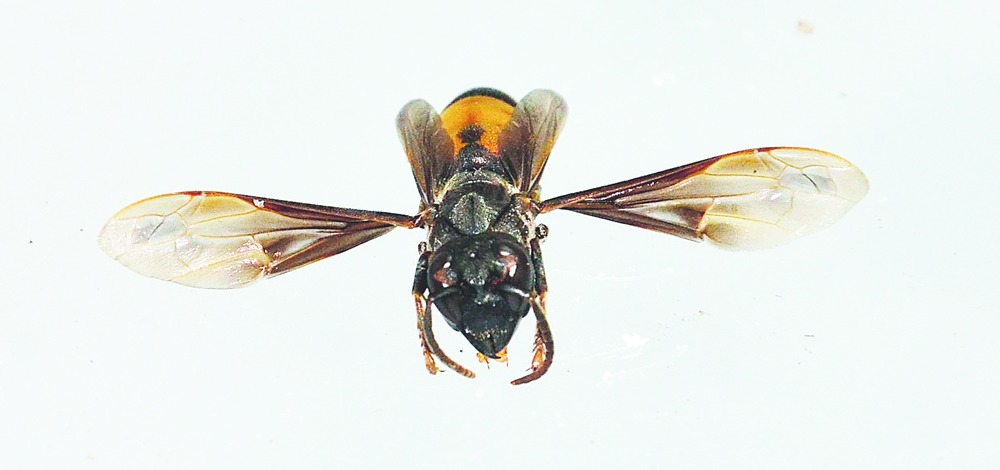

New Delhi, May 21: A wasp with a sharp sting that is stir-fried or boiled and eaten by some tribes in India's Northeast and prescribed by traditional healers for joint pain has been shown to possess anti-arthritic activity.
Scientists at the North East Institute of Science and Technology (NIEST), Jorhat, have discovered that extracts from these wasps' larvae enhance the activities of two key enzymes in the body. One of the functions of these enzymes is to eliminate biological molecules linked to arthritis and other health disorders.
The researchers have suggested a possible molecular mechanism to explain the traditional use of this edible wasp, Vespa affinis, against arthritis-like pain as had been documented by scientists about eight years ago. The findings have been published in the research journal PLOS One.
"We see dose-dependent enhancement of activity - the greater the dose of the larvae extract, the higher the activity of the detoxifying enzymes," said Jatin Kalita, a scientist at the NIEST, a laboratory under the Council of Scientific and Industrial Research.
Medical studies had in the past linked arthritis, diabetes and cardiovascular disease to enhanced oxidative stress in the body, a condition in which potentially harmful molecules called free radicals accumulate, overwhelming the body's ability to eliminate them.
Kalita and his colleagues have shown through laboratory experiments that the wasp larvae extract can significantly increase the activity of two detoxifying enzymes, called glutathione-s-transferase and catalase, and thus reduce oxidative stress.
The scientists do not know what specific compound in the extract - a complex mixture of larval remains - causes the observed anti-oxidative effect.
"Our goal is to look for this single compound. If we can pinpoint it, we may be able to synthesise it and evaluate it as a potential new anti-oxidative compound for arthritis and other health disorders," Kalita said.
Scientists have long known that tribal communities in parts of Assam, Manipur, Mizoram and Nagaland eat the Vespa affinis. The NIEST researchers say the wasp larvae are sold for about Rs 1,000 a kilo and are traditionally boiled or stir-fried with vegetables.
"The really exciting thing is finding anti-oxidative features in an insect. Most anti-oxidative activity has been known from plant sources," said Natchiappan Senthilkumar, a senior entomologist at the Institute of Forest Genetics and Tree Breeding, Coimbatore, who was not associated with the NIEST study.
Scientists at the NIEST say their research is in line with a campaign by the Food and Agricultural Organisation (FAO) to popularise the consumption of edible insects to combat malnutrition.
A 2013 document from the FAO estimated that insects formed part of the traditional diets of at least two billion people worldwide, with over 1,900 insects documented as having been eaten in some part of the world.
Insects are a highly nutritious food source with high fat, protein, vitamin, fibre and mineral content, the FAO document said.
The NIEST study is part of an ongoing effort to assess the nutritional and medicinal properties of edible insects in the northeastern states, said Bala Gopalan Unni, director of research at Assam Downtown University, Guwahati, who was formerly a senior scientist at the NIEST.