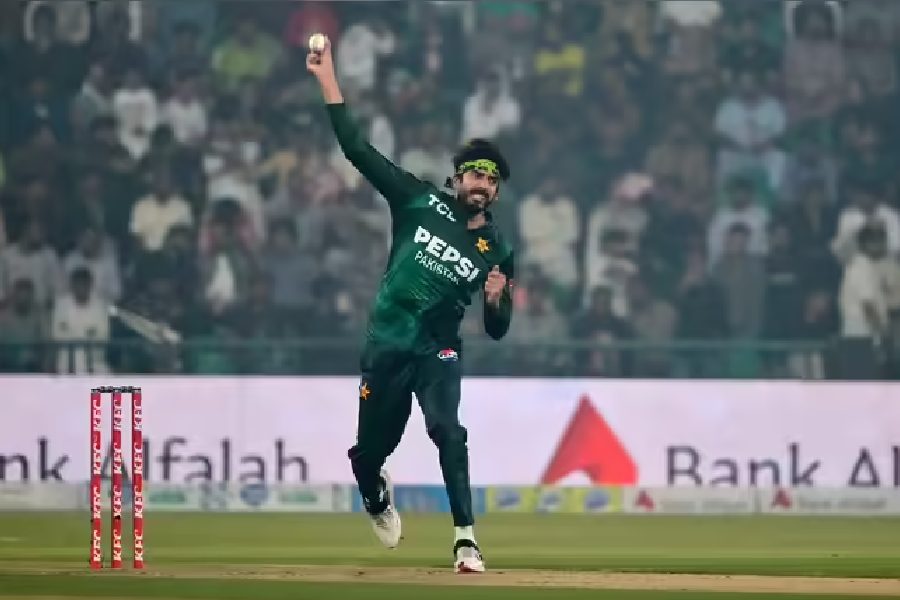
Usman Tariq freezes for a fraction of a second at the crease. Then comes the sling. In that moment of stillness lies both his greatest weapon and the controversy that now shadows him.
Pakistan’s off-spinner has emerged as one of the most talked-about figures of the Twenty20 World Cup, his stop-and-pause action unsettling batters and dividing opinion across the cricketing world. The 30-year-old’s unusual style has not only fetched wickets but also ignited renewed debate over bowling legality and the limits of cricket’s laws.
Tariq’s impact was immediate. In his first T20 World Cup appearance in Sri Lanka this week, he picked up three wickets against the United States, demonstrating the effectiveness of an action that has already left established international batters perplexed.
His rise has been swift and dramatic. In just four T20 Internationals, Tariq has claimed 11 wickets from 88 deliveries while maintaining an economy rate under six runs per over. He had earlier underlined his promise by taking 4 for 18, including a hat-trick, against Zimbabwe in Rawalpindi during a tri-series in November.
Yet, the wickets have come with scrutiny. Tariq has twice been reported for a suspect bowling action during the Pakistan Super League but was cleared on both occasions after biomechanical testing at the National Cricket Academy in Lahore. He insists his arm bend is natural.
“My arm bends naturally. I have got this tested and cleared,” Tariq said. “Everyone feels I bend my arm and all that. My bent arm is a biological issue.”
The controversy centres on two aspects. One is cricket’s so-called 15-degree rule, which allows bowlers to straighten their elbow joint up to that limit while delivering the ball. The other is Tariq’s pronounced pause at the crease, which disrupts the batter’s rhythm and anticipation.
Former Pakistan captain Sarfaraz Ahmed, who has played alongside Tariq in the Pakistan Super League, believes the pause is key to his effectiveness.
“The batters are struggling to read Tariq because of the long pause the moment he steps on the bowling crease,” Sarfaraz told The Associated Press. “The long pause disturbs all the concentration of batters and when he bowls a fastish delivery, or even a slow ball, it leaves the batters clueless.”
That confusion has been visible on the field. South Africa’s Dewald Brevis was dismissed off Tariq’s second ball in T20 internationals, while Australia’s Cameron Green reacted in disbelief after slicing a delivery to cover during Pakistan’s series sweep in Lahore. Green later apologised for mocking the action.
Tariq’s success is not limited to international cricket. He was the second-highest wicket-taker for Trinbago Knight Riders in the Caribbean Premier League, further establishing his credentials as a potent T20 weapon.
Pakistan’s selectors recognised his potential value on slow Sri Lankan surfaces and included him in their World Cup squad. His ability to exploit turning pitches could prove decisive, especially in high-pressure encounters.
India off-spinner Ravichandran Ashwin believes batters can counter Tariq’s unusual method by stepping away if they are unsure of his release point.
“If he stops before delivering the ball, the batsman has the right to move away. He can say that ‘I thought he is stopping’. That will be an interesting case and a huge headache for the umpire,” Ashwin said on his YouTube channel.
Ashwin, however, also defended Tariq, pointing to the difficulty of judging elbow flex in real time.
“To judge if a bowler is bowling within that 15-degree mark by the on-field umpire is impossible,” he said. “The only solution is having a real-time in-competition testing tool. The above is a grey area and to accuse someone for utilising the grey area is wrong.”
The debate reflects cricket’s enduring struggle to balance innovation with regulation. While some critics, including former England captain Kevin Pietersen, have questioned the legality of Tariq’s action, others view it as a legitimate variation within the laws.
For now, Tariq remains Pakistan’s wildcard. His pause is brief. Its impact is lasting. And in a format defined by split-second decisions, that hesitation could be the difference between survival and dismissal.