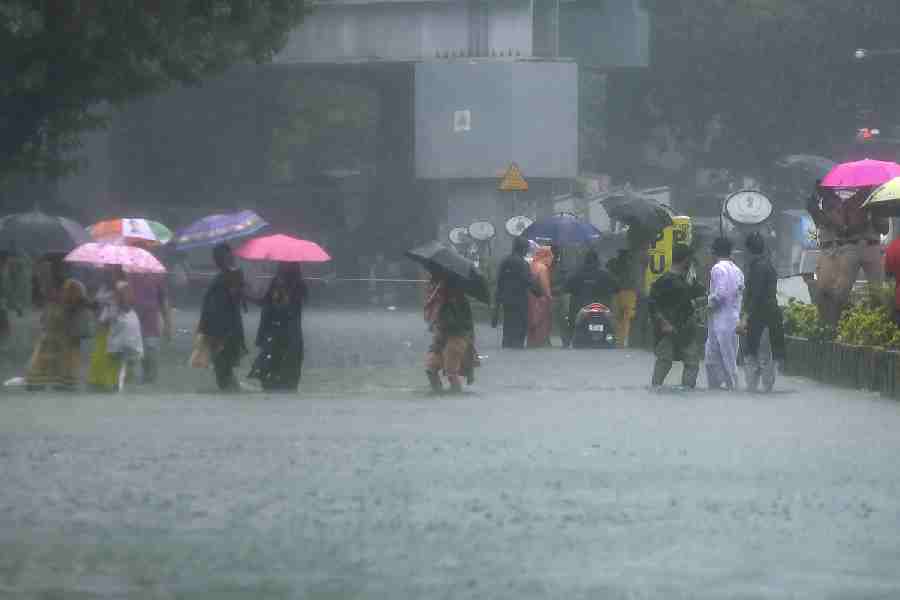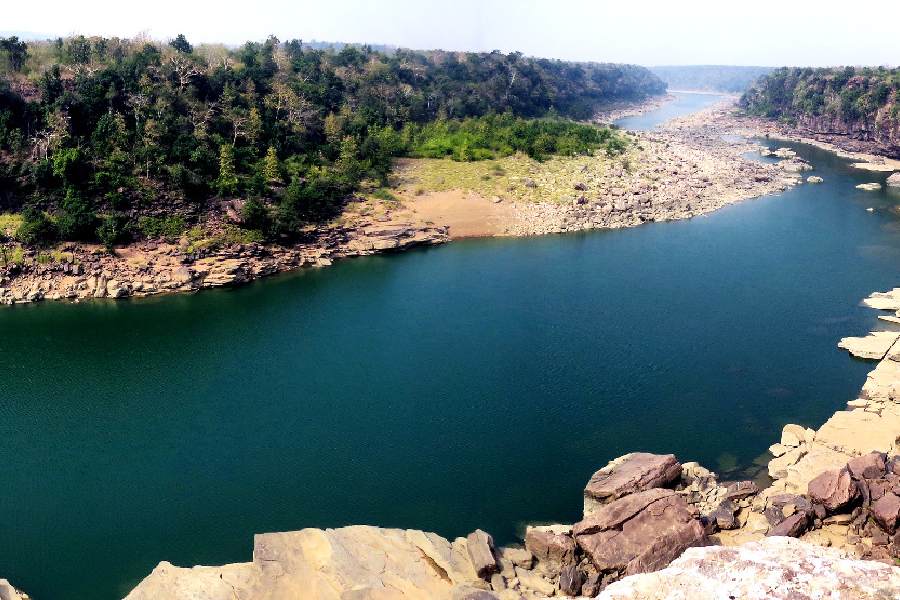
Tribal women and farmers affected by the Ken-Betwa river-linking project have resumed their agitation -- known as 'Chita Andolan' (pyre protest) -- near the Barana river, a tributary of the Ken, in a village in Chhatarpur district of Madhya Pradesh.
The protest, led by Jai Kisan Sangathan, was suspended in April after officials promised to address the grievances of affected people.
In a statement issued Monday, Amit Bhatnagar, leader of the Jai Kisan Sangathan, said, "After the April 2026 'Chita Andolan' was suspended on official assurances, the government's only response was to manufacture false charges against movement leaders, and we were put behind bars. Once we received bail, more false cases were filed against more than 250 people."
He alleged no gram sabhas were held in the project-affected villages, in blatant violation of laws. Communities were not asked for their consent, and no social impact assessment reports were placed before the public.
"The people of Bundelkhand are not asking for charity. We are asking the state to follow its own laws," he said.
The project, approved by the Union Cabinet in December 2021 at a cost of Rs 44,605 crore and launched by Prime Minister Narendra Modi in December 2024, aims at linking the Ken and Betwa rivers -- both tributaries of the Yamuna -- to supply water to the drought-prone Bundelkhand region, which covers nine districts in Madhya Pradesh and four in Uttar Pradesh.
According to the Centre, the project is expected to irrigate 10.62 lakh hectares of land (8.11 lakh ha in Madhya Pradesh and 2.51 lakh ha in Uttar Pradesh), provide drinking water to around 62 lakh people and generate 103 megawatts of hydropower and 27 megawatts of solar power.
Government estimates suggest that 6,600 families will be displaced and around 45 lakh trees will be cut down due to the project.
Under the project, a dam will be constructed on the Ken river inside the Panna National Park and Tiger Reserve, where tigers went locally extinct in 2009 but were reintroduced over the next decade.
Neelam Ahluwalia, co-founder of Aravalli Virasat Jan Abhiyaan, said in a statement, "The Daudhan Dam will submerge over 9,000 hectares of pristine forest, including 5,803 hectares inside the core zone of the Panna Tiger Reserve. We are not talking about degraded scrubland -- this is a living, functioning ecosystem that shelters tigers, ghariyals, Gangetic dolphins, vultures, chinkara, wolves and rare Mahaseer fish."
The Supreme Court's Central Empowered Committee has questioned the assumption that the Ken river possesses "surplus" water and warned that the project would be ecologically and financially unviable, according to Ahluwalia.
Questions have also been raised regarding the forest clearances given -- Stage-I in May 2017 and Stage-II in October 2023 -- to the project.
Himanshu Thakkar, water policy researcher and coordinator of the South Asia Network on Dams, Rivers and People (SANDRP), said in a statement, "A fresh tree census was mandated under Stage-I Condition 11. The Deputy Director of Panna Tiger Reserve has himself confirmed that no such census has been conducted. Stage-II Forest Clearance Condition 43 provides that all clearance conditions must be met within one year or approvals will lapse automatically."
"The question that neither the forest department nor the project authority has answered is simple: on what legal basis is construction continuing today," he added.