
New Delhi, Oct. 12: The last time anyone in the BJP recalled a key leader invoking the "Jai Shri Ram" slogan was on August 8, 2002, when L.K. Advani did so.
Advani was then the country's deputy Prime Minister. Responding to constant chants from an audience that heard him out when he inaugurated a website and released CDs and cassettes of Bhakta Ramadasa Keerthanas in Delhi, he had joined the chorus.
As the Prime Minister of the NDA's first government, Atal Bihari Vajpayee never ever uttered "Jai Shri Ram", which acquired the place of a war cry after Advani successfully spearheaded a campaign for the construction of a " bhavya" (grand) Ram temple on the site of the Babri mosque in Ayodhya.
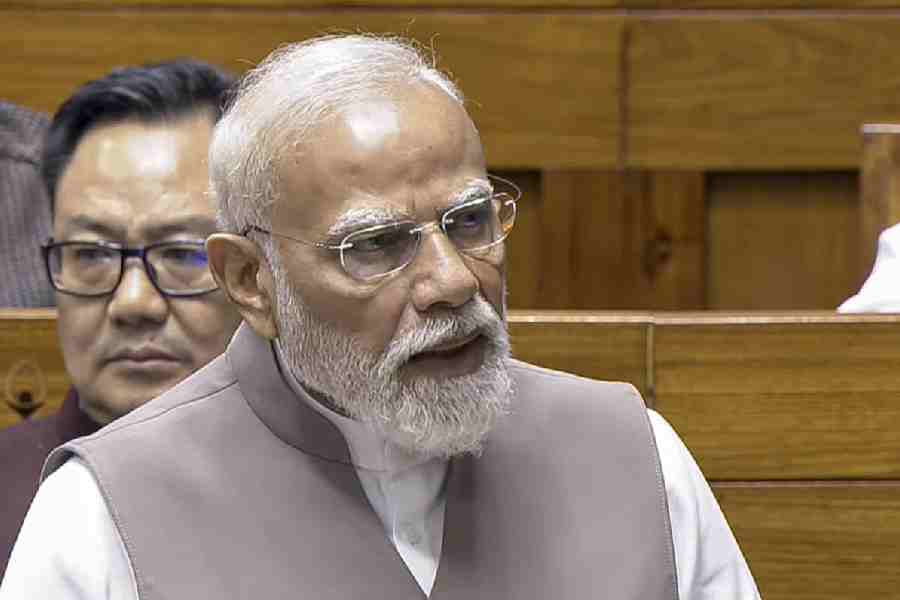
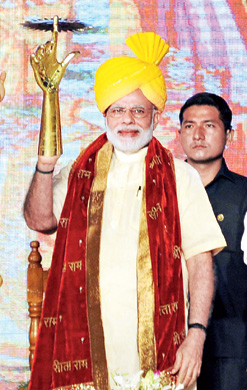
Yesterday, when Prime Minister Narendra Modi called forth Ram's name twice in his address at a Ramleela event in Lucknow - the second time with added emphasis, "Jai Jai Shri Ram" - the BJP was confident that no Vajpayee-like apologia in the shape of a musing would follow.
"Modiji is Modiji, he never says anything to retract or repent later. By chanting Ramji's name twice, he proved he is tactically smart and clear. Nobody can object to a Prime Minister taking Ramji's name and that too on the auspicious occasion of Dusshera at a Ramleela," an Uttar Pradesh BJP leader said.
Even when he was in the Opposition, Vajpayee never did so. In fact, he distanced himself from the Advani-led campaign and once refused to welcome the yatra when it reached the Delhi border. Old-timers recalled that Vajpayee agreed to put in a brief appearance when the chariot stopped at the BJP headquarters on Ashoka Road.
The closest Vajpayee came to pronouncing his view on the temple-mosque dispute was on December 6, 2000, eight years after the mosque was brought down. In Parliament, he called the movement a "nationalist movement" and added: "The task (of building a temple) remained unfinished."
The winter session of Parliament was on. The Opposition jointly held up proceedings for three days and asked whether Vajpayee had "masked" himself as a moderate all along.
"Pained" by the Opposition's tirade, Vajpayee signed off the year by posting his reflections on January 1, 2001, from Kerala's Kumarakom where he was vacationing with his foster family.
He maintained that his views on the issue were always consistent with the belief that a mutually acceptable solution lay either in the judicial route or through negotiations. Stressing that "respect" for Ram "transcends sectarian barriers", Vajpayee said had it been otherwise, the Urdu poet Allama Iqbal would not have penned an eulogy for Ram.
Asked whether Modi could lay himself open to the charge of politicising religion because this is the first time any Prime Minister had made a speech at a Ramleela and in Lucknow at that before the Uttar Pradesh polls, the BJP's media cell convenor and spokesperson, Shrikant Sharma, remonstrated and said: "This is the height of intolerance that the Opposition reacts when it comes to Modiji, attributing electoral and political motives. It is not sinful to take the names of Ram and Krishna."
Sharma said the elections would be fought against the Samajwadi Party, the Bahujan Samaj Party and the Congress and their "omissions and commissions".
"Why is the slogan being picked on? The Prime Minister spoke on a lot of other issues like the International Girl Child Day, the cleanliness drive and terrorists' violence. We are clear that our electoral discourse will focus on development alone, no matter how hard the Opposition tries to distract us," the spokesperson contended.
The Uttar Pradesh BJP - nurtured on a diet of divisive subjects since the party made rapid strides in the 1990s -welcomed" the resurrection of Ram.
"It's an indication that our core issues will be back on the agenda. When the Samajwadi and the BSP are openly playing the communal card, why should we get defensive? Mayawati is openly urging Muslims not to waste their votes. The Samajwadi has always been on an appeasement overdrive. So it is clear that the stage is set for communal polarisation. As a principal player, we cannot sit with our hands tied," a source said.
The "temple card" stopped yielding electoral dividends to the BJP since the 1993 Assembly polls that it lost a year after the Babri mosque was razed. Subsequently, the BJP did well in certain Lok Sabha polls but the gains owed less to the temple and more to the personalities of Vajpayee and Modi.
Faced with the prospect of Modi himself being possibly subject to the law of diminishing returns and the absence of a chief ministerial face, sources said a win was attainable only if the BJP's army of foot soldiers, replenished with strength from the RSS, the Vishwa Hindu Parishad and the Bajrang Dal, threw their weight wholeheartedly behind the party. "That's possible only if we address their sentiments and issues," a source said.