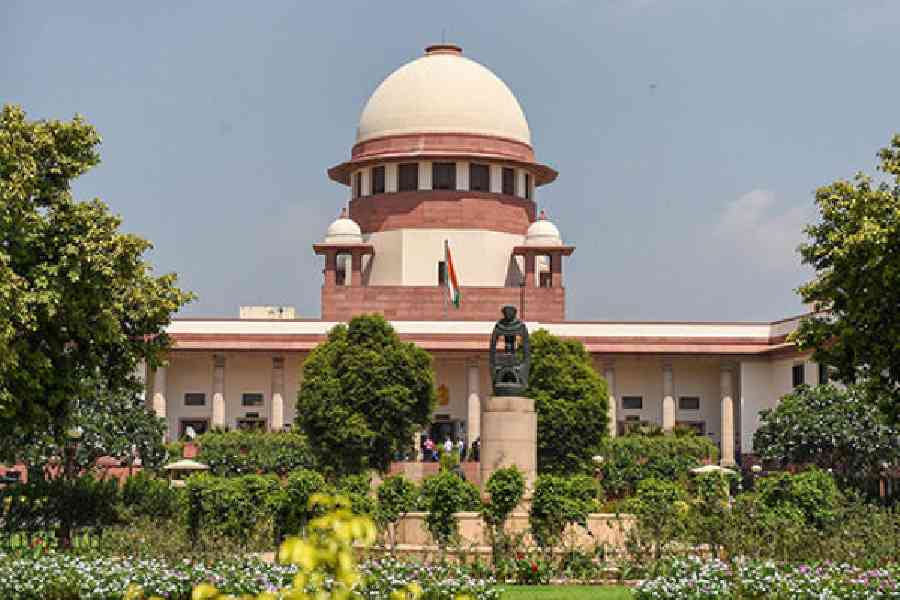
The Supreme Court on Friday agreed to hear a plea challenging several provisions of the Sustainable Harnessing and Advancement of Nuclear Energy for Transforming India (SHANTI) Act, 2025, saying the main dispute raised is between an actual, visible and tangible national interest versus an unfortunate hypothetical loss.
A bench of Chief Justice Surya Kant and Justice Joymalya Bagchi termed the matter as "extremely sensitive issue" requiring detailed hearing and asked the petitioners to submit comparative regulatory mechanisms of other countries, when the matter will be heard post Holi vacation.
Advocate Prashant Bhushan, appearing for a group of petitioners including professors, scientists led by former bureaucrat EAS Sarma, submitted that the Act of 2025, violates fundamental rights under Article 14, 19 and 21 of the Constitution.
He along with advocate Neha Rathi submitted that the Act which replaced Civil Liability for Nuclear Liability Act of 2010 permits private companies to set up civil nuclear power plants but exempts them from liability beyond Rs 3000 crore while in case of nuclear accidents, the loss is more than ten lakhs crore as was the case of Chernobyl nuclear power plant accident of 1986 and Fukushima nuclear power plant accident of 2011 in Japan.
Bhushan said the Act goes against the absolute liability principle for hazardous industries laid down by the Supreme Court in the Oleum gas leak case in 1987.
The CJI said, "The real dispute was between an actual, visible and tangible national interest versus an unfortunate hypothetical loss." He further said that India lacks enough energy resources and a balance needs to be struck between the development and adequate safeguard which needs to be provided for these industries.
CJI Kant said, "We don't allow Coal based power plants, forests we cannot compromise, gas we do not have. Where are we going?" Bhushan suggested that the answer is solar energy as the cost of producing nuclear energy is four times the cost of producing solar energy.
Justice Bagchi said that for solar energy, the country needs lithium for which India will have to rely on China.
Bhushan replied that unfortunately, a notion has gone in this country that the production of electricity in this country is very low.
The CJI said the problem was that many states have now started giving power subsidies which is affecting the interest of private companies.
The top court said though the issue requires detailed hearing, it would like to go through case details.
The petition filed through Bhushan sought enforcement of fundamental rights prayed for setting aside certain provisions of the SHANTI) Act, 2025, in so far as these are in violation of Articles 14, 19 and 21 of the Constitution as well as in violation of the doctrine of absolute liability, polluter pays principle, the doctrine of public trust, principles of inter-generational equity, sustainable development...which have been held by this court to be an intrinsic part of right to life guaranteed under Article 21 of the Constitution.
"The SHANTI Act, 2025 brought into force recently, while allowing private sector and foreign companies to operate nuclear power plants in India has also capped the liability of these operators at an absurdly low level and exempted the supplier from any liability," it said.
The plea further said the repealed Civil Liability for Nuclear Damage Act, 2010 expressly provided for operator's right of recourse against the supplier.
"That section 13 of the Act further caps the government's residual liability at 300 million special drawing rights - a figure that is abysmally low and effectively ensures that victims of death, injury, or property damage cannot recover even a small fraction of their actual losses," it said.
The PIL said instances like the Chernobyl nuclear disaster that occurred in the erstwhile Soviet Union led to enormous damage to life and property.
"That the loss caused due to Chernobyl disaster is estimated between USD 235 billion to USD 700 billion, moreover area of more than 4000 square kilometres was designated as the Chernobyl Exclusion Zone, rendering the entire region unfit for use for decades to come, forcing lakhs of people to relocate," it said.
It also sighted the example of the Fukushima Daiichi Nuclear Power Plant accident that occurred in Japan in 2011 and caused enormous socio-economic impacts on lives and livelihood.
"In contrast to this, SHANTI Act, 2025 caps the liability of the largest plant operator in India at a mere Rs. 3000 crores (i.e., approximately 331 million USD amounting to less than 0.1% of the cost of damage caused by the accidents at Chernobyl or Fukushima).
"That exemption of suppliers from any liability in the SHANTI Act is bound to encourage manufacturers and suppliers to cut corners in safety so as to maximise their profits and hence risks jeopardizing the lives and livelihood of people. That this is even more serious since operators under the SHANTI Act, 2025 can now be profit-driven private and foreign companies," it said.
Except for the headline, this story has not been edited by The Telegraph Online staff and has been published from a syndicated feed.