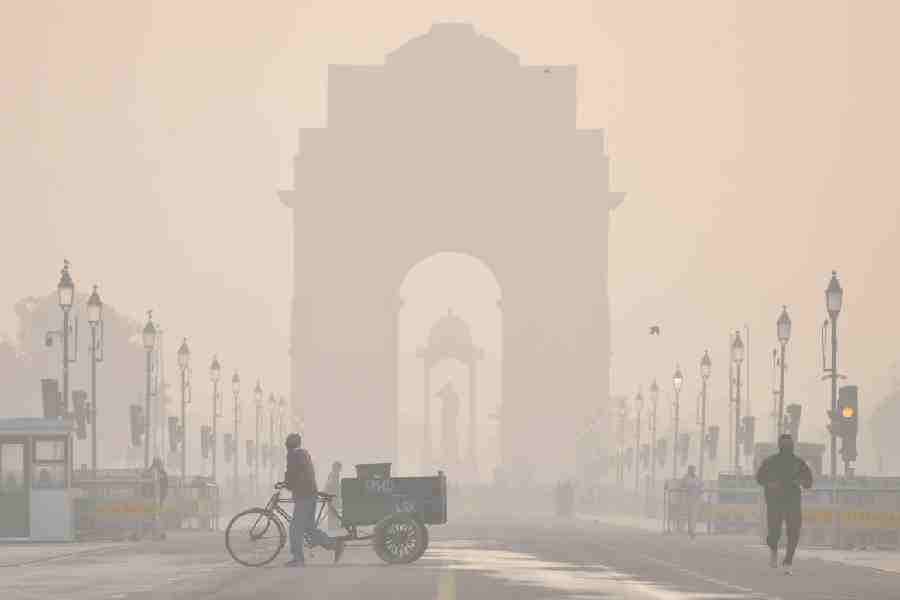
The Supreme Court on Wednesday directed the Centre, the Delhi government and other stakeholders to submit within four weeks their action plan on the central pollution watchdog's recommendations for long-term measures to improve the worsening Air Quality Index (AQI) in Delhi-NCR.
A three-judge bench comprising Chief Justice of India Surya Kant and justices Joymalya Bagchi and Vipul M Pancholi took note of a status report filed by Additional Solicitor General Aishwarya Bhati, appearing for the Commission for Air Quality Management (CAQM).
"The CAQM has recommended 15 long-term measures. CAQM has also identified the concerned agencies who are the competent ones to give effect to these long-term measures."
"While in addition to the aforesaid measures by the CAQM, there might be some additional long-term measures required to be adopted. There can be no doubt that these long-term measures recommended by CAQM are required to be given effect with no delay. We therefore call upon the stakeholders to submit their respective action taken plan to give effect to these measures. This court is not inclined to entertain any objections with respect to these measures," said the bench.
Delhi’s top pollution body has said that vehicular emissions remain the most prominent source of air pollution in the national capital region.
The Commission for Air Quality Management made the observation in a report submitted to the Supreme Court on Monday.
According to the CAQM report, the transport sector is one of the largest sources of primary emissions causing winter pollution in Delhi-NCR. This is closely followed by biomass burning, and dust.
Secondary particulate matter, transformed from emissions from other sources, also contribute significantly to winter pollution in Delhi NCR.
Transport includes off- and on-road vehicles – powered by petrol, diesel, and CNG. Even though older vehicles are being phased out, the transport sector, particularly diesel vehicles, continues to be a major source of particulate matter and nitrogen and sulphur oxides.
Traffic snarls are also a big contributor to Delhi NCR’s pollution problem, CAQM report noted.
Observing that the central pollution watchdog is "failing in its duty", the apex court on January 6 had rapped the authority for seeking a two-month adjournment on the issue of temporary closure or relocation of toll plazas at Delhi borders to ease traffic congestion.
It had criticised the CAQM for lack of "seriousness" in its approach and said it appears to be in no hurry to either identify the causes of the worsening AQI in Delhi-NCR or long-term solutions.
During the December 17 hearing, the court described the pollution crisis as an "annual feature" and called for pragmatic and practical solutions to tackle the menace.
It modified its own interim order of August 12 and permitted the authorities to take coercive action against older vehicles that do not meet Bharat Stage-IV (BS-IV) emission standards.