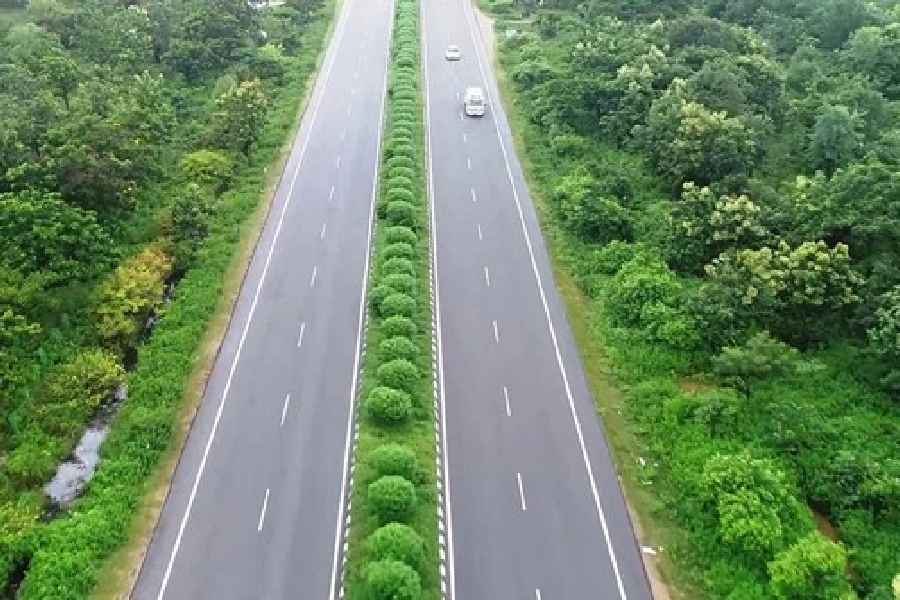
The Supreme Court on Thursday told the National Highway Authority of India (NHAI) to consider asking concessionaires involved in construction of roads to set up a gaushala (cowshed) under CSR responsibility to take care of stray animals entering the highways.
A bench of justices Vikram Nath, Sandeep Mehta and NV Anjaria which reserved its verdict on a batch of petitions seeking modification of the November 7 order of the top court on relocation and sterilisation of stray dogs expressed its unhappiness over the efforts of Punjab, Rajasthan, Uttar Pradesh and Tamil Nadu in complying with its direction.
The top court said the efforts of the Punjab government in sterilising 100 stray dogs a day was inadequate and said it is "needle in a haystack".
The bench asked the counsel appearing for NHAI to also develop an app where people can report sightings of stray animals on the national highways.
"You can also ask the concessionaires to setup a gaushala after say 50 km where these stray animals can be taken care of under the corporate social responsibility," the bench told the counsel.
The counsel agreed to look into the possibility of developing the app and asking the concessionaire to set up gaushalas.
The NHAI counsel pointed that there were over 1300 vulnerable locations on the National Highways and the authority is dealing with it to avoid any road mishaps.
He said that most of the states have taken steps in removing stray cattle from the highways but still few like Maharashtra, Jharkhand, Rajasthan are yet to come forward to deal with the issue.
Dealing with the compliance of its earlier directions, the top court was told by Additional Solicitor General Aishwarya Bhati, appearing for Rajasthan that sterilisation centres and fencing of education institutional areas have been done in the state.
The bench pointed out that as per the affidavit of the state government only 45 vans are there for catching stray dogs and said it was insufficient.
"Around 20 vans will be required for Jaipur alone. You need to ramp up the facilities and increase the number of vehicles for different cities. The arguments have been made that the CSVR (Capture, Sterilise, Vaccinate and Release) formula under the ABC rules has to be implemented. Unless there are more vehicles and manpower, how will you manage that," Justice Mehta asked.
Bhati said, "We have sought more budgetary allocations to deal with the issue." The bench said, "If you don't tackle this problem today it will keep on magnifying. Every year the population of stray dogs will go up by 10-15 per cent. You are increasing your own problems by avoiding this. As Punjab said, they are doing sterilisation for 100 dogs a day. This is no use. It is a needle in a haystack." The counsel for the Animal Welfare Board of India (AWBI) informed the bench that after November 7, last year, order of the apex court there was surge in applications from NGOs and private parties for opening of sterilisation centres and animal shelters.
"There are certain pending applications. There are more than 250 applications filed after the November 7 order...They have not yet been given recognition by us," the counsel said.
She pointed out inaccuracies in data reported by many state governments on sterilisation of stray dogs and said that in one State the dog population is less while the data for sterilisation is more.
Justice Nath while asking the parties to file their written submissions as early as possible asked the AWBI, "Our only request to the AWBI is whatever applications are pending, you should process them expeditiously. Either you accept it or reject them but take a decision." At the outset, senior advocate Gaurav Agarwal who has been appointed as amicus curiae summarised the steps taken by states like Punjab, Tamil Nadu, Uttar Pradesh and Rajasthan in complying with the orders and pointed out the deficiencies.
On Wednesday, the top court flagged its concern over state governments not complying with its directions to enhance their stray dogs sterilisation capacity, saying, "They are all building castles in the air." The top court was hearing several petitions seeking modification of its November 7, 2025, order directing authorities to remove stray animals from the institutional areas and roads.
On January 13, the top court said it would ask states to pay a "heavy compensation" for dog bite incidents and hold dog feeders accountable for such cases.
The court also flagged concerns over the non-implementation of norms on stray animals for the last five years.
Taking note of the "alarming rise" in dog-bite incidents within institutional areas such as educational institutions, hospitals and railway stations, the apex court on November 7 directed relocation of stray canines forthwith to designated shelters after due sterilisation and vaccination.
It had also said stray dogs picked up shall not be released back to their original place. The court had directed authorities to ensure the removal of all cattle and other stray animals from the state highways, national highways and expressways.
The top court is hearing a suo motu case, initiated on July 28 last year, over a media report on stray dog bites leading to rabies, particularly among children, in the national capital.
Except for the headline, this story has not been edited by The Telegraph Online staff and has been published from a syndicated feed.