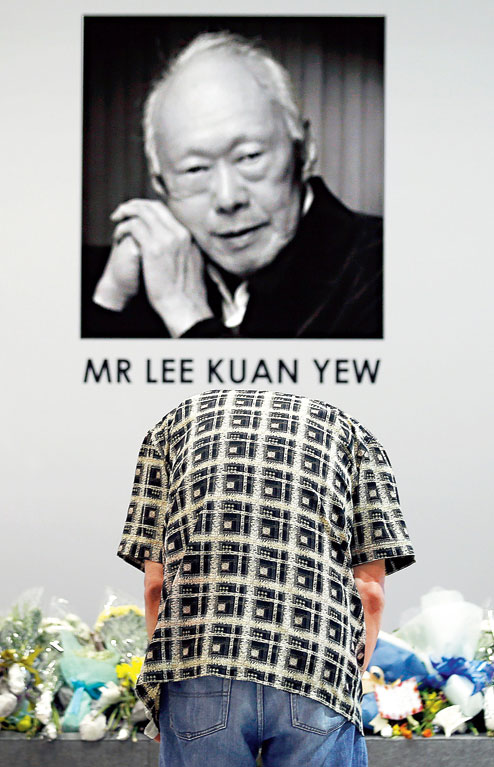

at a community club in Singapore on Monday. (AP)
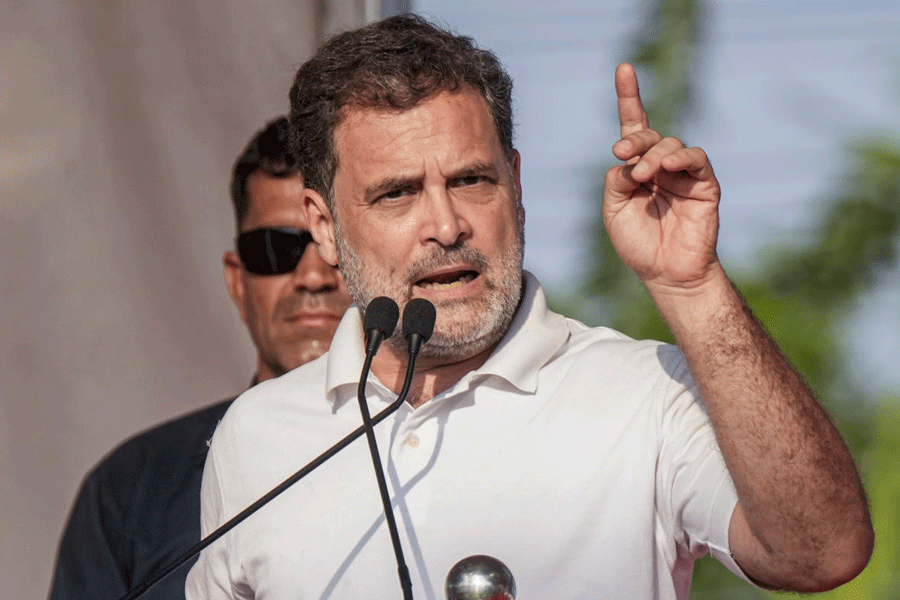
For those Indians who have followed Lee Kuan Yew's remarkable legacy, it offers an eerie contrast between how he successfully steered his country's generational transition and India's own politics which is once again at the crossroads with Rahul Gandhi's sabbatical and his mother Sonia Gandhi returning to the centre-stage in public life.
Lee died early morning on Monday at the age of 91 after more than a month in hospital for treatment of severe pneumonia.
Like Rahul, it was known since Lee's son and current Prime Minister Lee Hsien Loong entered parliament in 1984 that he was the heir-apparent to the father of modern Singapore.
But there ends the similarity.
It was the elder Lee's resolve that the son would be on the shop floor of statecraft and work his way up the ranks.
Lee's perspicacity, which has made Singapore an Asian showcase, is that he could have made his son his successor any time he wanted. But the son first served in the Singapore Army for more than a decade.
After he became a Member of Parliament, it took 20 long years in several challenging jobs and strict mentoring under Singapore's second Prime Minister Goh Chok Tong before Lee Hsien Loong became head of the government.
It should not come as a surprise to those who are familiar with Singapore's ethnic mix that the elder Lee's writings and speeches on India are voluminous enough to fill a whole section of any library.
That the city state's "Little India" is no longer little and its Indian community is not merely a token cultural or symbolic presence like the location's well-preserved Sri Veeramakaliamman Temple is a lasting tribute to Lee's skills in demographic social engineering.
India's misses and near-misses with greatness in the 1970s and 1980s, the tragedy of this country always performing economically way below its potential, troubled Lee. It was a recurring theme in Lee's public pronouncements in those years. It was almost as if he took the often sorry state of affairs in India to heart.
When China began its "real" great leap forward under Deng Xiaoping - as opposed to Mao Zedong's ideological leap by the same name which was a tragedy of immense proportions - it was Singapore's worst kept secret that Lee and some members of his close circle, all from his old school, the Raffles Institution, had advised Deng on how China could fulfil its destiny.
Perhaps Singapore was too small a canvas for Lee to unleash his full creative energy. Maybe China put in his visionary hands such a once-in-a-lifetime opportunity. It is tem-pting to think where India would have been if Lee had occasion to similarly advise Rajiv Gandhi, like he did Deng, and the latter had the wisdom to heed such sage advice.
The last time I met Lee, such an idea was in fact put to him, differently phrased, of course, by an IAS officer who was still young and whose idealism had clearly not yet given way to the cynicism of today's babu mould.
Lee's modesty swept everyone present at that meeting off their feet. He said he had no magic wand which could be used to replicate the Singapore story. He spoke candidly of how he cried when Singapore was unilaterally expelled from Malaysia in 1965. The city-state had little land, no water or natural resources and its different races were threatening to prey on each other in a cycle of death.
But on rare occasions, circumstances combine with people to produce results that are magical. The evolution of Singapore was one such. Lee told us that he was not sure if he could produce the same outcome if his city-state was given to him once again in the same condition that he inherited it as a republic on August 9, 1965.
There was no question, therefore, of him making a Singapore out of India or even a slice of India, he admitted with great humility. He then went on to identify some elements that made Singapore what it is today. Meritocracy, absence of corruption, integrity, a young population, English as a "neutral platform" among the different linguistic groups....
Lee did not say it in so many words, but the implication was that India did not have any of these qualities, at least not enough to realise this country's full potential at that time.
A strong streak of pragmatism was dominant in Lee's personality throughout. More than one biographer has recounted the World War II story of how Lee was rounded up by Japanese occupation forces along with several Chinese men. He asked for permission to go to his house nearby and fetch a change of clothes.
The Japanese agreed and Lee never returned. All the men who were rounded up that day were taken to a nearby beach and shot in cold blood. The incident is remembered in Singapore as the Sook Ching massacre.
A don in Fitzwilliam College in Cambridge, Lee's alma mater, told me long ago that when the time came to send Lee Hsien Loong to England to study, the senior Lee consulted some of his old tutors. One of them asked whether the Prime Minister had any preference for a particular Cambridge college.
"Suggest me one from where he will come back to Singapore after getting his degree," was the reply.
Lee has often been assailed for being authoritarian and for depriving his countrymen of democracy as it is understood in the "free world". Lee was practical enough to realise that even the prospect of future prime ministership was not good enough to persuade a bright young man to live in a society unless it appealed to him if there was a better choice elsewhere.
It was the same streak of pragmatism which persuaded him - once Singapore acquired prosperity - that corruption in government can only be ended by paying government servants more salary and benefits than what the private sector could afford. It was a unique experiment that has worked.
The same streak of pragmatism transformed Lee in his later years into an enthusiast for India's economic reforms and its place in the Asian century.
Lee had a conversation with former US ambassador to India, Robert Blackwill, and two Harvard academics from the Belfer Center for Science and International Affairs a few days before he was hospitalised in February 2013 for a cardiac problem which hindered blood flow to the brain.
Lee told them: "India is a nation of unfulfilled greatness. Its potential has lain fallow, underused. Whatever the political leadership may want to do, it must go through a very complex system at the Centre, and then even a more complex system in the various states."
Prophetic words, especially this month when the fate of the land acquisition legislation finely hangs in the balance.
He added: "The average Indian civil servant still sees himself primarily as a regulator and not as a facilitator. The average Indian bureaucrat has not yet accepted that it is not a sin to make profits and become rich." The entire conversation has been published as a book: Lee Kuan Yew: The Grand Master's Insights on China, the United States, and the World.
"India's private sector is superior to China's.... India has a stronger banking system and capital markets. India has stronger institutions - in particular, a well-developed legal system. India with an average age of 26, compared to China's 33... will enjoy a bigger demographic dividend, but it will have to educate its people better, or else, the opportunity will turn into a burden."