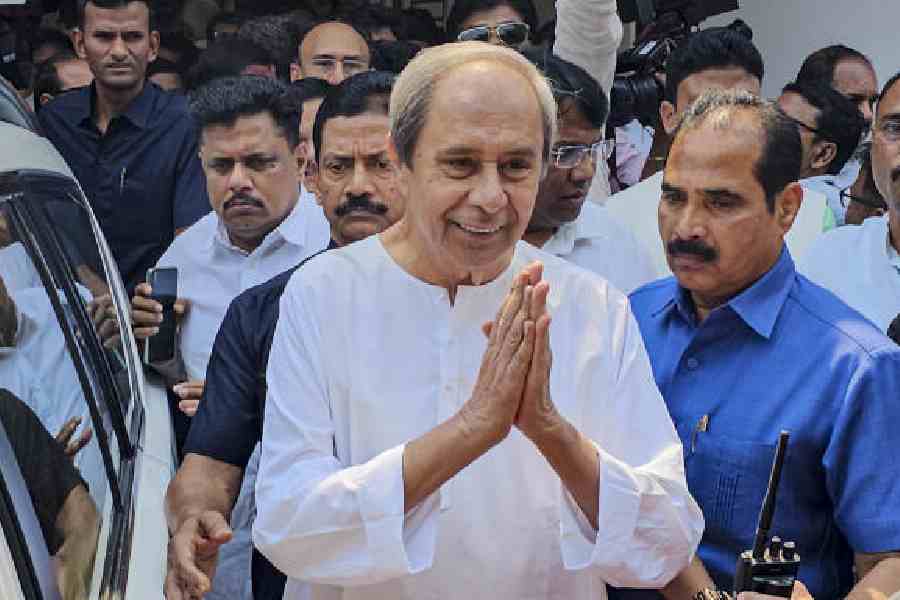
As the polling date for the Rajya Sabha elections draws near, former chief minister and Biju Janata Dal (BJD) president Naveen Patnaik faces what is arguably the biggest political test of his career.
The question dominating political circles is whether Naveen can keep his flock together amid a renewed threat following the entry of his friend-turned-foe, former Union minister Dilip Ray, into the fray. With Ray throwing his hat into the ring, the contest for the fourth seat has taken an intriguing turn. In the 2002 Rajya Sabha election, Ray had managed to orchestrate cross-voting within the BJD and won as an Independent.
“At that time Naveen was in power and still could not keep his flock intact. Much has changed in the last 24 years. New political equations have emerged. Now, Naveen is the leader of Opposition and dissent within his party is growing. Keeping his MLAs united and ensuring they vote for the BJD-Congress-backed candidate Dr Datteswar Hota will be the toughest challenge for him,” said senior political observer and vernacular editor Birupakshya Tripathy.
While the BJP and the BJD remain confident of securing two and one seats respectively based on their first-preference votes, the battle for the fourth seat remains crucial. On paper, the BJP — with 79 MLAs in the 147-member Assembly and the support of three Independents — can easily ensure victories for two candidates, as each seat requires 30 first-preference votes. After allocating votes to its official nominees Manmohan Samal and Sujeet Kumar, the BJP will still have 22 first-preference votes, which Ray can rely on completely.
Similarly, the BJD, with an effective strength of 48 MLAs after suspending Arvind Mohapatra and Sanatan Mahakud, can comfortably secure the victory of its first candidate, Santrupt Misra. After doing so, it will be left with 18 first-preference votes, which are expected to go to its common candidate, Dr Hota. With the Congress and its 14 MLAs extending support, the numbers seemingly favour the urologist.
“But the million-dollar question is whether all of the BJD’s first-preference votes will actually go to Dr Hota, and whether Congress MLAs will vote exactly as promised. In politics, two plus two does not always equal four. That is why so many possibilities are being debated,” said political analyst Girija Shankar Das.
Das added: “Ray, with tremendous resources at his command, has expressed confidence about Opposition MLAs exercising their ‘conscience’ — a veiled hint at cross-voting. In politics, conscience rarely plays any role.”
Other analysts also point out that Ray, a master strategist who won the 2002 Rajya Sabha election through cross-voting, is likely to tap into unrest within both the BJD and the Congress. “Earlier, Rajya Sabha polls involved a secret ballot. Now voting is open. Ray would have to persuade MLAs to take a significant risk by voting for him despite certain punitive action from their party leadership,” another observer said.
They also note that Ray is acutely aware of the churn within the BJD, which recently suspended two MLAs and expelled former legislator Pravat Biswal. Young MLAs, such as Cuttack–Choudwar legislator Souvic Biswal, are believed to be unhappy over the action taken against his father for opposing Santrupt Misra’s candidature.
Such discontent could ultimately benefit Ray. Thus, the outward impression that the BJD’s two candidates will sail through masks deeper political tensions and challenges for Naveen. With the BJP determined to exploit internal fractures, the battle for the fourth seat becomes a test of Naveen Patnaik’s ability to hold his party together — something that may decide the BJD’s future course.