|
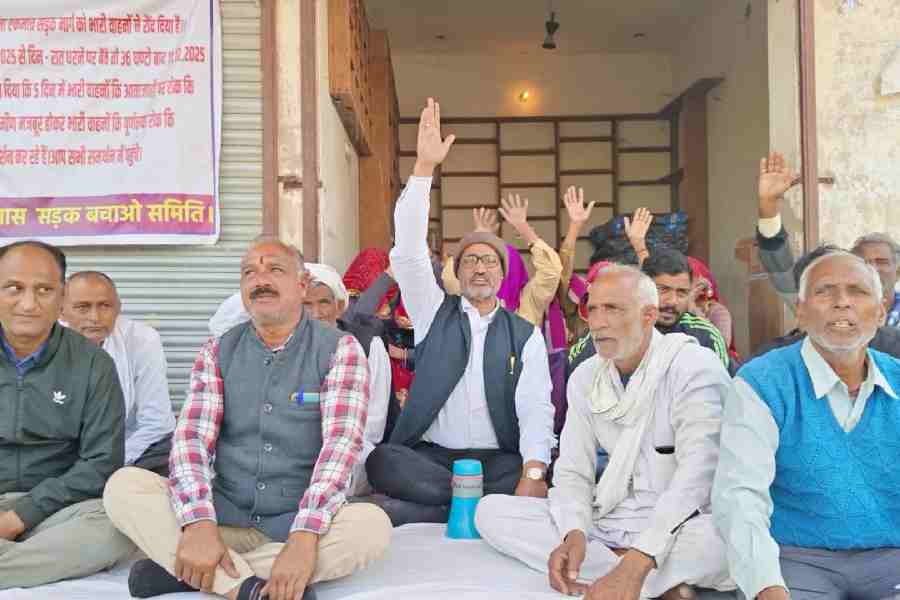
| Yamuna Giri, A German residing in India, at the book fair. Picture by Aranya Sen |
New Delhi, Oct. 8: Some of the books being showcased in Frankfurt — the venue of the celebrated book fair which is honouring India this year — are on palm leaf.
Or on birch-bark, copper plate and cloth.
On the sidelines of the annual fair, India’s National Mission for Manuscripts has put up its own exhibition — of material that goes far back than what is on display at the main event.
The exhibition — The Word is Sacred; Sacred is the Word — is running at Frankfurt’s Museum of Applied Art. Art historian B.N. Goswami is the exhibition curator, which the mission says is the first exhibition of this “width and depth” on Indian manuscripts to be organised abroad.
Over 90 pieces from 15 locations, including private collections, have been brought to Germany. They are meant to be representative of the country’s manuscript traditions — from palm leaf to paper and from veterinary stuff on elephants to legendary romances.
They range from scripts from the 2nd century BC Brahmi and the 15th century Meitei to the current Devanagari. Visitors will find manuscripts that are plain to look at and those that are richly illustrated.
According to a note released here by the culture ministry, there is a manuscript of Gita Govinda shaped like a garland and Yantras written in an accordion-shaped manuscript.
The exhibition includes instruments used in different regions to prepare manuscripts and in learning how to write.
A section — From Clay to Copper — showcases manuscript material like terracotta, copper plates, bamboo leaves, palm leaves and brass. Another segment — The Making of a Manuscript — shows instruments like inkpots, styli (an ancient writing instrument for use on papyrus), qalamdaans and manuscript stands.
Fields of learning highlight content, and include such texts as Rigveda Padapatha, Nrityaranganavikarnam, Gajayurveda and Ganitaprahelika. There is a section which focuses on traditions that use illustrations and features illustrated texts such as Kalpasutra, the Balakanda of the Ramayana in Mysore style, Rasamanjari and the Diwan-i-Hafiz.
Also on display are Mughal farmans, other documents written for administrative reasons and specimens of calligraphy.
The exhibition will be on till January, long after the book fair ends.