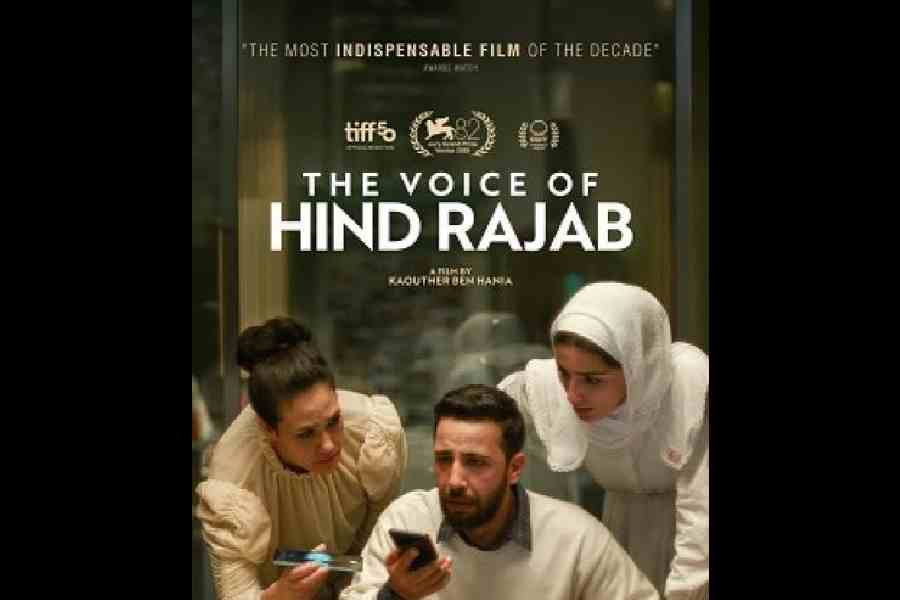
Eight INDIA bloc MPs have written to information and broadcasting minister Ashwini Vaishnaw questioning the denial of certification to the Oscar-nominated film The Voice of Hind Rajab, based on the story of a five-year-old Palestinian girl killed by Israeli forces in 2024.
Rajab was fleeing Gaza City in January 2024 with her family when their car came under fire from Israeli forces. Besides Rajab, six of her relatives and two paramedics who came to rescue them were killed. Although the Israeli government denied the presence of its troops in the firing range of the car, multiple investigations by global news outlets and NGOs have indicated repeated shelling of the car and an ambulance by battle tanks.
The film is based on the long phone call that Rajab was on with Red Crescent before she was killed. Earlier this month, US magazine Variety quoted the film’s Indian distributor Manoj Nadawana as saying that the movie had been censored, and that he was told by a member of the Central Board of Film Certification that “if it gets released it would break up the India-Israel relationship”.
Congress’s Jairam Ramesh, the CPM’s John Brittas, Samajwadi Party’s Ram Gopal Yadav and Javed Ali Khan, RJD’s Manoj Kumar Jha, DMK’s Rajathi Salma, JMM’s Sarfaraz Ahmed and IUML’s Haris Beeran expressed “deep concern” over the reported denial of certification.
“Such an approach raises serious concerns as to whether considerations extraneous to the statutory framework governing film certification have influenced the decision-making process. The screening of a film is an exercise of artistic expression protected within the constitutional framework and cannot be made contingent upon perceived diplomatic relationships,” they wrote in the letter.
The MPs added: “The Cinematograph Act, 1952, envisages a transparent and reasoned certification process, where decisions affecting public exhibition of films are taken strictly on statutory grounds. Any departure from this due process... undermines institutional credibility and erodes public confidence in regulatory bodies entrusted with protecting creative freedom,” the letter added.
Demanding the film’s release, the MPs said: “Engagement with complex or uncomfortable subjects has never diminished the strength of our democracy... The present issue therefore transcends an individual film and touches upon India’s constitutional commitment to freedom of expression as well as the credibility of its regulatory institutions in the global cultural sphere.”