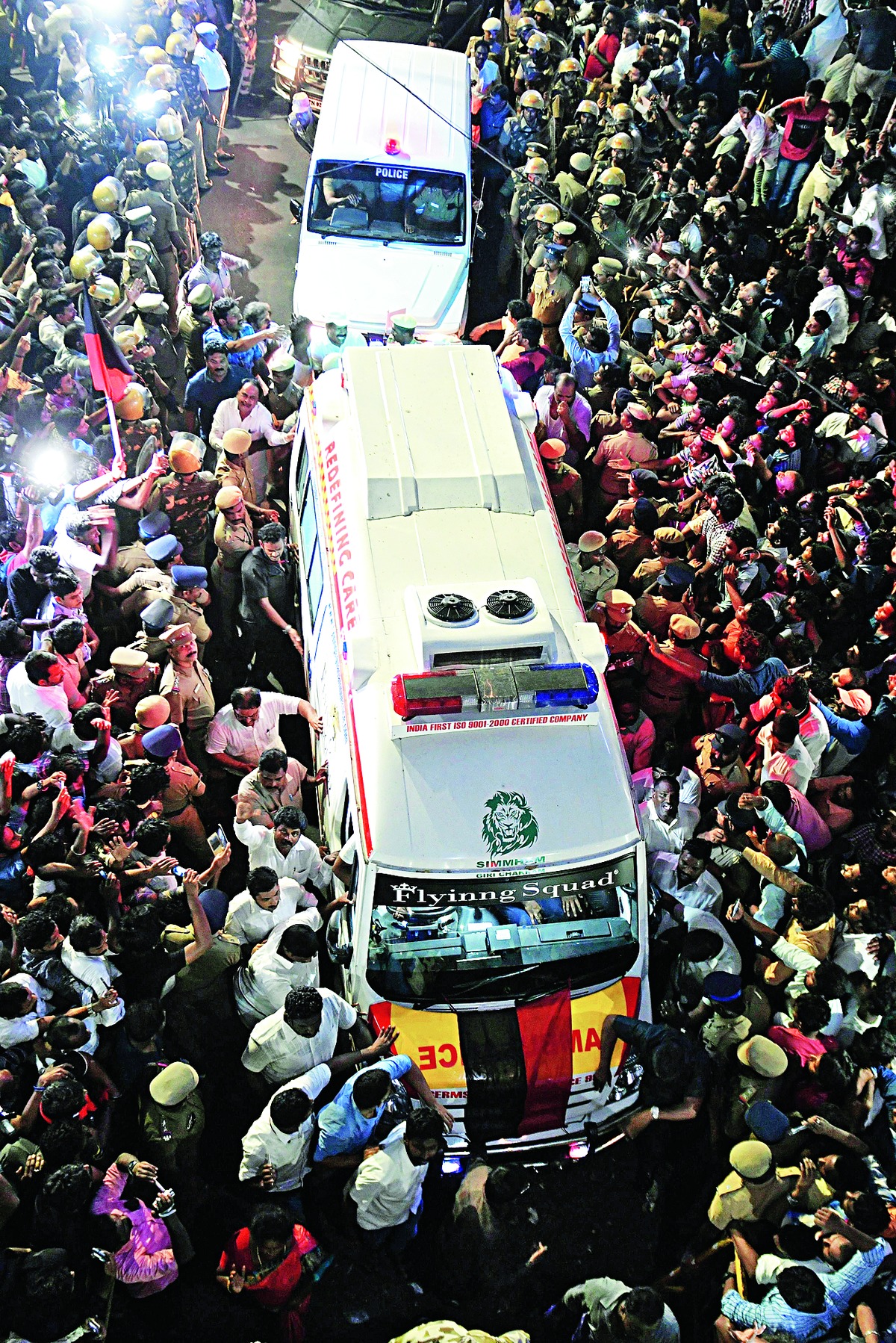

Chennai: The passing of Muthuvel Karunanidhi has snatched from Tamil Nadu the last of the five mass leaders who had held the state in thrall since the latter half of the 20th century.
Countless Tamilians were willing to lay down their lives for this political pentagram: C.N. Annadurai (1909-1969), K. Kamaraj (1903-1975), M.G. Ramachandran (1917-1987), J. Jayalalithaa (1948-2016) and Karunanidhi (1924-2018).
The life and times of some these political giants were so dramatic that they rivalled the larger-than-life themes for which Tamil films were known. But none was more poignant, if not heart-rending, than the relationship shared between MGR and Karunanidhi, the best friends who complemented each other as actor and scriptwriter on screen as well as off screen and eventually drifted apart as bitter foes.
While four of the stalwarts were at the helm of the state administration, Kamaraj contributed substantially at the national level also by being the "kingmaker" after the death of Jawaharlal Nehru.
Kamaraj, MGR and Karunanidhi were born poor and could not complete their school education. Jayalalithaa had a more affluent background and hence had excellent schooling. But she also could not pursue her studies beyond matriculation, thanks to celluloid calling and domestic pressures. It was only Annadurai who was a post-graduate.
But lack of formal education did not deter Karunanidhi from becoming one of the most celebrated wielders of the pen. Stepping into politics at the tender age of 14, he was a self-taught litterateur whose felicity of the language was phenomenal. He was an accomplished movie scriptwriter in the 1940s and has penned a number of books in Tamil, including Kuraloviyam and Nenjukku Needhi.
He was an orator par excellence and could speak on any topic. He was a politician who loved literature more than the loaves and fishes of office.
He is one among the very few politicians who never lost an election. After entering the Tamil Nadu Assembly in 1957 by bagging the Kulithalai seat, he continued winning election after election in the next six decades.
Although former governor general C. Rajagopalachari (Rajaji) was considered a Chanakya from Tamil Nadu, Karunanidhi's political sagacity was equally legendary.
After stitching together a mega-alliance in the company of several parties to defeat the Congress in the 1967 Assembly elections, he forged an alliance with Indira Gandhi in 1971 to snub Kamaraj (who was spearheading Congress-Organisation) and secured a landslide victory.
This is not to say that Karunanidhi steered clear of any blunder. The biggest probably was the expulsion of MGR from the DMK, although it was the matinee idol who helped Karunanidhi become chief minister after the premature death of Annadurai in 1969.
MGR, who floated the AIADMK to avenge his expulsion from his parent party, turned out to be a phenomenon beyond all expectations and he was virtually deified by the people of Tamil Nadu although he was a Malayali. As long as MGR was alive, Karunanidhi could not return to power.
Even after MGR's death, his legacy continued to haunt Karunanidhi. MGR's protégé Jayalalithaa became his life-long bête noire till her death in 2016.
The events that marked the rise of MGR, Karunanidhi and Jayalalithaa and the eventual separation of the two friends have few parallels anywhere in the world.
Such was the complexity that when Mani Ratnam made Iruvar (the Duo), which has some parallels with the lives of the Dravida politicians, the character played by Aishwarya Rai that launched her screen career, said to be partly inspired by Jayalalithaa though the film was portrayed as a work of fiction, had to die in a road accident. Prakash Raj, indisputably the most vocal voice in the film industry in India against the Narendra Modi government now, played the character loosely based on Karunanidhi.
Although Karunanidhi expelled his one-time protégé Vaiko also from the party in 1994 leading to one more split, this did not hurt the party too much.
The formation of the National Front in 1989 that helped V.P. Singh become Prime Minister could be considered a master stroke by Karunanidhi. He played a crucial role in the formation of both UPA-I and UPA-II. His death also took place at a time alliance-building skill is being seen as the make-or-wreck factor that will decide the outcome of the 2019 general election.
Karunanidhi was a chief minister who was dismissed twice -- once during the Emergency in 1976. The next time in 1991. But he rose like a phoenix from the ashes every time.
He was the chief minister of Tamil Nadu five times - 1969, 1971, 1989, 1996 and 2006 - and he was the president of the DMK for 50 years without break.
Although his party suffered grievously at the hands of Indira Gandhi, he joined hands with her whenever it suited him and thus helped Indira return to power again.
He had enjoyed a good rapport with Prime Minister Atal Bihari Vajpayee but he dumped the BJP in 2004 to join hands with the Congress and played a key role in building UPA-I as well as UPA-II.
Even his worst enemies would admit that Karunanidhi was a great administrator. Despite his poor education, he could understand each and every nuance of administration and respond to any emergency.
Being a disciple of the rationalist E.V.R. Periyar, Karunanidhi was the first chief minister to introduce 69 per cent reservation in the state. Born in an intermediate caste, he also supported the Mandal Commission Report.
This was followed by the "Samathuvapuram" project, which enabled various communities to live together in several villages all over the state. One among the most important legacies of Karunanidhi is " uzhavar sandhai' (shandy for farmers), which helped farmers eliminate middlemen and get remunerative prices.
Karunanidhi faced a number of charges, including that of corruption and nepotism. The Sarkaria Commission called his modus operandi "scientific corruption".
While the expulsion of MGR was perceived to have been intended at paving the way for his son M.K. Muthu into the celluloid world and also party hierarchy, the expulsion of Vaiko 20 years later was to clear the decks for his son M.K. Stalin to go up the party ladder. His stress on " kazhaga kudumbam" (party as family) was interpreted by his critics as his love for his own family as he tried to ensure plum posts for any number of his kith and kin, both in the party and the government.
Not only did he make his son Stalin the deputy chief minister of Tamil Nadu and later the acting president of the DMK, he made another son M.K. Alagiri, a Union minister, and ensured that his daughter Kanimozhi became an MP. His nephew Murasoli Maran became a Union minister and Maran's son Dayanidhi Maran took over as a Union minister after his father's demise.
His worst period of life was when the controversy over the 2G scam involving DMK minister A. Raja and later Kanimozhi broke and his daughter was in judicial custody.