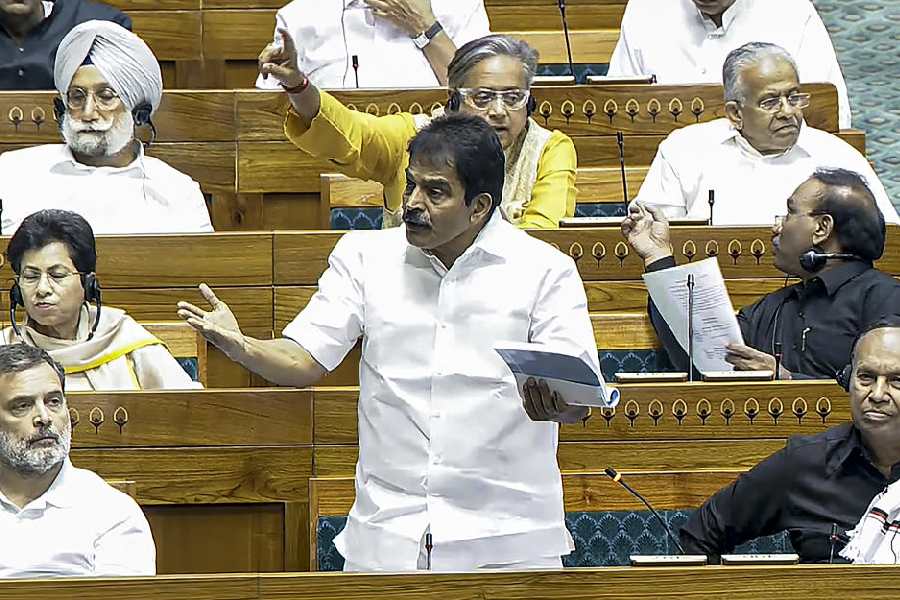
Congress on Thursday cited delimitation exercises in Jammu and Kashmir and Assam to argue that boundary redraws in both states helped the BJP expand its electoral base, and reshape constituency profiles, raising concerns over the delimitation bill in the Lok Sabha.
While Lok Sabha MP K.C. Venugopal and Gaurav Gogoi made the remarks during the House discussion on Thursday, claiming boundary redrawing in these states to argue that the process had shown political bias and uneven outcomes.
Venugopal claimed that the delimitation, which was "arbitrarily carried out" in Assam and Jammu and Kashmir, is being sought to be implemented across the country by the central government.
"In 2023, we supported the implementation of women's reservations from the 2024 general elections itself, but then the government did not accede to our demands. Now, they are using women's reservations to bring in a dangerous delimitation exercise to gerrymander the entire country as they did in J&K and Assam.
"A bill that strikes at the heart of our constitutionally guaranteed federal structure must be withdrawn," he said in his X post.
So what happened during the delimitation exercises in Jammu and Kashmir and Assam? Reports suggest constituency boundaries were redrawn, seat distribution altered and demographic balances reshaped, helping the BJP.
Jammu and Kashmir (2020–2022)
The delimitation exercise in Jammu and Kashmir followed the 2019 reorganisation of the erstwhile state into a Union Territory.
A Delimitation Commission was set up under the Delimitation Act, 2002 and the Jammu and Kashmir Reorganisation Act, 2019, headed by retired Supreme Court judge Ranjana Prakash Desai, with the Chief Election Commissioner and the J&K State Election Commissioner as members.
The Commission used the 2011 Census as base. It also factored in geography, terrain, remoteness and proximity to the Line of Control while redrawing constituencies.
Public hearings were held in Srinagar, Jammu and other locations, with participation from political parties, civil society groups and local delegations.
Districts were grouped into border-sensitive, hilly and remote, and plains categories. Constituencies were then redrawn to balance population while keeping administrative boundaries and connectivity in mind.
The new distribution assigned 43 seats to the Kashmir Valley and 47 to the Jammu region, which many observers saw as shifting relative weight toward Jammu compared with the earlier 46–37–4 split (Kashmir–Jammu–Ladakh).
The number of Assembly seats increased from 87 to 90. For the first time, seats were reserved for Scheduled Castes and Scheduled Tribes — 7 SC seats and 9 ST seats.
Lok Sabha constituencies were also adjusted, with each parliamentary seat now containing 18 Assembly segments. One new Lok Sabha constituency was created by linking parts of Anantnag with Rajouri and Poonch.
In Jammu and Kashmir, the delimitation structurally favoured the BJP by shifting the seat‑distribution toward the Jammu region, where the party’s core Hindu‑majority and “indigenous” base is concentrated.
In the 2024 Assembly elections, the BJP won five of the newly created Jammu‑region seats, raising its total tally from 25 in 2014 to 29, all from Jammu.
Though the BJP remained in opposition, the new map solidified its hold in Jammu and amplified its influence in the union‑territory’s politics.
Assam (2023)
The Assam delimitation was carried out by the Election Commission of India under the Representation of the People Act, 1950 and the Delimitation Act, 2002.
It followed a request from the Union law ministry and used 2001 Census data along with updated administrative boundaries as of 1 January 2023.
The Commission applied criteria such as population balance, contiguity, geography and administrative units. Public hearings were held in Guwahati, where political parties and local groups submitted views before the final order was notified.
Assam retained 126 Assembly seats and 14 Lok Sabha constituencies. The total strength did not change, but internal boundaries were redrawn.
Nineteen Assembly constituencies were renamed, and several others were adjusted to reflect population shifts.
In Assam, the redrawn boundaries and reservation pattern helped the BJP consolidate its base.
The exercise reduced the number of clearly Muslim‑majority constituencies by splitting dense minority pockets, while increasing the influence of Hindu‑majority, “indigenous,” and tribal‑category belts, including in border and Kamrup‑Metro districts, according to an analysis by The Quint.
BJP leaders have claimed that over 103 out of 126 Assembly seats now show a “stronger indigenous presence” after the delimitation, linking the new map to the party’s campaign on securing land and political space for indigenous Assamese‑speaking groups.
This realignment strengthened the BJP’s position in mixed‑caste and border districts ahead of the 2026 Assembly elections, even though the seat count itself remained unchanged.