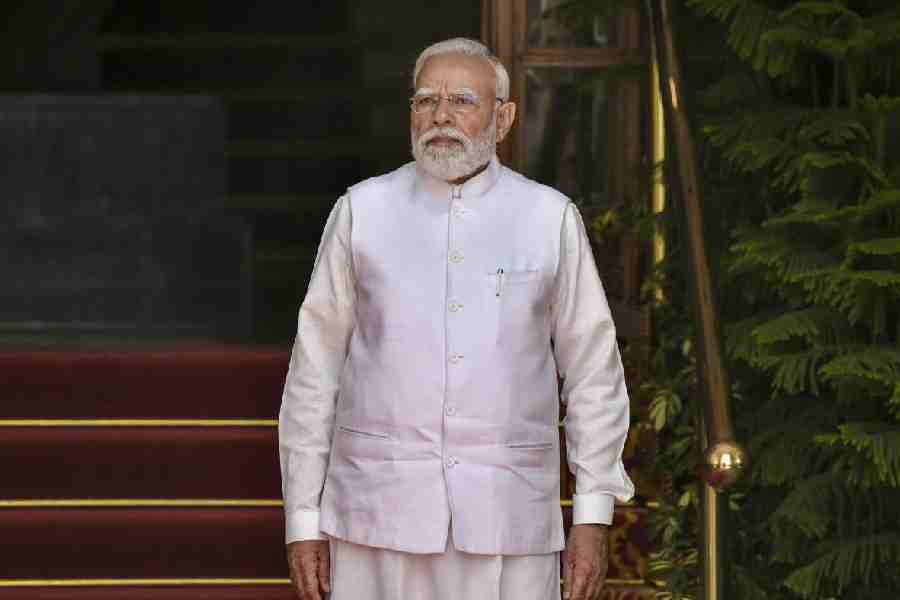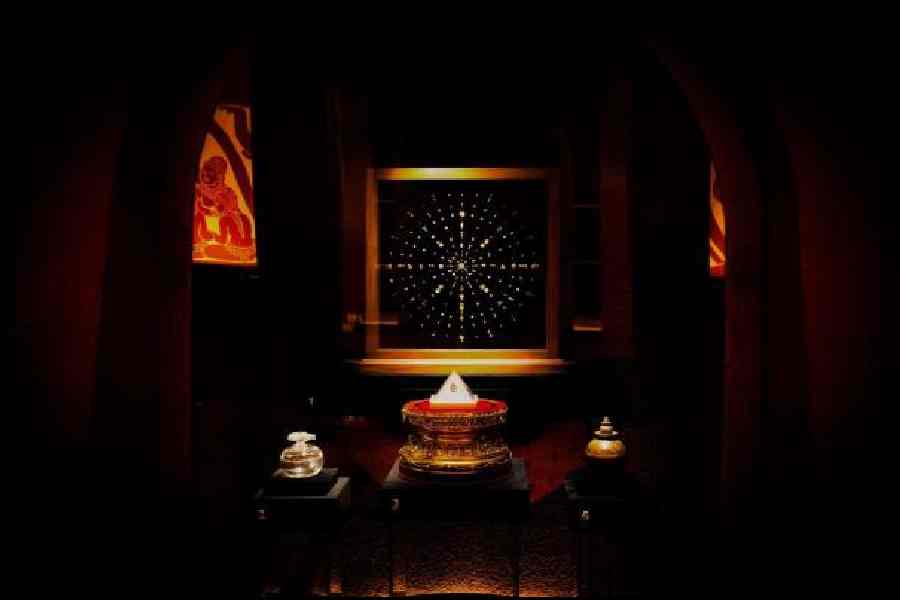
Prime Minister Narendra Modi on Saturday inaugurated the first exhibition in India of the Piprahwa funerary gems linked to the Buddha, which were acquired by the Godrej Industries from its British owners in July after the Centre stalled their auction by Sotheby’s Hong Kong.
“The lesson is that slavery is not only political and economic; slavery also destroys our heritage. The same thing happened with the sacred relics of Lord Buddha. They were taken from India during the period of colonial rule, and for nearly 125 years, they remained outside the country,” Modi said.
“For the descendants of those who took them from India, these were merely inanimate antique pieces. Therefore, they attempted to auction these sacred relics on the international market. But for India, these relics are a part of our revered deity, an integral part of our civilisation. Therefore, India decided that we would not allow their public auction,” he added.
Modi expressed his gratitude to the Godrej Group, which helped in the return of the relics “to the land of Lord Buddha’s work, his place of contemplation, his Mahabodhi land, and his Mahaparinirvana land”.
The Grand International Exposition — The Light and the Lotus: Relics of the Awakened One in South Delhi’s Rai Pithora Cultural Complex showcases 349 gems that were originally interred in a stupa in Uttar Pradesh’s Piprahwa.
The exhibits also include relics from the 1898 Kapilavastu excavation, the 1972 excavations, reliquaries and jewelled treasures from the Indian Museum, and the monolithic stone coffer in which the gems and reliquaries were originally found.
“The Piprahwa relics, comprising bone fragments of the historical Buddha, along with soapstone and crystal caskets, a sandstone coffer, and offerings such as gold ornaments and gemstones, were excavated in 1898 by William Claxton Peppé. An inscription in Brahmi script on one of the caskets confirms these as relics of the Buddha, deposited by the Sakya clan,” the culture ministry said.
“The majority of these relics were transferred to the Indian Museum, Calcutta, in 1899 and are classified as ‘AA’ antiquities under Indian law, prohibiting their removal or sale. A portion of the bone relics was gifted to the King of Siam, while a selection of funerary gems retained by W.C. Peppé’s great-grandson, Chris Peppé, was listed for auction,” it added.
The retrieval of these gems was the result of a three-month-long legal and diplomatic effort by India that began with stalling the auction at Sotheby’s in Hong Kong on May 7.
Since their return to India, they have been exhibited in Vietnam. Other relics of the Buddha from Piprahwa in the National Museum were also exhibited in Russia.
“In Vietnam, the public sentiment was so strong that the exhibition period had to be extended. In nine cities there, nearly 17.5 million people paid homage to the Buddha relics…. In the Kalmykia region of Russia, more than 1,50,000 devotees visited the sacred relics in just one week. This is more than half of the population there,” Modi said.
Stressing his personal attachment to Buddhism, Modi said he considered himself fortunate because Buddha had a “very deep place in my life”. “Vadnagar, where I was born, was a major centre of Buddhist learning. Sarnath, the land where Lord Buddha delivered his first sermon, is now my karmabhoomi (field of action in his constituency of Varanasi).” Listing the Buddhist temples he has visited, Modi said: “Wherever I went — China, Japan, Korea, Mongolia — I carried saplings of the Bodhi tree with me.”
A culture ministry official told The Telegraph that the exhibition was expected to continue till June.