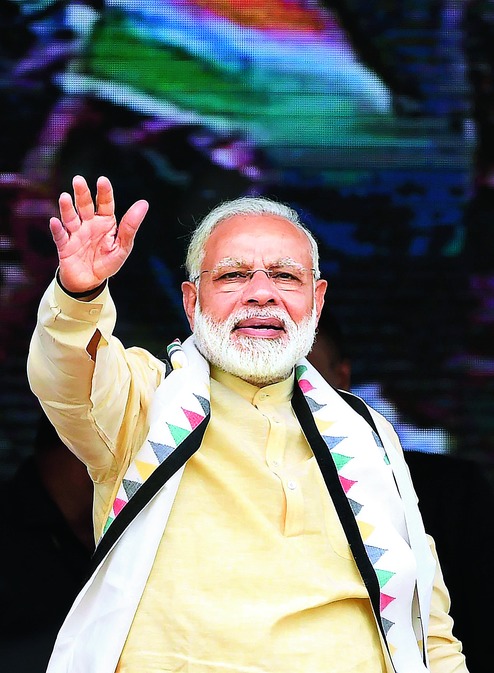

New Delhi, May 12: Prime Minister Narendra Modi used a Buddhist conference in Sri Lanka today to pitch India as an unselfish friend at a time neighbours and friends are queuing up for China's weekend summit where it will showcase its grand connectivity initiative as good for all.
Apart from many of India's neighbours, the US, Japan, South Korea, France, Germany, the UK and the European Union have confirmed that they will participate in the One Belt One Road (OBOR) conference Chinese President Xi Jinping is hosting on Sunday and Monday.
India views the OBOR - a network of highways, railway lines and ports connecting South East, East and South Asia with Central Asia, Africa and Europe - as a suspicious extension of China's efforts at regional and global hegemony. Till late this evening, India had not confirmed its participation, though Beijing had invited Modi for the summit.
The Modi government stepped up its demonstration of India as a reliable development partner that delivers on promises in the weeks leading up to the OBOR summit, including through the launch of a satellite aimed at helping six other South Asian nations. And Modi has gone beyond India's standard diplomatic practice by visiting Sri Lanka for the celebration of the Buddhist festival of Vesak, marking his second trip to the country in two years.
Today, Modi inaugurated a Rs 150-crore, India-built super-specialty hospital in Dickoya, a town in Sri Lanka's central highlands where he also addressed some of that country's Tamil minority. But a week after Modi held a televised video-conference with leaders of all South Asian countries other than Pakistan following the launch of the satellite, many of these nations are sending senior representatives to attend Xi's summit, worrying India.
"For us, the most relevant benchmark for the success of our friendship is your progress and success," Modi said in a morning address at the Buddhist meet in Colombo, attended also by Sri Lanka's President, before he went to Dickoya. "Today, India's development cooperation with Sri Lanka amounts to $2.6 billion. And its only aim is to support Sri Lanka in realising a peaceful, prosperous and secure future for its people."
India's concerns over the OBOR - Xi's signature foreign policy initiative - are rooted in a combination of the opacity surrounding China's plans with the project, and the deep pockets and delivery record that Beijing boasts and that New Delhi cannot match. The cumulative investments expected to go into OBOR projects over the coming years are estimated at between $4 trillion and $8 trillion. India, the world's seventh-largest economy, has a GDP of $2.3 trillion.
The current contours of the OBOR also include the China-Pakistan Economic Corridor (CPEC), which passes through Pakistan-occupied Kashmir (PoK). India has objected to this corridor, calling it a violation of its sovereignty. The CPEC alone costs $46 billion.
"Since they (China) are a country who have been very sensitive to sovereignty concerns, it was for them to say how a country whose sovereignty has been violated can come on an invitation," foreign secretary S. Jaishankar said in Beijing in February after strategic talks with Chinese leaders, during which they also iterated their invitation to India for the OBOR summit.
India has also tried to highlight how Beijing's infrastructure projects, built through loans to other countries, may end up leaving them with heavy debts to repay to China.
Its attempts at nudging at least its closest neighbours, like Sri Lanka, away from too tight an embrace with China appeared to convince Colombo into a juggling act.
China had requested Sri Lanka to allow one of its submarines to dock in Colombo this month, but the island nation turned down the request, Sri Lankan officials have said. In the past, India has protested the docking of Chinese ships and submarines in the ports of Sri Lanka, which New Delhi views as a part of its strategic area of influence.
But Sri Lanka Prime Minister Ranil Wickremesinghe is still scheduled to fly to Beijing for the OBOR conference.
Nepal's deputy Prime Minister Krishna Bahadur Mahara and Myanmar's de-facto leader Aung San Suu Kyi have confirmed their attendance, as has Pakistan Prime Minister Nawaz Sharif. Bangladesh, Afghanistan and the Maldives have confirmed participation - though the seniority of their representatives is unclear.
Pakistan, Bangladesh, Sri Lanka, Maldives and Nepal have all also confirmed their partnership with China under the OBOR.Some of China's biggest strategic rivals and India's closest friends - like the US and Japan - are participating in the summit. The US will be represented by Matt Pottinger, special assistant to President Donald Trump and senior director for Asia at the National Security Council, while Japan's delegation will be led by Toshihiro Nikai, secretary general of Prime Minister Shinzo Abe's party.
South Korea, where a new government in favour of talks with the North has just taken office, has also confirmed its participation - a former deputy speaker will represent the country.
The President of Vietnam, a country locked in a bitter maritime dispute with China, is participating too. The leaders of Uzbekistan, Mongolia, Laos and Cambodia are also joining the summit.
British Prime Minister Theresa May is sending the UK's chancellor of the exchequer Philip Hammond while German chancellor Angela Merkel is sending her economic affairs minister Brigitte Zypries.
The French delegation will be led by former Prime Minister Jean-Pierre Raffarin, while the EU will be represented by its Vice-President, Jyrki Katainen. The President of the Czech Republic and the Prime Minister of Poland have both already landed in Beijing.
From East Africa - a region Modi travelled to last year - the Prime Minister of Ethiopia and the President of Kenya will attend the summit. And from South America, the Presidents of Chile and Argentina will join the conference.