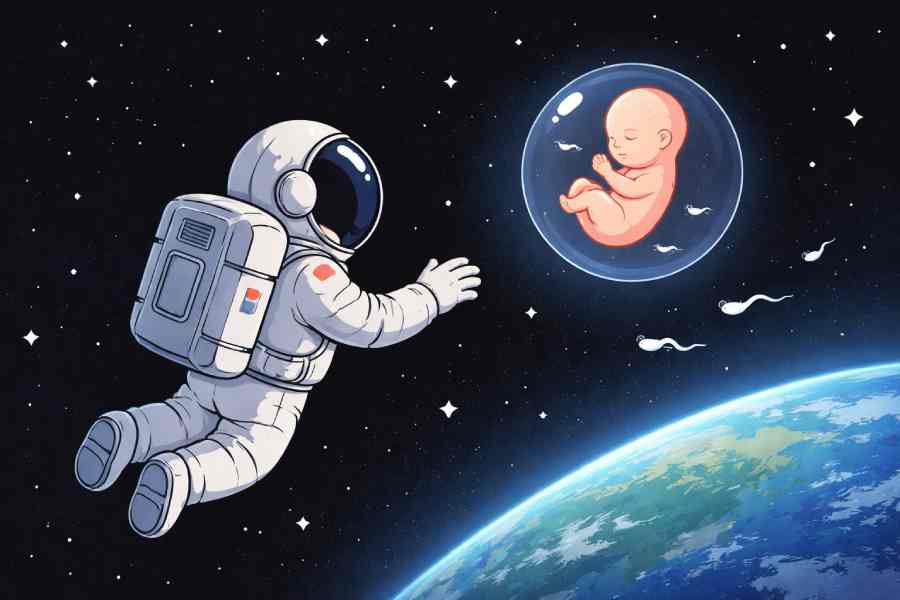
New research has cast doubt on the efficacy of human reproduction in the microgravity environments of space and other worlds.
Microgravity appears to negatively impact spermatozoa, egg fertilisation, and embryos in their earliest stages of development, researchers in Australia said on Thursday, announcing the results of lab experiments.
Their findings come at a pivotal time in space exploration as the idea of space settlements shifts from a hypothetical to an active pursuit, with Nasa's Artemis programme seeking to return to the moon and other efforts targeting crewed missions to Mars.
"Microgravity impairs sperm navigation and fertilisation rates," Nicole McPherson, a research fellow at Adelaide University in Australia, who led the study, told The Telegraph. "But we also found something unexpected: the sperm and embryos which did succeed under microgravity showed signs of being of higher quality, suggesting a kind of natural selection effect."
Most research until now that probed microgravity and reproduction had focused on whether sperm can move at all under weightlessness conditions, and even those studies had produced conflicting results.
"What had never been examined was whether sperm could actually navigate — that is, not just swim — but find their way through a confined space towards a destination, which is what they need to do in the female reproductive tract during natural conception," McPherson said.
McPherson and her colleagues introduced sperm samples from mice, pigs, and humans into a machine that simulated microgravity conditions experienced in space, and assessed their capacity for navigation and fertilisation.
Their study, published on Thursday in the journal Communications Biology, is the first to show that lack of gravity can reduce sperm's navigational ability.
The scientists also found that 30 per cent fewer mouse cells were successfully fertilised after four hours of exposure to microgravity, compared to similar experiments under standard Earth gravity. And fewer pig embryos reached the state of blastocysts — a critical stage in early embryonic development — after four hours of microgravity, compared to standard Earth gravity.
"What our findings tell us is that we cannot assume reproduction will simply function as normal in microgravity environments," McPherson said. "Microgravity appears to interfere with the processes so fundamental, and shaped by billions of years of evolution on Earth, that removing gravity from the equation has consequences we're only now beginning to map."
Nasa, the US space agency, announced earlier this month plans for new initiatives that would seek to build a moon base and establish an enduring human presence on the moon. And SpaceX, the private American aerospace company, envisions a permanent human presence on Mars.
"For any such endeavours to result in a truly self-sustaining (human) presence beyond Earth, reproduction has to work," McPherson said.
The Australian team also found that despite the negative impacts of the simulated microgravity, many embryos did form healthy blastocysts when fertilised.
"Taken together, our findings suggest that the picture is not uniformly negative — the relationship between microgravity and reproduction is not simply harmful, it is nuanced, timing-dependent, and more complex than appreciated," McPherson said.
"The effects we've observed suggest that establishing a reproductive future beyond Earth may require serious scientific investments, careful planning, and likely technological solutions either under development or not yet developed."