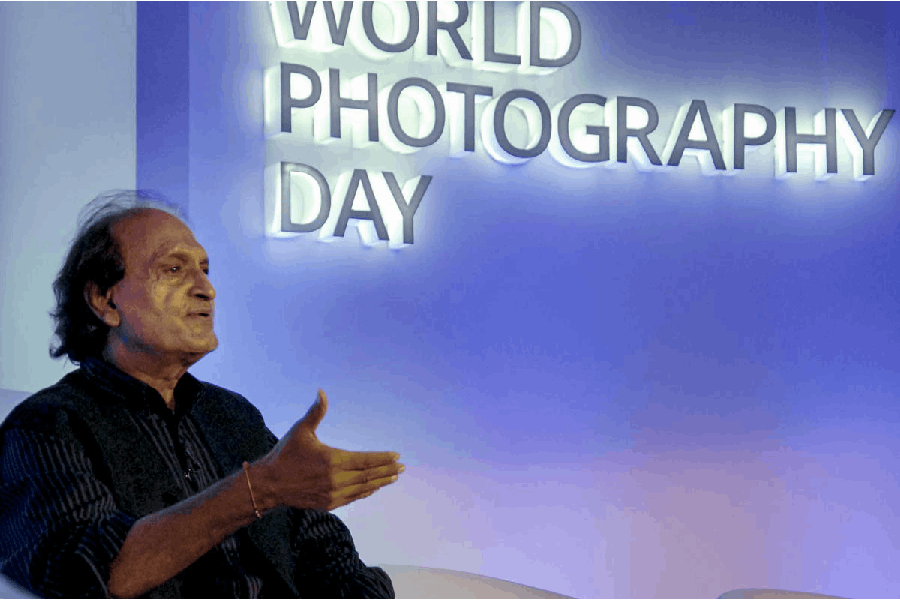
Raghu Rai, one of India's best known photographers who distilled the essence of an evolving India and its people through his lens, died at a private hospital here in the early hours of Sunday. He was 83.
"Dad was diagnosed with prostate cancer two years ago but he was cured. Then it spread to the stomach, that too was cured. Recently, the cancer spread to his brain and then there were age-related issues too," Nitin Rai, photographer and Rai's son, told PTI. He is survived by wife Gurmeet, son Nitin and daughters Lagan, Avani and Purvai.
Born on December 18, 1942, in Jhang, Punjab (now in Pakistan), Rai was qualified as a civil engineer and only took up photography at 23 before joining The Statesman newspaper as its chief photographer in 1966.
Life from that point onwards was anything but a blur. Over the next six decades, Rai's lens froze for posterity fleeting moments with unmatched clarity, documenting a growing India's socio-political landscape.
The prolific photographer, a protege of Henri Cartier-Bresson, shot some of the most significant events in Indian modern history, including the Bangladesh refugee crisis of 1972 and the Bhopal gas tragedy of 1984.
He recorded India's social, political and spiritual shades in his portraits of leading figures, including Indira Gandhi, the Dalai Lama, Mother Teresa, Satyajit Ray, Hariprasad Chaurasia and Bismillah Khan, which offered hitherto unknown perspectives into their lives.
More than what made news on a daily basis, Rai's camera caught the ordinary, the everyperson, with equal, if not more, sensibility and sensitivity. The mundane was made extraordinary, often in black and white, as if trying to soften the edges of life's ruggedness.
In a PTI interview in 2023, Rai said the best thing about capturing moments on camera is coming face-to-face with questions about life and its ever-changing nature.
"It's been more than 55 years but the most powerful part about photography is — life and nature are ever changing and ever challenging and that shakes you up," the veteran photographer had told PTI.
His pictures live on, seared into India's collective memory. One of the most haunting images that came out of the Bhopal disaster is that of an infant, eyes open forever in a cold dark gaze, as a hand caresses the child into an eternal slumber.
Another picture, among his most telling perhaps, shows a pensive group of Congress ministers, all male, standing huddled around Indira Gandhi as she sits at her desk. The photo is simply captioned: "Indira Gandhi with Congress men, Delhi, 1967".
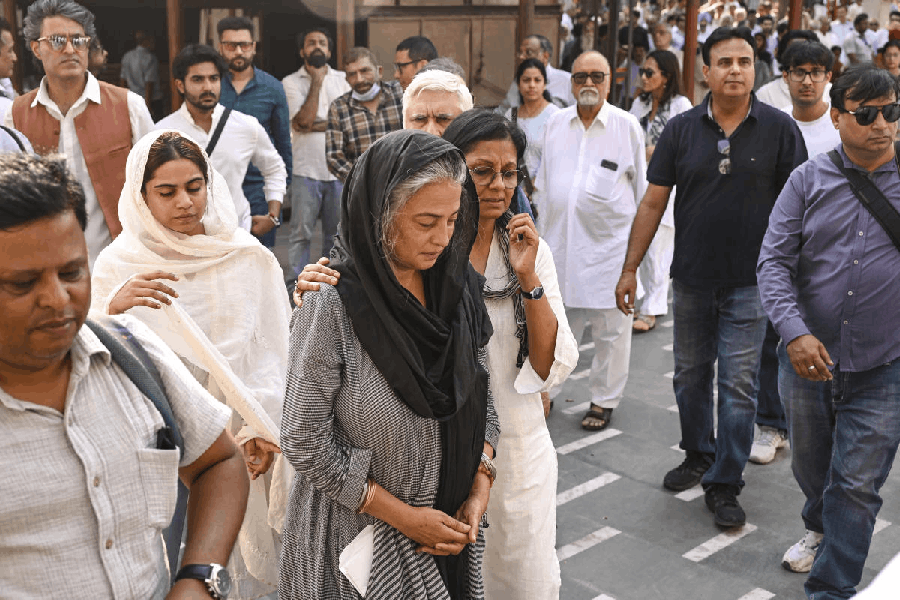
Gurmeet, wife of late photographer Raghu Rai, is consoled by actor Nandita Das during Rai's last rites, in New Delhi, Sunday, April 26, 2026. Rai, one of India's best known photographers who distilled the essence of an evolving India and its people through his lens, died at a private hospital in the early hours of Sunday at the age of 83 (PTI Photo)
The contrast, while stark, between the two images, conjures up the shadow of a photojournalist standing too close for comfort to his subjects.
Photographer Aditya Arya, founder of Museo Camera, said Rai introduced Indian journalism to such photography that you were almost one with the subject.
"Photojournalism has changed a lot. With his wide angle, he would be in the middle of the action. Today, the photojournalism is 300-400 feet away with the huge telephoto, because you are not allowed anywhere close to the personalities. You can see in his photos how things change when you are in the middle of the action," Arya told PTI.
Rai believed that the purpose of photography is "to capture the time we live in".
"When you capture the essence of any situation at the right time, it is going to be the visual history of tomorrow. History is written and rewritten but visual history can't be re-written," he had told PTI.
Varanasi fascinated him.
From the quiet rituals of cremations to the spiritual vibrations of the Ganga aarti, from the busy city streets with hurried movements to intense discussions at tea stalls, Rai's lens caught the holy city in its element, filled with raw and unmatched energy.
He saw a Banaras that was "less aware of its own image, a place that hadn't yet learned to pose for the lens", said photographer Samar Jodha, who felt like "a son and a friend" of Rai.
Jodha remembered Rai for the stories of the ordinary person, rather than the celebrities, that he portrayed through his camera.
"He was really about working with the ordinary people, working in the ordinary situation. And that's a real test of picture making, because working as a professional photographer, many times the theme which carries that image is more than just your great picture making," Jodha told PTI.
"He had what in Hindi, in Urdu, in Punjabi we call 'junoon'. That particular madness which keeps you going no matter what stands in your way. Not people pleasing. Not negotiating with the world. Just that stubborn, burning need to be true,” he said.
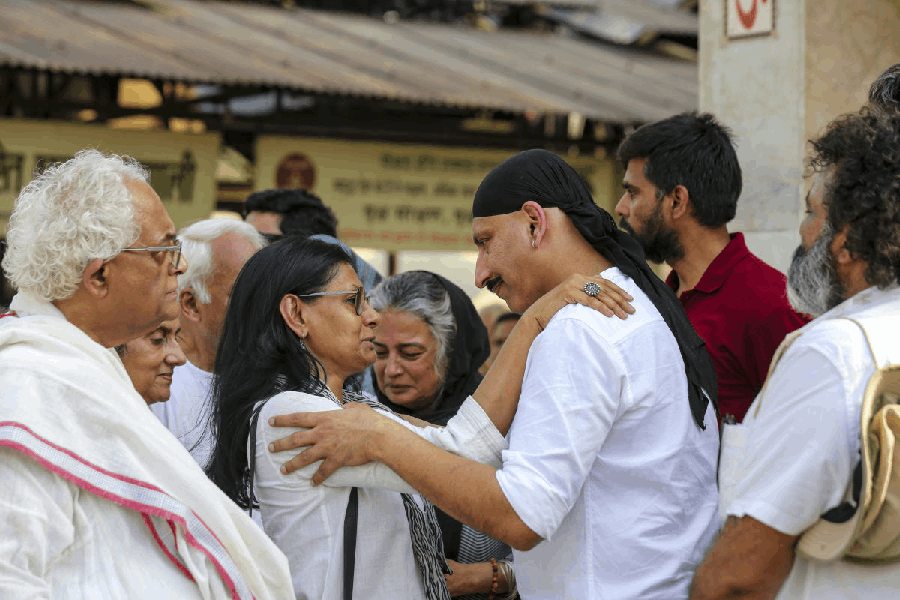
Late legendary photographer Raghu Rai's wife Gurmeet, centre, and son Nitin, front right, are consoled by actor Nandita Das, front second left, and others during Rai's last rites, in New Delhi, Sunday, April 26, 2026. Rai, one of India's best known photographers who distilled the essence of an evolving India and its people through his lens, died at a private hospital in the early hours of Sunday at the age of 83 (PTI Photo)
During his long and illustrious career, Rai worked with leading Indian magazines Sunday and India Today. Over the years, his photo essays appeared in renowned international publications, including Time, Life, The New York Times, The Independent, and The New Yorker.
He served three times on the jury of the World Press Photo and twice on the jury of UNESCO's International Photo Contest, according to Magnum Photos, where he was nominated to join by Cartier-Bresson in 1977.
Rai received the Padma Shri in 1972 for his coverage of the Bangladesh war and its aftermath, apart from several national and international awards.
He received the Photographer of the Year award in the United States for his photo essay "Human Management of Wildlife in India", published in National Geographic. The French government conferred him with the Officier des Arts et des Lettres in 2009.
Rai also left behind a large number of books, including "Raghu Rai's India: Reflections in Colour and Reflections in Black and White" and "Exposure: Portrait Of A Corporate Crime".
Rai was working on his 57th book, according to the website of the Raghu Rai Foundation, which was established in 2010 and has archived more than 50,000 of his images.
Tributes poured in from across political and creative fields.
Prime Minister Narendra Modi on Sunday condoled the demise of photographer Raghu Rai, and said he would be remembered as a creative stalwart who captured India’s vibrancy through his lens.
“Raghu Rai Ji will be remembered as a creative stalwart, who captured India’s vibrancy through his lens. His photography had extraordinary sensitivity, depth and diversity. It brought people closer to the different aspects of life in India,” Modi said in a post on X.
“His passing is an irreparable loss to the world of photography and culture. My thoughts are with his family, admirers and the photography fraternity in this hour of grief. Om Shanti,” he added.
Congress leader Rahul Gandhi on Sunday condoled the demise of photographer Raghu Rai, and said his lens chronicled the soul of India and preserved the nation's memory.
"Raghu Rai ji's lens chronicled the soul of India for over six decades - its people, its struggles, its joys, and its defining moments," Gandhi said in a post on X.
"He didn't just take photographs, he preserved our nation's memory," Gandhi said.
"My heartfelt condolences to his family, his colleagues, and the countless admirers his work touched across generations," he said in his post.
Priyanka Gandhi said that the legendary photographer "etched the stories of joys and sorrows, elation and grief, challenges and struggles of ordinary Indians into his images".
Maharashtra Chief Minister Devendra Fadnavis paid tribute to Rai, saying India has lost a towering figure in the field of journalism.
In a condolence message, Fadnavis said Rai captured the essence of human emotions through his lens and visually documented India's journey of development.
"He portrayed India's history, the sentiments of its people and the realities of everyday life through his camera. His photographs of the victims of the Bhopal Gas tragedy brought their pain to the global stage and drew international attention to the disaster," the CM said in a statement.
Shashi Tharoor shared on X that his memories of Rai stretched back to his childhood, as his father and the photographer were colleagues at The Statesman.
"For me, he wasn't just a global name; he was the man with the gentle smile and the observant eye who inspired my father's generation of journalists...," Tharoor said, adding that his contribution to visual history is unparalleled.
BJD president Naveen Patnaik said his frames were not just pictures, but living histories.
Lyricist-writer Varun Grover called Rai "the silent storyteller, the interpreter of light, the most gentle and kind".
Except for the headline, this story has not been edited by The Telegraph Online staff and has been published from a syndicated feed.