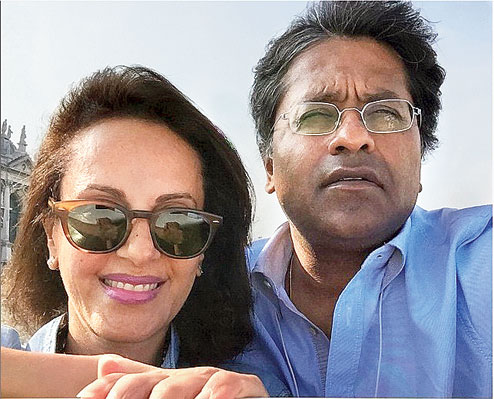
June 14: Lalit Modi faces a slew of charges and court cases in India but the one that caused his passport to be revoked, eventually leading to the current controversy involving Sushma Swaraj, was an allegation of foreign exchange violation.
It was among 22 accusations brought by the Board of Control of Cricket in India (BCCI) that led to Modi's suspension as chairman and commissioner of the IPL in April 2010 and prompted him to flee India in October that year.
The Enforcement Directorate began investigating the foreign exchange violation charge. When Modi kept evading its summons, the agency got the government to revoke his passport in March 2011.
It also issued a blue-corner notice against Modi, which would allow any foreign law-enforcement agency to detain him and deport him to India to face questioning.
Delhi High Court, however, restored Modi's passport in August last year ruling that its revocation had been based on "extraneous consideration and insufficient materials".
The court, however, said it was not expressing any opinion on the charges of foreign exchange violation against Modi, a member of one of India's richest business families.
BCCI charges
In September 2013, the BCCI's disciplinary committee, manned by Arun Jaitley and Jyotiraditya Scindia, found Modi guilty on eight counts, including financial irregularities, misconduct, indiscipline and "actions detrimental to the interest of the BCCI" - and even posting threatening tweets.
It indicted Modi for allegedly rigging bids during the 2010 auction for new franchises, arm-twisting some franchise buyers and selling media and Internet rights without authorisation.
The list of 22 charges the BCCI had emailed Modi in April 2010 included the allegation of embezzling $80 million from a TV deal. He fled India six months later saying he feared for his life.
Modi has claimed innocence all through, defending himself mostly on Twitter and television channels but never appearing before the BCCI disciplinary committee or the Enforcement Directorate.
However, from his self-imposed exile in Britain, he managed to get himself elected president of the Rajasthan Cricket Association in a December 2013 election whose results were announced in May last year.
That led to the BCCI suspending the state association. Eventually, a coup in the state body ousted Modi in October.
Other cases
A case lodged in Rajasthan accused Modi of dishonouring the national flag during an India-Pakistan match in November 2007. The media had splashed pictures of the Tricolour being used as a tablecloth on which liquor glasses were placed in the VIP gallery.
The police said they had failed to identify the people in the pictures. Modi obtained a stay on the case in 2010 from Rajasthan High Court which, in January this year, again directed the police to probe the case.
Another FIR accused Modi of cheating the state government by promising Rs 6 crore in aid for victims of the May 2008 Jaipur blasts but depositing only Rs 5.8 crore.
It alleged that Modi had presented a dummy placard cheque - on behalf of all the IPL franchises and sponsors - to then chief minister Vasundhara Raje during an IPL game.
Rajasthan High Court quashed the case last year saying that since the money was given in charity, the question of cheating or fraud did not arise even if the full promised amount was not paid.
In 2005, former Jaipur District Cricket Association member Anil Shekhawat had lodged a case accusing Modi of embezzling Rs 22 lakh of the association's money. The case is pending in a lower court, Shekhawat said.
Another criminal case was lodged in 2010 accusing Modi of illegally buying two heritage havelis (mansions) on Jaipur's outskirts. The then Congress government later cancelled the allotments.
Modi also faces a case over an allegedly bounced cheque.
THE CONSENT CLOUD

Foreign minister Sushma Swaraj has said she took a “humanitarian view” because Lalit Modi needed to go to Portugal to sign the consent papers for his wife’s surgery. But a website and two doctors have pointed out that consent from a patient is sufficient if he or she is not incapacitated.
Sushma tweeted: “… Modi spoke to me that his wife was suffering from Cancer and her surgery was fixed for 4th Aug in Portugal. He told me that he had to be present in the Hospital to sign the consent papers.”
But europatientrights.eu, a website describing patients’ rights, suggests that in Portugal, consent, while
required prior to treatment or surgery, can be given by the patient, unless in the case of “legal incapacity”.The website, outlining patients’ rights in each member country of the EU, also says: “A written consent is not required in Portugal… the consent can be expressed through any means....
A minor of 14 years of age and more can give valid consent to medical treatment if he has the ability to fully understand what is involved in the medical treatment in question.”
Two surgeons familiar with consent procedures in the EU said their understanding was that patients by themselves have the right to provide consent for surgical procedures. “A medical institution would normally be expected to accept consent from the patient,” said Subash Gupta, a liver transplant surgeon in New Delhi who has earlier worked in the UK.
“Consent received from patients is valid,” said Rogerio Carpallo Alphonso, a senior surgeon from Sao Paulo, Brazil, currently visiting India.The website on patients’ rights clarifies that if a person is legally incapable of providing consent, a legal representative needs to be present for the consent.
G.S. Mudur