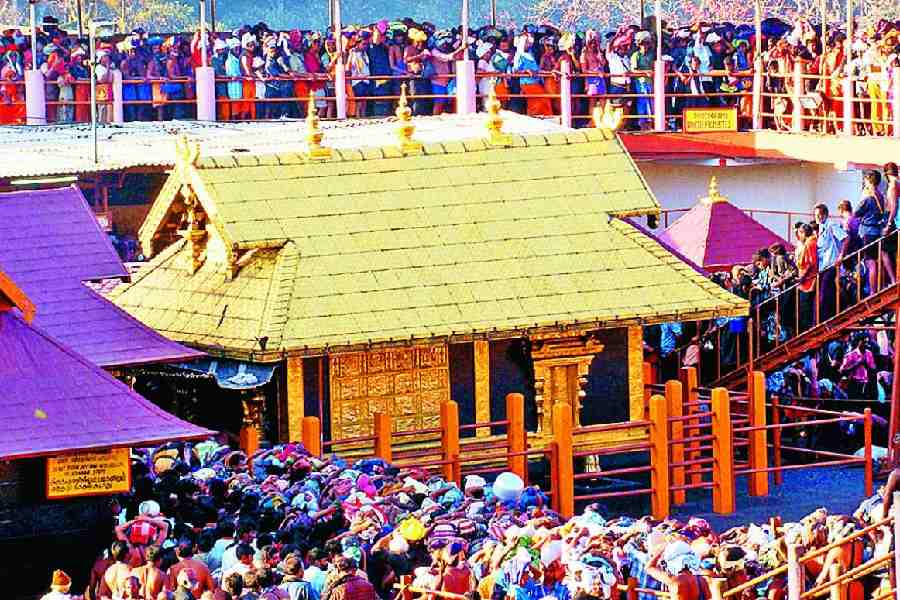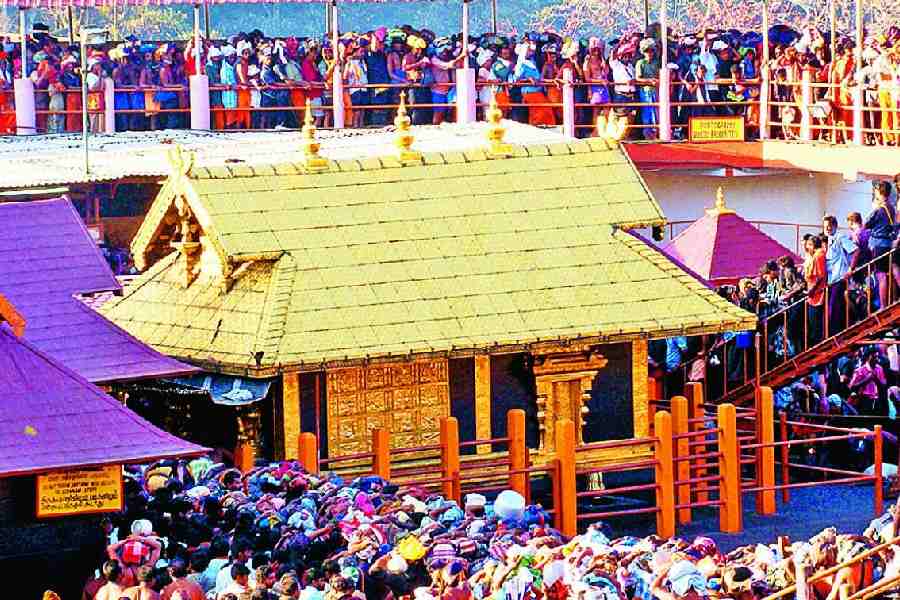
The Centre on Tuesday defended in the Supreme Court the ban on the entry of women of child-bearing age to the Sabarimala temple in Kerala, but Justice B.V. Nagarathna questioned the rationale behind women being treated as “untouchables” for three days during their periods.
Justice Nagarathna, the lone woman on the nine-judge constitution bench, said such practices militate against Article 17 of the Constitution, which prohibits “untouchability”.
While the Centre is batting for recall of the 2018 five-judge constitution bench ruling which had quashed the ban on entry of women of childbearing age into the temple, the Left Democratic Front (LDF) government in Kerala too has filed an application before the bench for review of the earlier verdict, travelling in the same boat with its ideological bete noire in the run-up to the state polls.
“Article 17 in the context of Sabarimala. Let’s go by the harsh reality…. I do not know how it can be argued. Speaking as a woman, there can’t be a three-day untouchability every month and on the fourth day, there is no untouchability and Article 17 will not have its application,” Justice Nagarathna orally told solicitor-general Tushar Mehta appearing for the Union government.
The judge made the observation in response to Mehta’s submission before the bench wherein he chose to assail the 2018 verdict of the Supreme Court quashing the ban and, in particular, one of the judgments penned by Justice D.Y. Chandrachud (since retired) that said the ban on the entry of women in the 10-50-years age group did violate Article 17 of the Constitution.
Mehta on Tuesday told the bench, which also had Chief Justice Surya Kant, Justices M.M. Sundresh, Ahsanuddin Amanullah, Aravind Kumar, Augustine George Masih, Prasanna B. Varale, R. Mahadevan and Joymalya Bagchi, that the issue was not about untouchability, but the fundamental right of “religious denominations” under Article 26 to follow their own religious practices.
“I am not on the issue of menstruation. It is about the uniqueness of the temple. It does not mean three days or four days of untouchability. It means a particular age group. It is not about any caste.
“Lord Ayyappa temples are open throughout the world for women of all ages. Such an exception is there in only one temple, which is a sui generis (of its own kind) case,” the top government law officer argued.
Mehta submitted that only at the Sabarimala Ayyappa Temple is there a restriction on women of childbearing age from entering the shrine, as the presiding deity is considered a “Naishtika Brahmachari” who has taken a vow of lifelong celibacy.
He referred to three Lord Ayyappa temples in New Delhi that are open throughout the year for all women irrespective of age group.
Mehta argued that the Sabarimala temple rituals are protected under Article 26 of the Constitution, which grants every person and religious denomination the fundamental right to follow their particular customs so long as they do not offend public order, morality and health.
The solicitor-general referred to the practice of devotees being asked to cover their heads while visiting gurdwaras and dargahs, which too is protected under Article 26 and cannot be termed discriminatory.
Tuesday was the first day of the hearing. The arguments will continue till Thursday.
The bench is dealing with a batch of petitions and cross-petitions seeking recall and defending the September 2018 judgment of a five-judge bench, which by a 4:1 majority had ruled as “unconstitutional” the centuries-old ban on the entry of women of childbearing age to the Sabarimala temple. The sole minority opinion upholding the ban was rendered by Justice Indu Malhotra (since retired).