
New Delhi: Aligarh Muslim University vice-chancellor Tariq Mansoor has pleaded inability to a verbal nudge from the Centre to explore the possibility of removing Muhammad Ali Jinnah's portrait from the students' union office, varsity officials have said.
Human resource development ministry officials are learnt to have spoken to Mansoor on Thursday, a day after a mob tried to storm the campus and remove the portrait.
"The vice-chancellor told the ministry he cannot ensure removal or shifting of the portrait since the students' union room is not directly under his authority," a senior university official said.
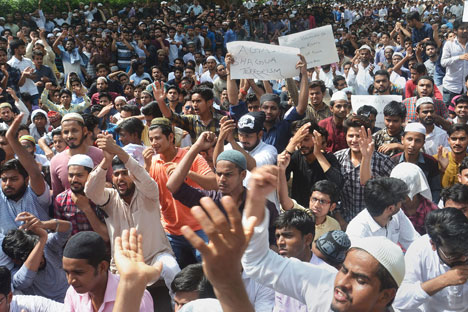
Half-a-dozen people were injured when the police carried out a baton charge and fired rubber bullets and tear gas on Wednesday as students tried to resist the mob.
On Thursday, the AMU teachers' association demanded action against the attackers. The students too sat on a dharna, demanding punishment for the aggressors, mostly members of the Hindu Yuva Vahini, a militia that current chief minister Yogi Adityanath had formed in the 1990s.
"They (the mob) came walking for 2-3km; the police did not stop them. When our students resisted them, the police beat our students. This is police-sponsored violence," a teacher said.
Police sources said the cops were even-handed, and that three from each side in the clash were in hospital.
A teacher said the "sudden" protest against the portrait was meant to inflame passions ahead of next week's Assembly elections in Karnataka.
"There was no protest all these years. All of a sudden, there is a protest.... It is purely political."
Constitutional expert Faizan Mustafa said the portrait had been in place since 1938, when Jinnah visited the campus and was made a life member of the students' union.
"Jinnah's portrait in the students' union office is part of (the country's) historical legacy. It has been there for a long time despite Jinnah having caused the most damage to the Muslims' cause."
Mahatma Gandhi and India's first education minister, Abul Kalam Azad, too were made life members of the students' union, and their portraits are also on display in the room.
Pak museum
Authorities of a museum in Pakistan said on Thursday they would not remove the statues of Indian leaders from display despite the Jinnah controversy at AMU.
Shahera Shahid, executive director of Lok Virsa, a government organisation that preserves and promotes Pakistan's cultural heritage, confirmed that statutes of Gandhi, Jawaharlal Nehru and Baldev Singh, India's first defence minister, were on display in the Pakistan Monument Museum in Islamabad, established in 2010.
Gandhi's statue is in "a gallery on the advent of the freedom movement and depicts the Gandhi-Jinnah talks of 1944", Shahid told The Telegraph from Islamabad.
Some tweeters, however, suggested that a false equivalence was being drawn between Gandhi and Jinnah, whose call for Direct Action Day led to massive violence in Calcutta in August 1946.