Exhibit A: When the Election Commission of India asked the Bengal government to shift Rajeev Kumar from the helm of Calcutta police, state chief secretary Basudeb Banerjee wrote to the panel: "This transfer will adversely affect the morale of the force and the state government should not be held responsible for any fallout arising out of this...."
Exhibit B: When a minister reportedly told Calcutta police commissioner Soumen Mitra to ensure there were no police "excesses" during the voting in the city, the officer brought out the Election Commission's manual, cited the norms and told the minister his force would follow the rulebook.
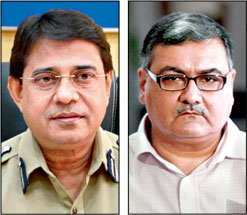
Banerjee and Mitra are part of two pillars on which the edifice of power rests in Bengal but one letter on their prized badges separates them.
One belongs to the IAS or the Indian Administrative Service and the other to the IPS or the Indian Police Service.
In the pecking order, IAS ranks above IPS. But in front of the Mamata Banerjee government, IPS stands taller, dwarfing the suits.

Cut to February 2013. Ranjit Pachnanda, the then Calcutta commissioner, gets a hero's farewell after he was shunted out when he refused to dilute the FIR against a Trinamul leader linked to the murder of sub-inspector Tapas Chowdhury during a college election.
Cut further back to February 2012. Police officer Damayanti Sen wins accolades for cracking the Park Street rape case although chief minister Mamata Banerjee had dismissed the complaint as " sajano ghatana (fabricated incident)".
Pachnanda is from the IPS, so are Sen and Mitra.
The IPS love affair with the spine is by no means limited to Bengal. In Kerala, which shares many a trait with Bengal, state police chief T.P. Senkumar had stirred a hornet's nest after he objected to Prime Minister Narendra Modi's and Rahul Gandhi's plans to visit the scene of the temple tragedy last month. Senkumar said such trips meant diversion of the resources to ensure the security of the VIPs.
Do all these instances mean that IAS is more servile than IPS?
Several serving and veteran officers demurred, saying such a generalisation cannot be made on the basis of a handful of episodes. But most agreed that the Bengal chief secretary could have acquitted himself better while drafting letters to the Election Commission.
The letter earned the chief secretary a scathing reprimand from the commission: "Such observation is uncalled for and unbecoming of a civil servant and is an apparent attempt to abdicate the role and responsibility of the state government conferred on it by and under the Constitution of India."
Worse, the police force led by Mitra helped conduct one of the most peaceful elections in recent memory, proving the chief secretary and his dire prediction wrong in an emphatic manner.
Banerjee, a veteran IAS officer, would not have written such a letter without an instruction from the chief minister. While few officers dare speak their mind before Mamata, veteran officers said an array of diplomatic skills was at the disposal of bureaucrats to get across unpalatable messages without appearing to be confrontational.
But, one official added, if bureaucrats are fishing for cosy post-retirement posts, it is unlikely that they will put themselves in harm's way at the fag end of their career.
"Everyone knows how pushy the chief minister is.... But as the head of state administration, the chief secretary could have shown some spine. After assuming the chair, the new police commissioner could have tried to play safe and made his position permanent but he didn't bend his back," said a retired IAS officer, lauding the way Calcutta police functioned on polling day in the city.
At the moment, the IPS does have an edge over the IAS on the "spine-meter". But it was not always so.
T.N. Seshan, who sent a shiver down the Indian political establishment and began the electoral clean-up whose legacy continues to torment mass leaders like Mamata, had cut his administrative teeth as an IAS officer. (IPS officers will point out that Seshan had actually joined the police service for a year or so before appearing for the civil services examination again and making the IAS.)
Alphonse Kannanthanam, the "demolition man" of Delhi who played a key role in battling the construction mafia in the capital, also served as an IAS officer before plunging into public life. G.R. Khairnar, the original demolition man, was not an IAS officer but started his career as a clerk in Mumbai.
Without the glitz and power of the uniform, these civil servants had made a name for themselves by standing up to authority to uphold the rule of law.
A senior IPS officer pointed out that Mitra's proactive approach should not be seen as a reflection of the superiority of the police service. He pointed out that Mitra found himself at the helm of Calcutta police precisely because his predecessor Rajeev Kumar, also from the IPS, faced charges of discrimination.
Besides, Kumar's predecessor Surajit Kar Purkayastha had not covered himself in glory during his stint that coincided with violence and malpractice during the civic poll last year. "He was the police chief for about three years and he set new standards in being accommodative," the officer deadpanned.
According to some old-timers, IAS officers are at a disadvantage in the sense that even when they ensure course corrections by the executive leadership, the outside world rarely comes to know of it.
Information on what transpired behind the closed doors of power mostly flows through "leaks" from other officers unless some publicity hounds "plant" news of their accomplishments. Usually, bad news takes precedence over good deeds when others tell it. Shakespearean justice applies here too: "The evil that men do lives after them; the good is oft interred with their bones."
In the police force, the avenues for leaks are more than in the cloistered nests of bureaucrats. The news media, too, have more contact with police sources than IAS officers.
Often, shows of polite defiance by IAS officers go undisclosed or unreported, according to sources. But there have been some exceptions.
Information had trickled out that former chief secretary Samar Ghosh had put his foot down when Mamata wanted to make Gautam Sanyal, a central secretariat services officer, a principal secretary soon after she took over as the chief minister in 2011.
Another instance was when finance secretary H.K. Dwivedi had declined to clear a tax-saving deal between film producer Srikant Mohta's firm and the Calcutta Municipal Corporation despite repeated nudges from finance minister Amit Mitra.
But such instances do not unfold in the glare of the public eye, unlike the accomplishment of Mitra's police force, which could be seen in newspapers and on television screens.
"I think it is all about the individual and his or her commitment to the service," said a retired bureaucrat, adding that the two sets of officers cannot be compared because of the differences in the nature of their work.
IAS officers largely deal with policy matters and project implementation - dry subjects that do not catch the public imagination unless word of a dramatic confrontation leaks.
"The police officers, on the other hand, enjoy visibility because of the nature of their work and issues involving the public.... In case of IAS officers, the focus is on policy, which is difficult to be fathomed by common people," said a bureaucrat.
"Besides, the police officers command a special place because of their uniforms," he added.
Does that mean that a Banerjee in uniform will be bolder than a Banerjee in civvies? In the absence of official comment, perhaps it is best to return to Shakespearean wisdom: "A rose by any other name would smell as sweet."