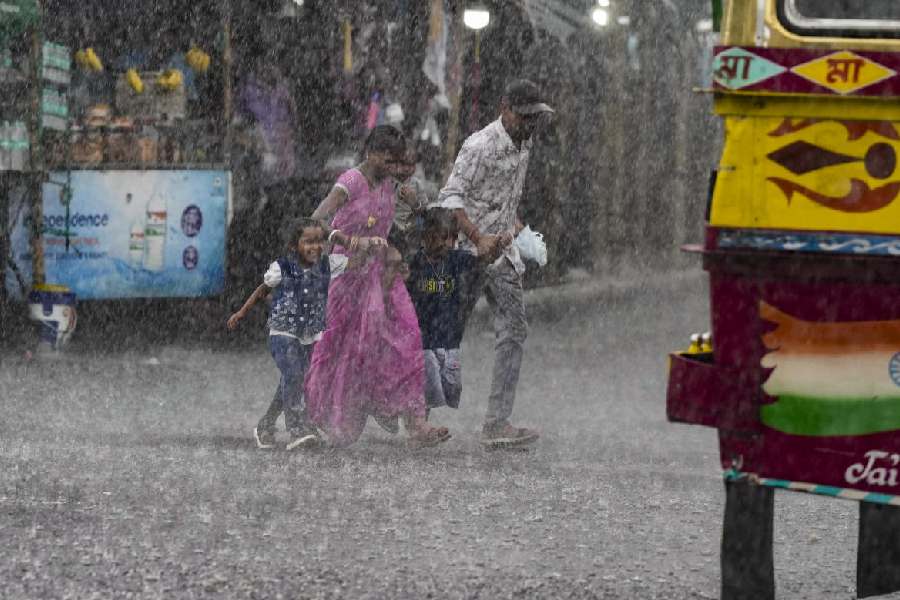
Heavy rains battered Sikkim, north Bengal and Arunachal Pradesh -- where three people have died in flash floods -- even as IMD on Sunday said conditions are favourable for further advance of the southwest monsoon into northern states over the next five days.
The national capital recorded its warmest morning in two years amid the delayed seasonal rainfall.
The India Meteorological Department (IMD) said in a release that conditions are favourable for further advance of the southwest monsoon into some more parts of the North Arabian Sea and some areas of Uttar Pradesh and Uttarakhand, among other states, during the next two to three days.
It is likely to continue its movement over some more parts of Uttar Pradesh, Uttarakhand, some areas of Himachal Pradesh, Jammu and Kashmir, Ladakh and southeast Rajasthan during the subsequent two to three days.
However, it also warned of heatwave conditions -- possibly severe -- in Uttar Pradesh on June 28 and 29.
According to weather forecasting agency Skymet, Delhi is likely to see the arrival of monsoon on July 4 if conditions remain favourable.
Three dead in Arunachal Pradesh rain fury
Three people have died in the rain-triggered flash flood in Arunachal Pradesh's Keyi Panyor even as search and rescue operations were underway, officials said.
Floods and landslides caused by incessant rainfall were also reported in several other parts of Arunachal Pradesh, where houses were inundated and infrastructure damaged, prompting the local administrations to launch rescue and evacuation operations, they said.
Ten districts -- Keyi Panyor, Papum Pare, Kra Daadi, Kurung Kumey, Lower Subansiri, Kamle, Upper Subansiri, East Siang, Leparada and Lower Siang-- have been affected by the rain fury, the officials said.
The India Meteorological Department (IMD) also forecast the possibility of more than 200 mm of rainfall in parts of Arunachal Pradesh over the next 24 hours till Monday morning, prompting the state government to issue an alert and urge people to remain vigilant.
Rainfall in Sikkim washes bridge away
A key bridge in north Sikkim's Dzongu was washed away due to heavy overnight rainfall, disrupting road connectivity in the region, officials said.
Movement on the Phidang to Sankalang stretch was affected after the Bailey bridge over Phee Khola was washed away on Saturday night following incessant rain, they said.
Continuous downpour has also caused extensive damage in the Upper Kaw Khola area of Lingee in south Sikkim, he said.
An IMD bulletin said heavy to very heavy rainfall lashed one or two places in Sikkim, while light to moderate rainfall occurred in most parts of the Himalayan state in the past 24 hours till 8.30 am on Sunday.
However, there have been no reports of any injury or fatality so far, officials said.
IMD warns of landslides amid heavy rain in north Bengal
The IMD issued an alert for extremely heavy rainfall till Monday at one or two places in sub-Himalayan West Bengal, where normal life has been affected in some parts due to incessant downpour.
Cautioning about the possibility of landslides in the hilly areas of Darjeeling and Kalimpong districts and inundation of low-lying areas in the plains of north Bengal, the IMD advised authorities to take necessary action.
The weather office issued an alert for Darjeeling, Kalimpong, Jalpaiguri and Alipurduar, warning of heavy to very heavy rain at some places with extremely heavy downpour at one or two places till Monday morning.
The administration is closely watching rising river water levels owing to incessant overnight rain, an official said. The water levels of rivers Teesta, Jaldhaka, Dayna, Leesh and Gheesh have risen, he said.
*** Delhi, neighbouring states await monsoon amid scorching heat ***
Recording its warmest morning in two years, Delhi's minimum temperature settled at 31.1 degrees Celsius, 3.2 notches above the seasonal average, while the maximum climbed to 41.8 degrees Celsius.
The last time the city's minimum temperature was higher was on June 14, 2024, when it was recorded at 33.3 degrees Celsius.
According to the weather office, a heatwave has been realised over Delhi, and the "feels-like" temperature at 5.30 pm, as calculated by the IMD, was around 50.7 degrees Celsius. For Monday, however, it forecast thunderstorms with rain.
Skymet said the delay in the onset of the monsoon and the interaction of dry and moist winds have kept both temperatures and humidity unusually high.
"Normally, the monsoon reaches Delhi around June 27-28, after which temperatures begin to ease and humidity increases. This year, however, the monsoon is likely to be delayed by about a week. Dry westerly winds from Pakistan are keeping temperatures high, while southwesterly winds from the Arabian Sea are also reaching Delhi and increasing humidity," Mahesh Palawat, Vice President (Meteorology and Climate Change), Skymet, said.
"When these dry and moist air masses interact, clouds do form, but there is not enough moisture for widespread rainfall. By the time cloud formation takes place, usually around 4 or 5 pm, the day's maximum temperature has already been recorded. That is why both the maximum temperature and the 'feels-like' temperature have remained unusually high," he said.
The meteorological centre in Shimla predicted a wet spell in Himachal Pradesh till July 4, saying a fresh western disturbance is likely to affect northwest India from July 2 onwards.
It issued an alert for thunderstorms and gusts of 30-40 kmph in isolated places in the state between June 30 and July 4.
In Uttar Pradesh, mercury soared to 43.4 degrees Celsius in Paryagraj, while Lucknow recorded a maximum temperature of 39.7 degrees Celsius, 3.6 notches above normal, the meteorological department said.
The isolated parts of the state are very likely to witness a heat wave in the next 24 hours, the department said, adding that thunderstorms/lightning accompanied by gusty winds are very likely at isolated places over eastern Uttar Pradesh.
Hot weather conditions prevailed in Punjab and Haryana, with Faridkot sizzling at 45.7 degrees Celsius and Bhiwani recording 45 degrees Celsius.
At several other places in the two states, maximum temperatures hovered a few notches above normal limits.
The maximum temperature in Chandigarh, the common capital of the two states, settled at 41 degrees Celsius, over four degrees above normal, according to a MeT department report here.
For the two states, the IMD predicted scattered rainfall on June 29 and July 1 and 2 and said thunderstorm, lightning and gusty winds (with speed reaching 40-50 kmph, gusting to 60 kmph) were also likely in certain areas between July 1 and 4.
In Rajasthan, humid weather conditions persisted across large parts, even as scattered rainfall was reported in several districts, including Pilani in Jhunjhunu district, which saw 7 mm of rain since morning.
The meteorological office has predicted moderate to heavy rainfall accompanied by thunderstorms in parts of the Kota and Udaipur divisions over the next few days, with rainfall activity expected to increase across southeastern and eastern Rajasthan from July 2.
Light rains were witnessed in parts of Himachal Pradesh in the 24 hours since Saturday evening, and Shimla, Kangra and Mandi districts witnessed thunderstorms.
In Jammu and Kashmir, Srinagar recorded a maximum temperature of 33.8 degrees Celsius, 3.8 degrees above normal, and a minimum of 19.7 degrees Celsius, 2.6 degrees above normal. For Jammu, the maximum stood at 37 degrees, and the minimum was 3.8 notches below normal at 22.5 degrees Celsius.
The weather office said pre-monsoon showers in the plains of Jammu and adjoining areas were likely on June 29 and forecasted intense heavy showers, thunder and gusty winds at a few places.
Yellow warning in parts of Uttarakhand's hilly districts for thunderstorm
Noting that the temperatures have remained appreciable above normal in several parts of Uttarakhand, the Dehradun Meteorological Centre issued a yellow (watch) morning for thunderstorm accompanied by lightning, an intense to very intense spell of rain and gusty winds at isolated places in the hilly districts of Uttarakhand.
Dehradun registered a maximum temperature of 37.1 degrres Celsius, which was five degrees above normal, and a minimum of 26.8 degrees, which was three notches above normal.