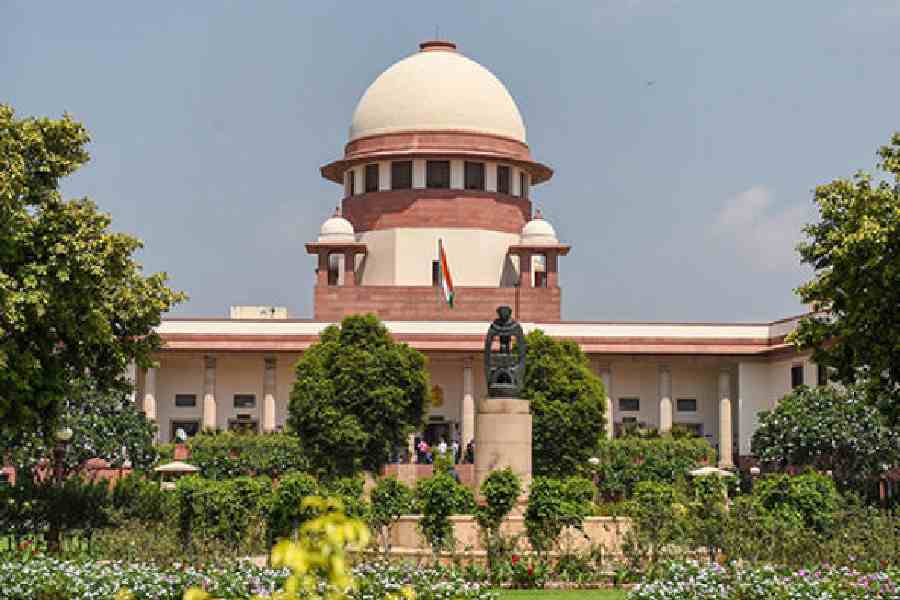
Evidence, even if collected illegally, is admissible and cannot be discarded as long as it’s “not tainted by an inadmissible confession of guilt”, the Supreme Court has ruled.
“A document which was procured by improper or even by illegal means could not bar its admissibility provided its relevance and genuineness were proved,” the apex court said.
It added: “Unless there is an express or necessarily implied prohibition in law, evidence obtained as a result of illegal search or seizure is not liable to be shut out.”
The bench of Justice Manoj Misra and Justice Ujjal Bhuyan dismissed an appeal filed by a radiologist, Dr Naresh Kumar Garg, who had challenged the summons issued to him by a Haryana trial court for allegedly carrying out a sex determination test.
The Pre-Conception and Pre-Natal Diagnostic Techniques (Prohibition of SexSelection) Act, 1994, bans sex selection by anyone, not even an infertility specialist or a team of specialists. The offence is punishable by five years.
Garg had challengedthe summons on the grounds of violation of the prescribed procedure for searchand seizure under the 1994 Act.
He had argued that any decision to authorise a search under Sub-section (1) of Section 30 of the Act must be taken by the appropriate authority, made up of three members.
If a single member of the authority — even if they happen to be the chairperson — authorises a search, it will be illegal.
Garg’s counsel contended that the committee chairperson had unilaterally directed the search and seizure of the radiologist’s premises without the consent of the othermembers.
Writing the judgment, Justice Bhuyan said that discrimination against the girl child and, by extension, women in several parts of the country often took the ugly form of female foeticide.
The first step towardscommitting such an offence was the sex determinationof the foetus, the judgment said.
Referring to earlier Supreme Court decisions from the 1970s, the bench held that “as long as evidence is not tainted by an inadmissible confession of guilt, evidence — even if it is illegally obtained — is admissible”.
A constitution bench had in Pooran Mal vs Director of Inspector (Investigation), New Delhi, held that neither the Indian Evidence Act nor any other similar law excluded relevant evidence on the grounds of having been obtained through an illegal search or seizure.
The bench headed by Justice Misra also referred to the Supreme Court judgment in R.M. Malkani vs State of Maharashtra that held a taped conversation was admissible provided it was relevant to the matter, the voice had been identified and the accuracy of the tapes proved.