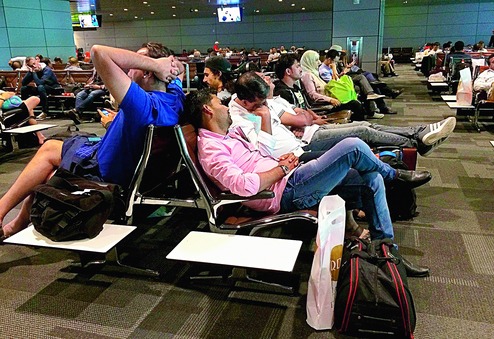

New Delhi. June 6: When images of 10,000 retrenched and starving Indian workers in Saudi Arabia reached home last August, the Indian government was caught napping, unprepared for the crisis. Now, it is taking steps to ensure it isn't caught off guard in a volatile Middle East again.
Foreign minister Sushma Swaraj last week called the ambassadors of Gulf nations that together host close to eight million Indian nationals to ask them to alert New Delhi when they foresee mass firings or wage cuts in their countries, senior officials confirmed to The Telegraph .
The officials could not recall a prior instance where a foreign minister has sought assistance from foreign envoys not just in addressing a crisis but in predicting one. Successive Indian governments have been slow to read signs leading up to such humanitarian crises in West Asia, though they have then worked to bring trapped Indian workers home - as the Narendra Modi government did in 2016.
But a series of fundamental economic and political shifts within the Middle East nations and increasing evidence of their impact on India have spooked the government into finally trying to prepare in advance, officials said. The split within the Gulf Cooperation Council - with Saudi Arabia, Kuwait, the UAE, Bahrain and Oman severing diplomatic ties with Qatar - is only the latest among them.
Persistently low oil prices have driven down jobs in the region, and forced cutbacks in salaries and benefits foreign workers received. Worried by the Arab Spring, most Gulf sheikhdoms have introduced laws restricting the number of foreign workers that firms can hire - except for highly specialised jobs. And desperate to break out of their overweening dependence on high oil prices, many Middle Eastern nations are transitioning their economies and positioning themselves as financial hubs - killing many of the traditional labour-intensive jobs Indians went to the region for.
"The economic space for millions of Indians in the Middle East is shrinking and will only keep shrinking," said K.V. Shamsudeen, an Indian-origin entrepreneur in Dubai who runs weekly classes on financial management for Indian workers across the Middle East, speaking to this newspaper over the phone. "The earlier crises have had to do with war, temporary or localised phenomena. But the shifts that countries in the Middle East are now undertaking are permanent."
The eight million Indians working in West Asia form an umbilical cord between India and the region, which supplies jobs and money that the workers send back home.
The increasing flow back to India of workers from the Middle East is the most visible sign that the recent shifts aren't temporary. The 10,000 Indians from Saudi Arabia weren't alone. At least 1,000 Indians are estimated to have lost their jobs in Qatar over the past 18 months as the gas-rich country curbed its production amid low prices.
In the UAE, the construction industry has cut 40 per cent jobs over the past two years. Another 1,700 Indian workers returned from Kuwait last year after they were fired. In March this year, 500 Indian workers in Bahrain appealed to the Indian foreign office for help after their employers refused to pay them wages. Nearly 200 Indian workers in Oman faced an identical crisis - non-payment of wages - in 2015.
Saudi Arabia hosts 3 million Indians, followed by the UAE with 2.5 million, Kuwait with 800,000, Qatar with 700,000, Oman with 450,000 and Bahrain with 400,000. Kerala remains the single largest supplier of Indian labour to the Middle East.
To be sure, past crises in the Middle East have impacted India. Saddam Hussein's invasion of Kuwait in 1990 forced over 100,000 Indians to return home. The Iraq War in 2003 and the 2008 global financial crisis triggered fears of a repeat but the impact was limited, said demographer K.C. Zachariah who has led the Kerala government's research into the state's Middle East addiction since the 1990s. And India had to pluck out more than 4,000 nationals from war-torn Yemen in 2015.
In many of those cases, as also instances involving mass retrenchments of Indian workers, India's response was eventually effective - but slow, and so costly in financial and humanitarian terms. The workers in Saudi Arabia had protested for two months about their retrenchment and non-payment of wages before a message on Twitter to foreign minister Sushma Swaraj prodded the government into action.
But the challenges India now faces aren't restricted to one round of retrenchments - but relate to more fundamental shifts linked to an evolution within the global energy sector. With shale gas emerging a popular alternative, and renewable energy generation picking up pace, the Middle East's dependence on oil and gas is a limitation for the region. The economics is simple: the supply of oil and gas these countries are churning out outstrips the demand, keeping prices subdued.
That these shifts - and the resultant shrinking of the West Asian job market for Indians - are long-term is also evident from a steady decline in remittances that India's work force sends back. More than half of India's remittances are sourced from the Middle East. India's inward remittances fell 3 percent in 2015-16 and by a further 9 per cent in 2016-17.
Kerala is the worst hit among Indian states - it draws 36 per cent of its GDP from remittances.
Migrant workers support every fourth Kerala family, said S. Irudaya Rajan, demographer at the Centre for Development Studies in Thiruvananthapuram who has been asked by the state government to determine the severity of the impact of the current crisis.
Another third of the state's families depends on incomes linked to the Middle East migration - through travel agencies and recruitment firms that help workers land jobs there - leaving nearly two-thirds of Kerala households dependent on the region, Rajan said.
There is a silver lining, though. Unlike in the past, white-collar workers - doctors, nurses and managers - are increasingly forming a growing chunk of the Kerala workforce in the Middle East, said Zachariah. While the lifestyle choices of their families hinge on remittances, he said, their dependence on the money for bare subsistence has reduced.