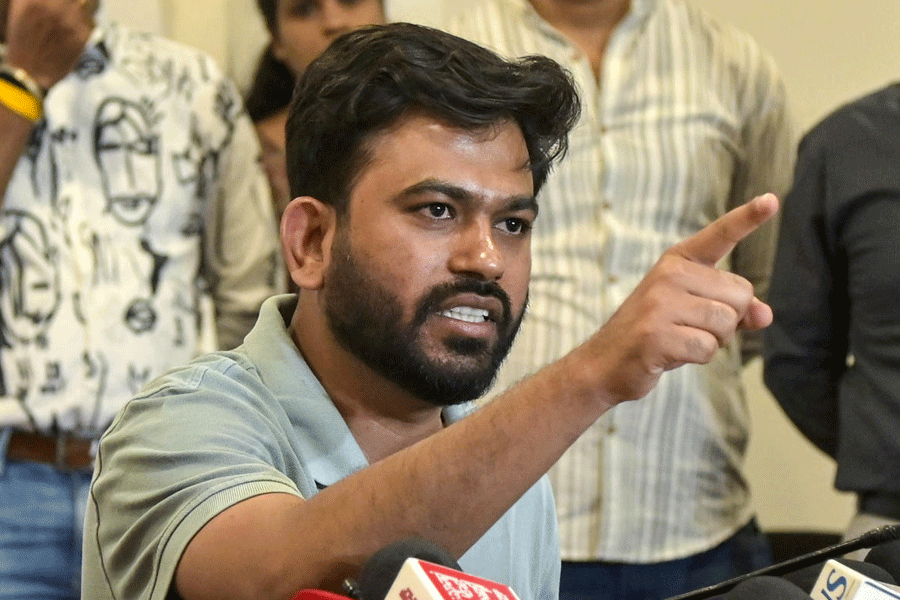
Congress MP Manish Tewari has introduced a private member’s bill in the Lok Sabha seeking to free lawmakers from what he called “whip-driven tyranny,” arguing that elected representatives should be allowed to vote independently on most bills and motions except those that directly affect the government’s stability.
Tewari said the bill, introduced last Friday, is intended to reopen a core democratic question: Who holds primacy — the voter who stands in the sun to choose a representative, or the political party whose whip that representative must obey? The proposal marks the third time he has placed this bill before Parliament, following earlier attempts in 2010 and 2021.
The legislation seeks to amend the Tenth Schedule of the Constitution so that MPs and MLAs may vote according to their judgment on all matters except confidence motions, no-confidence motions, adjournment motions, money bills and other financial business that could destabilise a government.
“This bill seeks to return conscience, constituency and common sense to the echelons of the legislature… so that an elected representative functions as the representative of the people who elected him and not as an instrument of a whip… transforming lawmakers into mere lobotomised numbers and dogmatic ciphers responding to a division bell,” Tewari told PTI.
The bill proposes that a member would lose his seat only if he defied the party whip on those limited categories of motions. It also mandates that the Chairman or Speaker announce in the House any direction issued by a political party regarding such matters as soon as it is communicated.
"While making such an announcement, the Chairman or the Speaker of House shall also specifically inform the members that the defiance of the direction issued by a political party by any member shall result in automatic cessation of his membership; and a member shall have the right to appeal against cessation of his membership to the Chairman or the Speaker, as the case may be, within a period of fifteen days from the date of such cessation and the appeal shall be disposed of within a period of sixty days from the date of its receipt by the Chairman or the Speaker of a House," it said.
Speaking about the bill, Tewari said it seeks to achieve twin objectives - the stability of the government is not impacted and parliamentarians and legislators exercise legislative choice.
"What is happening is when Parliament assembles at 2 o'clock in the afternoon, for government business, there is at times not even a quorum in the House. And in fact, there is an unspoken agreement between the treasury benches and the opposition not to raise the quorum issue so that if at all the House is functioning and it is not disrupted, it can continue," the Congress MP from Chandigarh said.
The reason for this is that parliamentarians do not see a role for themselves in lawmaking which is one of their essential functions, he said.
"So the law is made by some joint secretary in some ministry. It is brought to Parliament, a minister will read out a prepared statement explaining what it is. Then it's put to a pro forma discussion and then as a consequence of a whip-driven tyranny, those on the Treasury benches invariably vote for it and those on the opposition benches vote against it.
"So good lawmaking where members of Parliament would actually spend time looking at best practices around the world, researching legal precedent and then contributing to the proceedings, that has all become history," Tewari said.
Asked whether the bill aims to remove the tyranny of the whip and promote good lawmaking, Tewari said "absolutely".
"It is important to contextualise the bill. From 1950 to 1985, Members of Parliament and members of the state legislatures were subjected to whips by their respective political parties but the whips carried no coercive consequences," he said.
"In 1967, the ugly spectre of Aaya Ram Gaya Ram started when legislators were crossing the floor with impunity with one legislator in Haryana crossing the floor eight times in one day. The spectre of defections became the bane of Indian democracy. Subsequently, almost 18 years later, then prime minister Rajiv Gandhi brought the anti-defection law as the 10th Schedule to the Constitution of India," he said.
"It has been 30 years, the anti-defection law, however well intended it may be, has not been able to check the menace of defection. If defections were a retail activity in the 1960s, they became a wholesale activity by the 1990s after the introduction of the anti-defection law and subsequently by the year 2000s, especially after 2014 it has become a mega mall activity where entire parties are bought and sold wholesale, lock, stock and barrel," Tewari said.
He asserted that the kind of "whip-driven" tyranny that the 10th schedule has inadvertently ended up introducing is not present in any other democracy around the world.
"You have reduced legislators, parliamentarians, parliamentary choice and parliamentary lawmaking to a complete farce -- the principal function of Parliament is to appropriate a portion of monies to the government. How can that be done without free choice," he asked.
Noting that Parliament at times sits as a jury or decides on action against one of its own, Tewari asked how can that be subjected to a whip-driven process.
The statement of objects and reasons of the bill said that after quarter of a century of the enactment of the 10th Schedule, it needs certain adaptations and further strengthening so as to be of greater relevance to our democratic process today.
Tewari also called for setting up a judicial tribunal outside the prescient's of Parliament consisting of a division bench of the Supreme Court to hear 10th Schedule matters. Appeals of any would lie to a five-judge bench with the provision of a statutory review after that to be heard in open court, he said.
Similarly, for the state legislatures the original appeal must lie to a judicial tribunal consisting of a division bench of the high court with the appeal to a five-judge bench and subsequently to the Supreme Court, Tewari said.