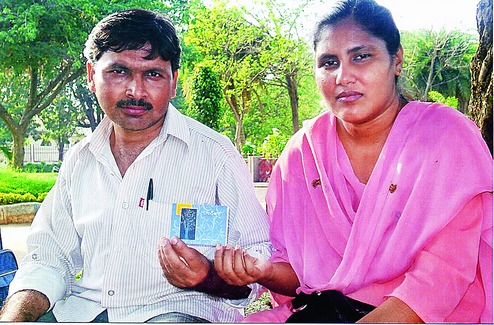


His pen name is Skybaaba but his writings are rooted in bitter ground realities. Shaik Yousuf Baba's 2016 work, Vegetarians Only, is the English translation of a slim volume of stories about Telugu Muslims. He writes in what he calls Telugurdu - a mix of Telangana Telugu and Deccani Urdu - as opposed to the "pure" and upper-class Telugu used in coastal Andhra. Telugu critic K. Srinivas has said of his writings that they effectively manage to convey the "ekakitanam", the internal and external loneliness and sense of utter abandonment experienced by the Muslim community.
Yousuf was in Calcutta recently to attend the People's Literary Festival organised by the NGO, Bastar Solidarity Network. At the panel discussion titled "Singing in the Dark Times: Writing Off Fascism", he spoke of the escalating "ghettoisation" faced by Muslims across India.
It was a Sunday afternoon. Many of the chairs in the auditorium were unoccupied as a large section of the audience was on the roads blocked by multiple Ram Navami processions. At the venue of the literature festival,students shouted slogans against the machinations of majoritarian politics. Yousuf absorbed the dissent in the air and, after the panel discussion, said, "The process of ghettoisation intensified after the Gujarat genocide in 2002. However, the Muslim identity came to be increasingly questioned with the rise of Hindutva politics in the wake of Babri Masjid demolition."
Yousuf had travelled to Gujarat in the aftermath of the 2002 pogrom as a freelance journalist. Even now, his narrative style is stark, direct, reads like reportage. He said, "None of my stories is a work of pure fiction. I have merely narrated things that happened to me."
The eponymous story of Vegetarians Only is culled from the personal experience of Yousuf and his wife, Shajahana. It is about a newly-married couple house hunting in a cosmopolitan suburb of Hyderabad. They are educated, speak fluent Telugu and look like thousands of other young couples of the country. On the face of it, there is nothing that the landlords or landladies can object to. And then comes a point when they have to tell their names. Writes Yousuf: "My heart sank. I hesitated... At that moment I really wished my name was Ramesh or Rajesh or Amit. But there was nothing I could do." And when he said, Yousuf, the owner froze "as if he had got an electric shock". The couple continues to wander from door to door but everywhere they are faced with a volley of questions - Are you a non-vegetarian? Do you eat beef? Why doesn't she (the wife) maintain purdah? After countless such episodes and rejections, they find a room on rent. Some days later, the protagonist asks the domestic help - "Narsamma, what people are they [the landlord]?... 'Arijans,' she said." Writes Yousuf, "Then it dawned on me. With the exception of the Dalits, and the Madigas in particular, all other castes were in fact untouchable."
Yousuf's stories open a window to the syncretic culture of Muslims in Telangana and Andhra Pradesh. He talks to us about the region's fusion food - bagara rice, double ka meetha - common social rituals such as chouthi or the haldi ceremony that precedes Hindu and Muslims weddings alike. "But Muslim life has been excluded from the world of Telugu stories. Even Muslims did not write about their own lives. This led to the rift and misunderstandings between Hindus and Muslims," he says.
To bridge the rift, Yousuf along with some fellow writers and poets pioneered the Muslimvadam Sahityam movement in Telugu literature in the mid-1990s. He edited several collections of Telugu Muslim writings, poems and essays. He brought out several magazines and even founded a publication house - Nasal Kitab Ghar - to bring out the books. Yousuf hopes that reading will bring about awareness about the Muslim condition and awareness will temper hatred.
He calls for a social movement within the community as well. "Muslims must stand up for themselves. They must get educated themselves. The community needs reforms and especially women need to get ahead. Otherwise, the RSS-BJP will continue to politicise the backwardness. Like they did with the teen talaq issue."
Yousuf's activism often lands him in trouble. He says he is used to receiving all kinds of threats; his book launches have also been scuttled by both Hindu and Muslim fundamentalists. Through all this, his pillar of support has been his wife. "I fell in love with her after having read her poem in a news daily," says Yousuf. Shajahana is a poet herself and part of the Muslimvadam movement. Her writings mirror the agony of illiterate Muslim women. Her poem Nakhab, meaning the veil, reads thus: "...Burkha worn or nothe world is/ Saffron rock.../Point of a knife.../ Thrusting manliness.../There is so much hidden cruelty/And we are blamed, we aren't allowed to go out/This is a frightening dream, if it's a dream at all..."