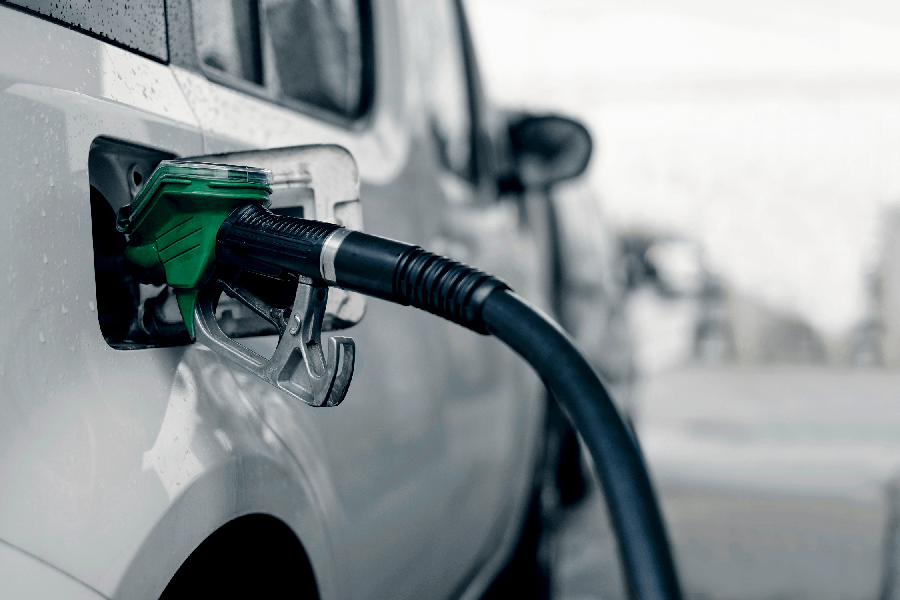
A fresh wave of criticism has emerged surrounding E20 fuel, with the latest trigger being an old advisory issued by oil marketing companies, with the virtual world abuzz once again stoking concerns over ethanol-blended fuels’ impact on vehicles, particularly older models.
The old advisory urges consumers to ensure that water does not come in contact with ethanol-blended fuel inside vehicle tanks. It warns that even small quantities of water can trigger phase separation — a process in which ethanol separates from petrol and settles at the bottom of the fuel tank — potentially causing starting troubles, jerking and poor drivability.
The advisory also states that oil companies would not be liable for damage caused by water contamination inside fuel tanks.
The government has dismissed the concerns as misleading. In a press statement issued on Tuesday, it said it had taken note of "misleading and unsubstantiated claims" regarding ethanol-blended petrol circulating on social media and alleged that old images and videos were being recirculated to create "unwarranted concerns" about the fuel.
The advisory doing the rounds on social media is at least a year old. The Centre had earlier described the anti-ethanol narrative as a product of "misinformation and disinformation" spread by "vested interests" amid concerns over possible engine damage, reduced mileage and compatibility with older vehicles.
Addressing concerns over moisture contamination, the government acknowledged that ethanol is hygroscopic, meaning it can absorb moisture from the atmosphere. However, it maintained that ethanol-blended petrol supplied by oil marketing companies conforms to Bureau of Indian Standards specifications and does not undergo phase separation on its own.
The Centre further argued that water contamination is undesirable for all fuels, not just ethanol blends, and said modern vehicles are equipped with safeguards to prevent water ingress into fuel tanks.
Shubhabrata Marmar, an expert on two-wheelers at MotorInc, clarified that moisture ingress into fuel tanks was uncommon and was something manufacturers had long accounted for, even before the advent of ethanol-blended fuels.
According to him, older vehicles are more susceptible because fuel-tank seals can degrade over time or get damaged due to misuse. He advised bike owners, particularly in humid regions and ahead of the monsoon, to periodically inspect these seals.
If water contamination is suspected, the only remedy is to drain the fuel and eliminate the source of ingress, Marmar said, noting that the procedure had remained unchanged even before ethanol blends were introduced.
"Keeping your tank full rather than empty more often than not seems to help over long durations," he said, explaining that fuller tanks leave less space for moisture to accumulate.
He pointed out a common prevalence — “Bikes often fill Rs 50 of petrol, for example. These fuel tanks will generally show more corrosion in time. Again, this was empirically happening pre-ethanol, too.”
He acknowledged that ethanol's hygroscopic nature means higher ethanol blends are inherently more susceptible to moisture-related issues than pure petrol.
"The more ethanol is in the system — as the blends rise — the more this challenge has to be dealt with," he said, adding that manufacturers would have to do much of the "heavy lifting", particularly in the case of flex-fuel vehicles.
The government made E20-compatible vehicles mandatory only from April 2023, meaning a large section of India's existing vehicle fleet predates the transition. According to industry body SIAM, most petrol-powered two-wheelers and cars sold before 2023 were designed for lower ethanol blends such as E5 and E10, leaving only a minority of vehicles on Indian roads fully compatible with E20 fuel. According to a report by a Thompson Reuters-backed outlet, only two in 10 petrol vehicles sold in India since 2011 are E20 fuel compliant.
Several garages and bike mechanics said that water seepage in tanks is a very common problem in bikes, in contrast to the government's claims, and advised the most impromptu solution is to buy petrol tank covers.
On concerns surrounding older vehicles, Marmars said many cars manufactured 10 to 15 years ago were already built with materials capable of handling ethanol blends.
However, he added: “Tuning compliance – how well the vehicle runs – is another thing. Ethanol being managed by pure-petrol vehicles is said to be at its maximum stretch at 20 per cent ethanol.”
He also drew reference to the concerns aired by SIAM a few years ago that smaller engines, particularly those in two-wheelers and older budget cars, face distinct structural and performance challenges with E20 fuel compared to larger passenger vehicles.
Suresh Patil, founder and CEO of Agnipankh Energy Private Limited, said that while concerns surrounding older vehicles are valid, it is important to distinguish between mileage, compatibility and fuel quality.
Although ethanol contains less energy per litre than petrol — a point frequently highlighted by critics — Patil cautioned against drawing conclusions about mileage or performance based on energy density alone. He explained that ethanol's higher octane rating allows engines to operate at higher compression ratios, potentially improving thermal efficiency.
"Fuel performance should be evaluated as part of the complete engine-fuel system rather than by considering a single property in isolation," Patil said, citing early US studies that found differences in fuel economy between petrol and alcohol fuels narrowed considerably when engines were optimised for the fuels they used.
On concerns over engine damage, Patil said durability depends on multiple factors, including fuel quality, vehicle maintenance, operating conditions and manufacturer specifications. "Therefore, broad generalisations should be avoided," he added.
The ethanol boom has also led to a boom in the market of fuel additives and stabilisers. Marmar said that while these may help, there was little official Indian data on their effectiveness. He also cautioned against viewing premium fuels as a solution, noting that these too contain ethanol blends. XP100, marketed as pure petrol, remains prohibitively expensive at Rs 160 per litre and is not widely available, he said.
The Centre has maintained that extensive field trials have found no compatibility issues or adverse effects from E20 use, including in legacy vehicles. It noted, however, that some older vehicles may require earlier replacement of certain rubber parts and gaskets, a relatively inexpensive intervention that can be carried out during routine servicing.
The government has repeatedly defended its ethanol-blending programme, arguing that it has helped India save more than Rs 1.4 lakh crore in foreign exchange by reducing crude oil imports while creating additional demand for agricultural feedstocks and boosting rural incomes.
"Ethanol blending plays an important role in enhancing India's energy security, reducing carbon emissions and advancing the country's transition towards cleaner mobility," the government said.