|
| The wreckage of the CRPF vehicle that was blown up by Maoists in Gadchiroli on March 27. (Reuters) |
• Maoist landmine kills 12 CRPF jawans in Maharashtra’s Gadchiroli on March 27 but the government appears uninterested in finding out why the victims flouted a key safety norm
• Rebels kill a young Congress rural poll candidate in Gadchiroli on January 28 but no leader comes to his funeral or condemns the murder, prompting several party candidates to pull out of the elections in protest
Only the chits pasted on the 12 coffins had words. One read: “Constable Digvijay Singh — 191 Battalion....”
Like the detached whiteness of the cloth that draped the coffins, a chilling silence enveloped the scene as the troops quietly wound up the final salute before the bodies would be sent home.
For eastern Maharashtra’s Gadchiroli district, located in the heart of the country’s Maoist zone, it’s a familiar but endless cycle: blast, death and silence. To many here, the silence seems to stretch up to Mumbai and New Delhi like a giant white sheet.
Mumbai, where ruling partners Congress and NCP are locked in squabbles and the Opposition Shiv Sena-BJP in backstabbing each other, has contented itself with ritual statements. Delhi is apparently too busy containing the fire from a disgruntled army chief to notice or probe the tragedy in a remote corner of the country.
The Maoists know their enemy well. “Your leadership stands too divided,” a surrendered guerrilla once told this correspondent in Gadchiroli.
The “divisions” and the apathy they breed seem to have ensured that a crucial deviation from the standard operating procedure (SOP) by CRPF troops that day — which cost the 12 lives — will go unexamined.
Why did a four-vehicle convoy not wait for “road clearing” — jargon for a mine screening by foot patrols travelling ahead of vehicles — as it made the 50km journey from the district headquarters to Gadchiroli’s Gatta town where the troops’ boss was waiting for them?
Were they negligent, or had they been under pressure to hurry up through a sensitive zone with their cargo of sewing machines, clothes and utensils that CRPF director-general K. Vijay Kumar was to distribute among villagers at a police-public programme? Do such norm violations happen all too often in an area where the margin for error is razor-thin?
Delhi has not ordered an inquiry into the “SOP violation” that Maharashtra home minister R.R. Patil has pointed a finger at. Patil has also acknowledged, but not tried to explain, why the local police were not informed before the CRPF convoy headed for Gatta.
The confusion and division at the top is too stark, a former Gadchiroli district collector told this reporter. “The nation’s priority is certainly not the hinterland.”
Tug-of-wars
The “divisions” and lack of coordination show up also in the implementation of the government’s development programmes for the tribal areas, considered one of the two prongs of the country’s counter-Maoist strategy.
As the former collector said: “The Planning Commission comes up with a plan; the home ministry tweaks it to its advantage; the rural development ministry complains that its views are not heard; the tribal welfare ministry sulks over not being taken on board; and the state government is not ready to forgo its control over anything.”
Nobody factors in what the local populations want, he added.
One example is the Integrated Action Plan, a two-year central scheme that ended on March 31 this year and is likely to be granted extension. In these two years, the Centre has allocated Rs 55 crore to each of the country’s 78 districts identified as Maoist-affected.
The rural development ministry wanted the thrust to be on health centres and mobile health units, a view supported by many local tribal leaders. The tribal affairs ministry suggested building more residential schools.
But the home ministry, whose clearance is needed, prioritised infrastructure for troop deployment, perhaps because development projects often get stuck owing to the Maoist threat.
So, the focus was on roads, bridges and buildings to fill up “critical infrastructure gaps”. It brought hardly any succour to the local people, whose views were not sought.
For instance, in Gadchiroli city, the money helped build a bus stand. That was of little help to the Gond and Madia populations who live deep inside the forests and have hardly any roads or buses. Among the schemes that have foundered for fear of the rebels is the Pradhan Mantri Gram Sadak Yojana.
Not that boosting the infrastructure has resulted in better security.
Maharashtra home minister Patil virtually conceded this after announcing that the State Reserve Police Force will raise a tribal battalion for Gadchiroli. This will be in addition to the C60 commandos, highly trained paramilitary forces, special anti-Maoist forces, the elite Cobra battalions and, of course, the district police.
Why is the tribal battalion necessary? Because, Patil admitted, not many police officers are ready to work in the Maoist hubs of Gadchiroli and Chandrapur. He cited how four police sub-inspectors had recently quit the force after being posted in Gadchiroli soon after the completion of their training.
Rural development minister Jairam Ramesh’s officials believe the building of bus stands should be left to the state transport department. The central scheme, instead, should concentrate on providing the tribals with livelihood opportunities — for instance, by giving them the right to cut and sell forest bamboo.
But the forest departments of the various state governments have stalled such moves.
Blind eye
During a recent visit to Gadchiroli, Ramesh declared that along with security operations, there was a need to restart democratic political activities and take the local people on board over development projects right from the planning stage.
“You have to win the people back,” he said, “not alienate them.”
That was what the CRPF chief’s programme in Gatta was intended to do but after the blast, his troops’ pursuit of suspects has unleashed such terror on local tribals that it risks undoing any good the earlier social events did.
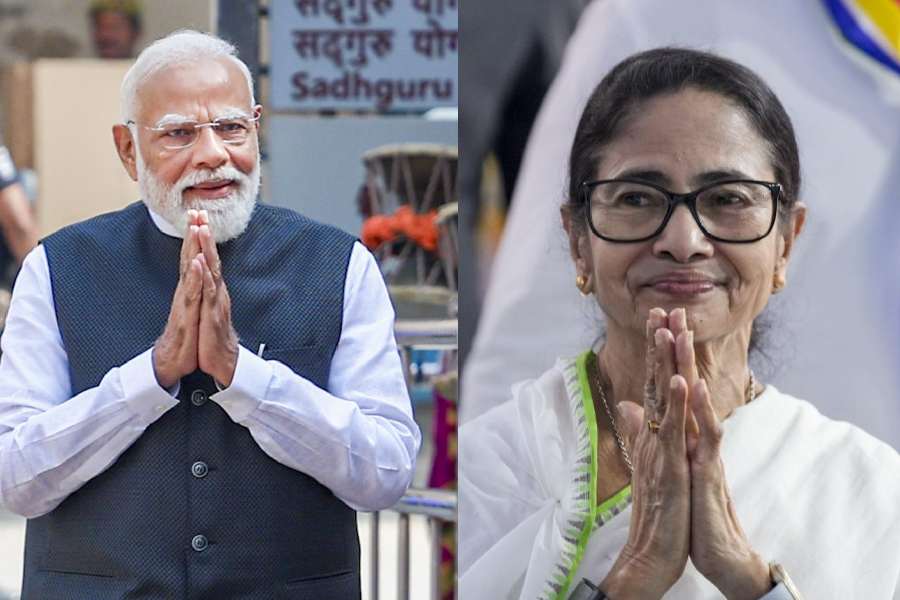
Ramesh also advised the political parties, including his own, to be “pro-active” in tribal areas. He cited Bengal chief minister Mamata Banerjee’s visits to Jungle Mahal and her rallies there as a model that political parties might follow elsewhere to win the confidence of the tribals.
In Gadchiroli, that remains a distant dream.
Here, the political parties remain unseen even when the Maoists kill one of their own. Such a victim was Bahadurshah Alam, the Congress’s block unit chief and chairperson of the panchayat samiti in the south Gadchiroli town of Bhamragarh.
On January 28, the day he was to file his nomination for the local body elections, four rebels in their late teens shot him point-blank in full public view at the town’s popular tea joint, barely 100 metres from a well-fortified police station.
No political leader from any party, least of all the Congress, came to his funeral. Neither the state leadership nor central functionaries condemned the murder. Many local Congress activists withdrew their nominations in protest — against not the killing but the political apathy.
If the forests could speak, they might echo the surrendered Maoist’s view: “Your leadership is too divided.”
At least that would break the silence in which Bahadurshah Alam’s story ended.