Astronomers and skywatchers will be keeping an overnight watch as India awaits a rare chance to witness the Aurora Borealis, more commonly known as the northern lights.
A giant geomagnetic storm, triggered by an Earth-directed coronal mass ejection (CME) associated with a powerful M1.8-class solar flare, could make the phenomenon visible from some of the country's highest-altitude regions.
While auroras are typically confined to the polar regions, the strength of the incoming geomagnetic storm means parts of northern India may get a rare opportunity to catch a glimpse of the celestial display.
The Space Weather Prediction Center has issued a G3 (strong) geomagnetic storm watch, warning that conditions could briefly intensify to G4 (severe) levels. The storm is expected to peak between 11:30 pm on Monday and 2:30 am on Tuesday, June 9.
High-altitude locations with exceptionally dark skies — particularly Hanle Dark Sky Reserve, Pangong Tso and Nubra Valley in Ladakh — offer the best chance in India of spotting the rare phenomenon.
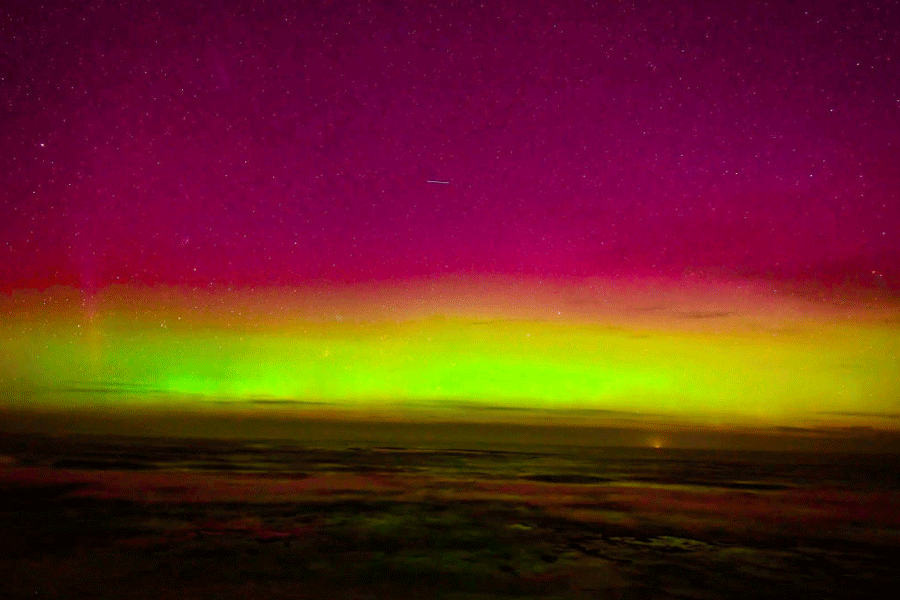
If visible from India, the aurora may not display the vivid green and purple hues often associated with Scandinavian skies. Instead, observers are more likely to see crimson or deep-red glows near the horizon.
At lower latitudes, viewers typically observe emissions from the upper reaches of Earth's atmosphere, where incoming charged particles interact with low-density oxygen atoms to produce red light.
The storm stems from a powerful solar eruption on June 6 that originated from Active Region 4461, a highly active area on the Sun. The eruption launched a massive cloud of magnetised plasma — known as a coronal mass ejection (CME) — along with a dense filament of cooler solar material towards Earth.
The CME is travelling at a high speed of around 1,400 kilometres per second, allowing it to cover the roughly 150 million kilometres between the Sun and Earth in less than 48 hours.
Scientists are also monitoring the possibility of a "cannibal CME" event, in which the fast-moving eruption overtakes and merges with slower solar material released earlier. Such interactions can sometimes amplify the strength of geomagnetic storms.
India has witnessed this spectacle before.
In 2024, observers at the Indian Astronomical Observatory in Hanle, Ladakh, located about 4,500 metres above sea level, recorded auroral displays during major solar storm events. That year saw a G5 (extreme) geomagnetic storm — the strongest in more than two decades — strike Earth in May, followed by another event in October.
Geomagnetic storms do not pose a direct threat to people on the ground, as Earth is shielded by its magnetic field and atmosphere. However, they can affect technological infrastructure, including GPS systems, navigation services and low-Earth-orbit satellites. High-frequency radio communications used by aviation, maritime operators and amateur radio enthusiasts may also experience temporary disruptions.