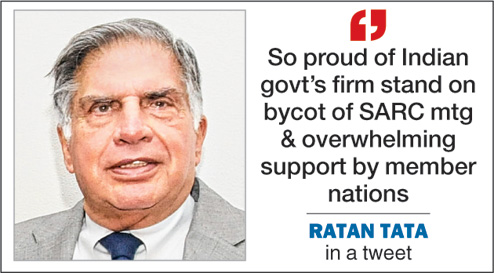

New Delhi, Sept. 28: India's boycott of the upcoming South Asian Association for Regional Cooperation (Saarc) summit in Islamabad was coordinated with Bangladesh, Afghanistan and Bhutan to shield New Delhi from charges of killing the multilateral grouping's meeting over bilateral tensions.
Saarc tradition and rules require a postponement of the grouping's summit if the leader of even one of the eight member nations is unable to attend, and India's declaration yesterday that it would not participate in the Islamabad conclave was enough to force a deferral.
But India wanted to avoid any ambiguity about its reasons for not participating by making clear it was unhappy about the use of terrorism by "one country", a strategy that risked violating a core Saarc rule, senior officials familiar with the government's planning told The Telegraph.
By convincing others to join India in boycotting the summit, and getting at least one other member to also refer to Pakistan, the foreign office wanted to highlight Islamabad's growing isolation over terrorism, the officials said.
But equally, that coordinated declaration of a boycott over a shared concern - terrorism - insulated India from allegations that it was violating a key provision in the Saarc charter that "bilateral and contentious issues shall be excluded from the deliberations".
Negotiations on jointly acting against Pakistan, using the Saarc banner, have been on for over a month now, officials said.
Today, Bangladesh, Bhutan and Afghanistan, all of which had indicated last night they may follow India, wrote to Nepal, the current Saarc chair, making clear they would not participate in the November Islamabad summit.
"The growing interference in the internal affairs of Bangladesh by one country has created an environment which is not conducive to the successful hosting of the 19th Saarc summit in Islamabad in November 2016," the Bangladesh foreign ministry note to Nepal said.
"Bangladesh, as the initiator of the Saarc process, remains steadfast in its commitment to regional cooperation, connectivity and contacts but believes that these can only go forward in a more congenial atmosphere."
The letter from Bangladesh, where Prime Minister Sheikh Hasina's government has locked horns with Pakistan repeatedly over the past few years, accusing Islamabad of supporting Islamic militancy in her country mirrored India's words in its note yesterday.
India's note too had referred to the "growing interference in internal affairs" by "one country" apart from "cross-border terror attacks". It had also asserted that New Delhi "remains steadfast in its commitment to regional cooperation, connectivity and contacts but believes that these can only go forward in an atmosphere free of terror".
Saarc secretary-general Arjun Thapa, currently not in Nepal, is expected to return home tonight, and a formal declaration of the summit's postponement - not cancellation - is expected by Monday, officials in the Saarc secretariat in Kathmandu said.
Late evening, Nepal Prime Minister Pushpa Kamal Dahal, better known as Prachanda, said his country had received the notes from the four countries declaring their decision to skip the Islamabad summit.
"As the current chair of Saarc, the government of Nepal strongly urges that a conducive environment be created soon to ensure the participation of all member states in the 19th Saarc summit in line with the spirit of the Saarc charter," Prachanda said in veiled criticism of Pakistan.
Unless the Saarc secretariat decides otherwise, the next summit will still be held in Islamabad - on dates that are acceptable to all.
Those dates are likely to hinge principally on the health of India-Pakistan relations, which nosedived following clashes between security forces and protesters in Kashmir over the past two months, followed by a terrorist attack in Uri on September 18 that left 18 soldiers dead.
India's tensions with Pakistan have thrice been a reason for the postponement of Saarc summits, while differences with Bangladesh and Sri Lanka have led to deferrals once each. In 2005, Bhutan too had joined India in declaring it would not participate in the Dhaka summit planned in January. The then Manmohan Singh government in New Delhi was battling militancy from Bangladesh, then governed by Begum Khaleda Zia. Some militant groups from Bangladesh had also taken shelter in Bhutan.
But then, unlike now, India did not publicly highlight the reasons for its decision to skip summits.
Never before have four countries publicly declared their decision to boycott the Saarc summit, all pointing fingers at a fifth member - Pakistan.
"Due to increased level of violence and fighting as a result of imposed terrorism on Afghanistan, His Excellency the President of Afghanistan Mohammed Ashraf Ghani with his responsibilities as commander in chief will be fully engaged, and will not be able to attend the summit," the note from Kabul said.
Bhutan, in its letter, cited the "recent escalation of terrorism in the region" to justify its decision to skip the summit.But with the grouping seemingly split - Sri Lanka, the Maldives and Nepal have not declared their posture on the boycott by four members - the future of Saarc remains unclear.
In New Delhi, Bangladesh high commissioner Syed Muazzem Ali suggested Dhaka wanted to keep the grouping alive - but needed Islamabad to change first.
"We would still like to continue with the Saarc process and hope there will be change and Pakistan comes to the path of cooperation instead of contradiction," Ali said.